
Bib overalls side access design should make the garment practical to put on and remove while preserving the intended fit when the side closure is fastened. An opening that appears generous on a flat sample may still be awkward over the wearer’s hips or clothing layers. Buyers need a documented dressing sequence, measurable garment details and representative wearer feedback before approving the construction.
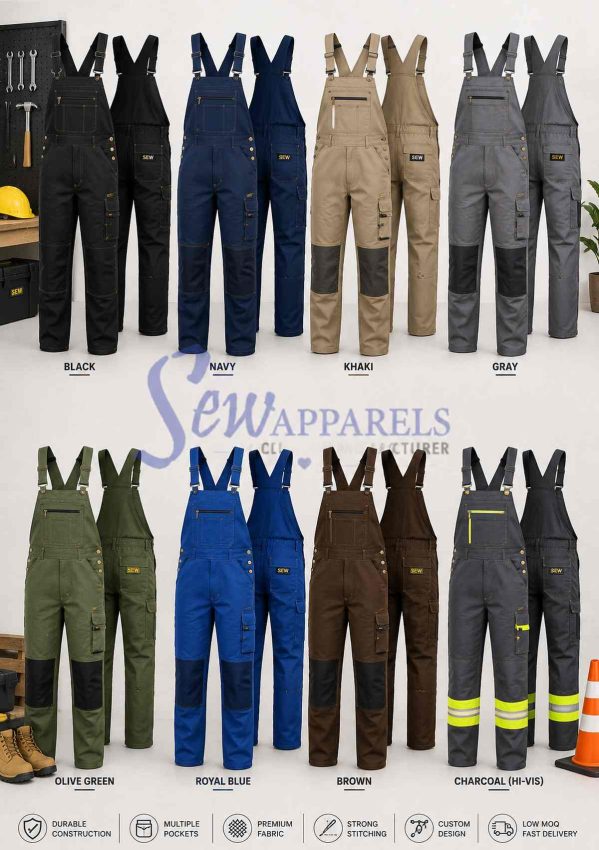
For custom bib overalls manufacturing, begin with the wearer group and intended use rather than choosing a side button arrangement from appearance alone. This guide covers six development checks connecting entry clearance, closure selection, movement and seam construction. The objective is a repeatable sample approval, not a universal opening length or a claim that one fastening works for every wearer.
1. Define bib overalls side access design through the dressing sequence
Describe work overall side opening access in practical terms. Record which closures are opened before dressing, whether shoulder straps remain connected and how the wearer brings the garment over the hips. State whether the garment is put on over trousers, a base layer or another planned combination. Those details define the entry problem more clearly than asking for an “easy-access” overall.
For the bib overalls dressing sequence, observe the steps in the intended order. Identify where the wearer needs to hold fabric, reach a closure or adjust straps. Avoid judging the side opening while the rest of the garment is arranged differently from actual use. A closure that is convenient with the bib hanging loose may become harder to reach after the straps are positioned.
Bib overalls side access design should distinguish initial donning, normal adjustment and removal. Record any task that needs assistance or repeated repositioning. If gloves are part of the intended scenario, define when they are worn rather than assuming the wearer always dresses with them. A realistic sequence helps the sample team address the actual difficulty instead of enlarging unrelated garment areas.
Keep this assessment within ordinary garment development. Where an overall is intended to provide protection, the applicable protective clothing requirements and hazard assessment remain separate. Altering an opening or fastening can affect the declared construction. Do not describe easier access as proof of protective suitability or authorize changes to a protective design through a general fit review alone.
2. Separate body measurements from the garment opening
The bib overalls hip entry measurement should identify whether it refers to the body, finished garment or effective opening during dressing. Those quantities are related but different. Record the garment state, closure position and measurement path. An opening length along a side seam is not automatically equivalent to the circumference available for entry.
ISO 8559-1:2017 provides anthropometric definitions for body measurements used in clothing development. It supports consistent size-profile work. It does not prescribe the finished side opening of a bib overall or guarantee dressing clearance for every body shape. Use the adopted body-measurement definitions alongside an explicitly documented garment method.
A bib overalls side closure sample measurement should include the agreed opening length, overlap and relevant closed garment dimensions. Use a drawing or clear measurement reference so the supplier and buyer inspect the same points. Identify whether the sample is new or evaluated after the specified care process. Do not compare unlike garment states without recording the difference.
Bib overalls side access design should be reviewed across the planned size range. A successful middle-size sample does not establish entry clearance at smaller and larger sizes or across different body proportions. Record the size, wearer reference and actual garment revision for each assessment. Keep production tolerance distinct from the design allowance required for dressing and the intended closed fit.
3. Compare fastening options within the complete construction
Bib overalls side seam access options can include different opening positions and fastening arrangements where appropriate to the product brief. Compare their operation, overlap, construction space and interaction with the waistband or bib. Do not select an option solely because it is familiar or visually compact. The same fastener can perform differently when the fabric stiffness or panel arrangement changes.
The bib overalls side opening fastening comparison should use identifiable samples. Record component reference, number of fastening points, spacing and orientation. Compare buttons, snaps or other proposed closures only within the actual approved development options; do not imply that every option is offered or suitable for the order. Keep material and commercial availability subject to quotation.
Overalls side fastening usability includes locating the closure, aligning its parts and completing the operation without unintended fabric tension. Inspect the closed overlap and check whether the wearer can verify that all fastening points are secured. An easy opening action does not prove that the closure stays correctly positioned during movement or that the underlying fabric is adequately covered.
Bib overalls side access design should also consider pockets and straps. A side opening may intersect a pocket entrance, while loaded pockets can change how the panel hangs. Assess the intended pocket arrangement and strap setting on the same sample. Moving a closure to improve reach should not silently make a pocket difficult to use or distort the bib position.
4. Conduct entry and usability trials with planned layers
A bib overalls hip opening entry trial should observe dressing and removal on representative fit samples. Record the clothing worn underneath, garment size and closure state. Note where fabric catches or where the wearer has to pull strongly to obtain clearance. Do not substitute a flat measurement alone for the observed entry sequence, particularly when the construction has limited stretch.
Bib overalls entry access over layers requires the actual planned layering combination or a clearly identified development equivalent. A thin base layer and bulky work clothing create different conditions. Record the evaluated combination and its limitations. Avoid claiming that a successful trial over one layer covers every seasonal arrangement or an unspecified additional garment.
For a bib overalls gloved fastening observation, use the relevant glove type only where that operation is part of intended use. Record reach, alignment difficulty and whether the wearer needs to remove the gloves. This is a usability observation, not a glove performance test or a safety clearance. Evaluate protective equipment requirements separately where they apply.
CCOHS guidance on designing a PPE programme discusses fit, comfort and wearer acceptance during selection. Its Canadian workplace context is useful when organizing relevant wearer feedback, but it is not a bib-overall opening specification or a worldwide legal rule. An ordinary overall fit trial does not establish compliance with PPE requirements.
For bib overalls donning usability, record specific observations rather than a single “comfortable” result. Identify the step that caused difficulty and whether the problem relates to entry clearance, reach or fastening alignment. For a fictional comparison, two sample revisions might have similar closed hip dimensions but different opening positions. That example illustrates a development question, not a Sew Apparels fit result or a universal design recommendation.
5. Review the closed fit, movement and opening seam
Bib overalls side access fit samples should be assessed after all intended closures and straps are correctly positioned. Review standing, seated and relevant movement conditions in a controlled setting. Record gaping, pulling, pressure or unintended closure movement. A garment that is easy to enter may still have an unsuitable closed shape; those outcomes should remain separate in the sample record.
The bib overalls opening seam review should identify how the opening ends, where reinforcement sits and how seam allowances are managed. Examine the junction between the opening and closed seam. Record visible distortion or discomfort from bulky layers. Do not infer seam strength or long-term durability from appearance alone; agree additional performance assessment where the product brief requires it.
A bib overall side seam sample review should include the inside as well as the outside of the garment. Check whether exposed trim, seam edges or overlap construction create contact points for the wearer. Review accessibility to any fastening component without assuming that added reinforcement is always beneficial. Its placement and bulk can affect the entry and wearing experience.
Bib overalls side access design should preserve the intended coverage during movement. Record whether the overlap changes when seated or reaching and whether pockets interfere with the closure. Identify the evaluated tasks and limitations. A brief fitting session cannot demonstrate every workplace condition, and an observed problem should not be dismissed merely because the garment meets a flat dimension.
6. Approve a measurable revision and control repeat samples
The bib overalls side opening approval record should connect the opening measurements, fastening reference, fabric and pattern revision with the reviewed fit sample. Include the dressing sequence and wearer observations that supported approval. State the changes required before the next sample. A comment such as “increase access” needs a defined construction response and a follow-up assessment.
For private label bib overalls production, keep entry and closed-fit requirements within the same controlled specification. Identify who authorizes changes to the opening, fastening or overlap. If a different component or fabric is proposed, assess whether the previous fit evidence remains applicable. Similar outward appearance does not prove equivalent fastening operation or garment behavior.
Bib overalls side access design should lead to an approval for the actual sample configuration. If a revision improves dressing but worsens closed coverage, resolve the trade-off before release. Document any explicitly accepted exception and its scope. Avoid promising universal accessibility, unlimited durability or suitability for every wearer from a small development sample set.
For repeat orders, compare the current specification with the approved sample record. Check relevant component references, opening dimensions and construction details during the agreed inspection. Use subsequent wearer feedback to identify a specific issue and sample revision, rather than changing the design informally. Clear records help preserve the approved function while supporting a focused correction when new evidence appears.
Review the bib overalls bib pocket configuration alongside access changes so opening clearance, pocket use and the intended bib position are assessed on the same sample.
Side access approval checklist
- Record the dressing and removal sequence with intended layers.
- Separate body measurements, opening measurements and closed fit.
- Compare identified fastening samples and overlap construction.
- Observe entry, reach and closure operation across relevant sizes.
- Review movement, coverage, pocket interaction and opening seams.
- Approve the exact revision and control later substitutions.
Discuss the access brief through the bib overalls manufacturing page and use the Bib Overalls Buying Guides for related development decisions. Bib overalls side access design should leave a repeatable record of how the garment is entered, fastened and evaluated in its approved configuration.
Frequently asked questions
Does a longer opening always improve the overall? No. Bib overalls side access design must also preserve closed fit, overlap and the intended construction. Assess both entry and wearing conditions.
Can one size prove access for the whole size range? No. Bib overalls side access design needs review across relevant sizes and body proportions with the planned layers. Keep each observation connected to an identified sample.
Should glove operation always be tested? Include it where it reflects the actual intended operation. Specify the glove type and sequence rather than assuming every wearer fastens the garment while wearing gloves.