
FORMAL TROUSERS DEVELOPMENT LIBRARY
Formal Trousers Buying Guides
A tailored trouser crease can make a garment look controlled, but the result depends on more than the final pass of an iron. Fabric composition, weave, finishing, pattern balance and pressing route all influence how a front and back crease looks after wear and care. These Formal Trousers Buying Guides help a brand compare the finished garment with an approved standard rather than buying a vague promise of “permanent crease.” Start by deciding whether the style needs a sharp office trouser line, a softer casual crease or a washable uniform result. That choice should be visible in a full-size sample.
These Formal Trousers Buying Guides connect six development decisions: crease retention, waistband curtains, front pleat geometry, side adjusters, alteration reserves and transit packing. Begin with the intended fit and fabric, then use the relevant article to define the construction, sample review and approval record. A pressed crease, a sewn pleat and spare fabric for an alteration perform different jobs; describe each separately. Keep pattern revisions, trims, finished garment samples, care observations and packing references together so a later change can be checked against the actual approved trousers.
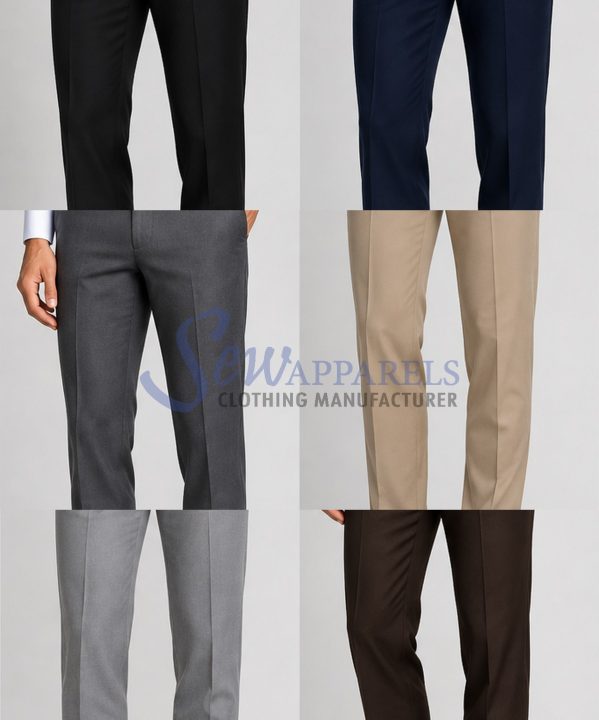
These Formal Trousers Buying Guides use existing trouser style references to support development discussions. The design image does not prove pleat measurements, crease retention, alteration reserves, a tested fabric finish or an approved production sample.
Formal trousers crease retention choices
Compare fabric composition, pressing response and front/back crease alignment before approving a tailored trouser sample.
Read the crease-retention guideFormal Trouser Front Pleat Specification: Direction, Intake and Fit
Define pleat direction, intake, release and spacing with clear pattern references. Connect waistband assembly, seated fit, pressing and size grading to one traceable garment approval.
Review front pleat specificationsFormal Trouser Side Adjuster Specification: Travel, Grip and Attachment
Connect the identified buckle and tab to usable waist travel, grip and reinforcement. Review finish, wearer-facing clearance and care evidence on the assembled trousers before approval.
Review side adjuster specificationsFormal Trousers Alteration Allowance Specification: Hem and Waist Reserves
Define the delivered hem condition, usable reserve and accessible waist construction. Connect retail finishing instructions to an identified alteration trial before approving the adjustment provision.
Review alteration allowance planningFormal Trousers Transit Packing Approval: Flat and Hanger Delivery
Compare fold positions, hanger contact and carton layouts on the actual garment. Record unpacked presentation and permitted receiving preparation before releasing the packing specification.
Review transit packing approvalFormal trousers waistband curtain construction
Specify waist lining, hook-and-bar placement and internal seam finishing as one clean, comfortable tailored waistband.
Read the waistband guideFormal Trousers Buying Guides: Choose the Crease Character
These Formal Trousers Buying Guides begin by asking the buyer to describe the intended appearance at normal viewing distance before discussing fibre percentages. A sharp crease for a formal uniform, a softer line for travel wear and a pressed look for occasional tailoring are different targets. Record where the line begins at the front waist or pleat, where it passes the knee and where it ends at the hem. Compare the garment standing, walking and seated. Include the expected care method and how many wears or washes the appearance should withstand. Avoid calling any result “permanent” unless the finished fabric and garment have been tested against an agreed protocol.
Separate visible crease retention from general wrinkle resistance. A cloth may recover from incidental wrinkles but still need pressing to create a crisp intentional line. A durable-press finish may help retain shape and creases after laundering, as CottonWorks explains in its wrinkle-resistant-finish definition. That describes a treatment category, not a guarantee for any trouser fabric. Ask whether the proposed cloth is untreated, finished at fabric stage or treated as a garment, and compare actual post-care samples before accepting a marketing claim.
Specify fabric composition with performance evidence
In these Formal Trousers Buying Guides, fabric comparisons may include wool, cotton, polyester, viscose or blends, but the percentage alone cannot define the finished crease. Yarn, weave, fabric mass, stretch, finishing and care route matter too. Request a full fabric specification and the supplier’s available tests, then compare sewn trousers made in candidate cloths. State the priority: a crisp line after repeated home washing, a comfortable drape after seated wear, or a traditional pressed office appearance. Tradeoffs should be decided on the actual garment rather than assumed from a fibre label.
For a wool-rich option, follow the care claim and evaluate steam pressing on the specific cloth. Woolmark advises steam and moderate heat for wool when pressing is allowed, with care against heavy pressure that may make a surface shiny. Those instructions are for wool garments, not a universal rule for synthetics or mixed fabrics. On any composition, check heat sensitivity, seam shine, color change and recovery after the garment cools. Ask the supplier to state a repeatable pressing route that the factory and the end user can reasonably follow.
Test pressing response instead of guessing
Use these Formal Trousers Buying Guides to define a documented pressing sequence for a complete sample: equipment, moisture or steam, temperature range, pressure, dwell time and cooling method. The final look should be judged after the trouser has cooled and hung, not while warm on the press. Compare the front and back crease sharpness, any double lines, fabric shine, seam impression and puckering. A sharp line achieved only with excessive heat or pressure may damage the cloth or prove difficult to repeat in production. A softer but stable line may be the better commercial decision.
Repeat the assessment after the stated care cycle and a practical wear trial. Put the same garment on a hanger, then view it worn from the front, side and back. If the line drifts, determine whether the issue comes from cloth response, pattern balance, incorrect seam placement or pressing alignment. Change one variable at a time in sampling. Keep photographs under consistent light so the team can compare revisions rather than relying on memory of a garment seen days earlier.
Align the crease through the pattern and leg
The crease should follow the approved front and back leg line through hip, knee and hem. Mark the desired path on the pattern and sample, then compare both legs while the trousers hang naturally. A crease that twists to the side may expose grainline or pattern imbalance rather than poor pressing. Check the waist-to-hem line in the intended size range, particularly if the garment has pleats, tapered legs or a strong side-seam shape. Specify whether the front crease starts at a pleat, waistband or a measured offset.
Do not hide an alignment issue by pressing a new line over the old one. Double creases are conspicuous in dark suiting cloth. First inspect the seam and leg geometry, then reset the pressing marks only if the garment construction supports the intended path. If a fabric lot changes, confirm the same drape and pressing response. A buyer table should record alignment locations, allowed visual variation and which size-set pieces must be checked before bulk release.
Connect care claims to real appearance
These Formal Trousers Buying Guides connect crease maintenance to the final care label and user instructions. A dry-clean-only trouser, a machine-washable uniform and a travel trouser will not share the same approval route. Evaluate the finished garment after the exact recommended wash or professional care process and after hanging or pressing as directed. Photograph crease sharpness, surface shine, seam smoothness and leg shape. Avoid using a fabric-only wrinkle test as the sole proof of garment performance; pockets, waistband, interlining and seams can change the outcome.
Plan low MOQ formal trousers for startup brands
A startup brand can make a small formal-trouser launch easier to sample by choosing one fit block, one approved cloth and one crease standard before multiplying colorways. Low MOQ planning should state the intended quantity, size curve, fabric source, trim and care route, then ask the manufacturing team which combinations are feasible. There is no universal minimum for every fabric or finish. Preserve the signed sample, pressing record and post-care images so a later reorder does not lose the agreed line or create a different sheen. Clear references let a startup brand receive more useful feedback in fewer sample rounds.
Keep the front pleat drawing alongside the intake definition, fold direction and release point. Confirm whether the size range uses fixed positions or agreed grade rules. For side adjusters, identify buckle and tab references, usable travel and attachment reinforcement. If retail alterations are planned, show the delivered hem condition, accessible waist construction and usable reserve on an identified trial. State whether delivery is folded or on hangers, then review receiving appearance on a representative packed sample. These details help the supplier quote the complete scope and identify which choices still need development rather than treating all tailored styles as equivalent.
Turn tailored-trouser choices into a product brief
Share the target wearer and fit, fabric specification, desired crease character, pressing route, line-alignment marks, waistband curtain, waist lining, closure model and seam map. Include pleat count, direction, intake, release and the reviewed size rules. Identify side-adjuster travel and attachment, any usable alteration reserves and retail finishing instructions, and the fold or hanger packing configuration. Add photographs of the approved trousers inside and out, standing, seated, after care and after unpacking where relevant. Connect the request to the controlling pattern, sample and material revisions. A complete brief gives the team a defined product to assess, quote and sample.
Explore Formal Trousers manufacturing