
SCHOOL T-SHIRT DEVELOPMENT LIBRARY
School T-Shirts Buying Guides
Use these school t-shirts buying guides to turn school t-shirt ideas into measurable product briefs. The guides connect emblem placement, print alignment, embroidery backing, fabric, fit, grading, laundering and bulk inspection. Each decision is written for schools, uniform suppliers, distributors and startup brands that need repeatable evidence from sampling through replenishment orders. Keep artwork, measurements, decorated samples, care results and approved revisions together so pattern, sewing, decoration and quality teams work from the same controlled standard while the original product page remains focused on manufacturing enquiries.
Review the School T-Shirts product page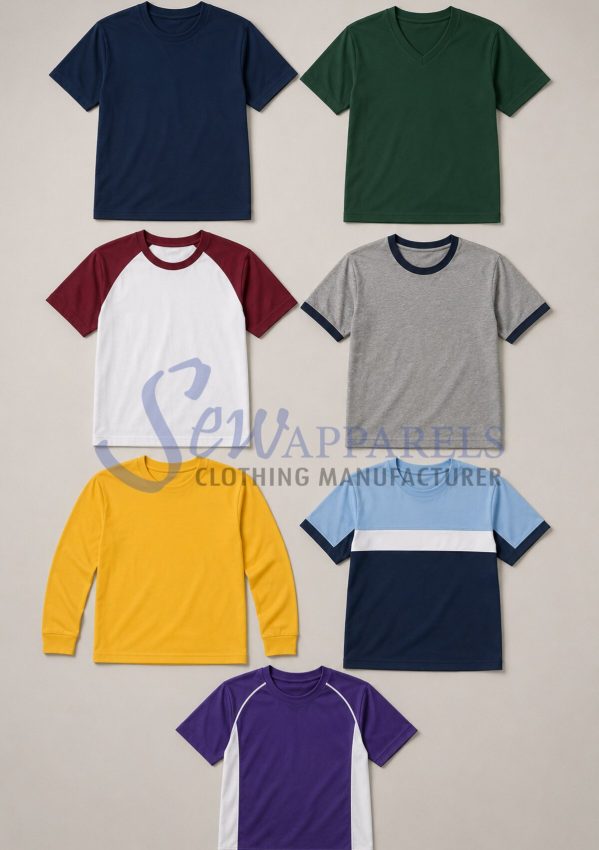
School tee style references from the existing product page. These illustrations do not establish actual emblem placement, fabric performance, wash results or certification.
GUIDE 01
Emblem Placement Planning: School T-Shirts
Control chest badge size, print alignment and embroidery backing with measurable placement, grading, care and bulk-inspection checks.
Read the emblem placement planning guideGUIDE 02
Cotton Blend Selection: School T-Shirts
Compare breathability, drying time and fabric weight through measurable blend, construction, care and bulk-approval checks.
Read the cotton blend selection guideGUIDE 03
Small event order costing: reconcile setup, quantity splits and quote scope
Compare small school-event tee quotations on the same garment and artwork brief. Use five critical checks and a short-run worksheet to separate supplier-entered setup and per-piece charges, quantity variants, exclusions and timing dependencies without invented prices or minimums.
Read the small event order costing guideGUIDE 04
House packing reconciliation: verify size counts and carton allocation
Reconcile each approved house, size and anonymous delivery group with verified packed quantities. Use five critical checks and a working matrix to connect carton references, differences and authorized corrections before the programme’s actual release decision.
Read the house packing reconciliation guideGUIDE 05
House identification design: compare names, symbols and size proofs
Review approved house names and symbols alongside garment colour. Use five critical checks and an identity matrix to connect actual size proofs, intended-user feedback and artwork-to-packing consistency without claiming universal accessibility.
Read the house identification design guideGUIDE 06
Raised print sample review: verify process, detail and care evidence
Confirm the actual raised-print process and compare artwork detail on complete tee samples. Use five critical checks and a proof card to connect profile references, garment sizes, care observations and retained approval without invented height or durability claims.
Read the raised print sample review guideBuild a Controlled School T-Shirt Specification
Start with wearer ages, school rules, climate, activity, size range, garment colours, care conditions and the intended term of use. Define silhouette, body length, sleeve, neckline, hem, side construction and decoration zones from stable reference points. Record fabric composition, knit structure, weight, finished width, shrinkage, colour standard and conditioning method.
Add finished measurements, tolerances, grade rules, stitch and thread details, labels, packaging and approval stages. Name the artwork and sample revision that governs each decision. A controlled brief prevents the pattern, sewing, printing, embroidery and quality teams from approving different interpretations of the same school t-shirt. Use these school t-shirts buying guides to identify which decisions need an actual sample before a quotation can be finalized.
Plan Emblem Size and Placement
Treat a crest, house mark or sponsor graphic as a measured garment component. Identify artwork code, decoration process, finished emblem width and height, reference point and tolerance. For left-chest placement, combine a vertical measurement from high point shoulder with a horizontal measurement from centre front or another clearly defined landmark.
Approve junior, youth and adult size bands on real garments because one emblem size and offset may not remain visually balanced across the range. Retain a sealed decorated sample and a numeric placement matrix. Production and inspection teams should reproduce the placement without interpreting a marketing mock-up or a vague instruction such as logo on left chest. The school t-shirts buying guides connect each placement decision with the approved size-specific garment reference.
Control Print Alignment and Registration
Print alignment depends on square garment loading, stable construction and artwork registered to the approved origin. Record vertical and horizontal targets, permitted deviation and a visual rule for rotation or skew. For multi-colour work, separate whole-emblem placement tolerance from colour-to-colour registration.
Check the shirt relaxed on a flat surface and on the wearer because a level print can appear crooked when the neck, side seam or hem is distorted. Approve the intended fabric colour, ink or transfer, curing route and production strike-off together. Recheck alignment after laundering because body shrinkage and torque can alter the visible relationship between the emblem and garment landmarks. These school t-shirts buying guides keep whole-print placement and colour registration as separate approval questions.
Engineer Embroidery Backing and Comfort
Select embroidery backing with fabric stretch, colour, emblem size, stitch count, density and expected care in mind. Stretchy t-shirt knits usually need continuing support, but excessive weight or poor trimming can create a rigid patch, visible halo or rough edge against the skin. Specify backing type, weight, colour, layer count, cut dimensions and finishing method.
Approve a production-intent decorated sample after washing and inspect both faces for puckering, distortion, show-through, hard corners and loose edges. Record the embroidery file, thread chart, machine setting and backing reference together so later colourways and repeat orders do not substitute one part of the system without reassessment. In these school t-shirts buying guides, the complete decorated sample governs backing selection rather than a generic backing name.
Develop Fabric, Fit and Size Grading
Approve fabric and fit before sealing decoration measurements. Record fibre blend, yarn, knit structure, weight, stretch, recovery, opacity, colour and dimensional change. Specify chest, shoulder, armhole, sleeve, body length, neck opening and hem dimensions with tolerances. Test movement, layering and comfort on representative wearers.
Review small, middle and large sizes so grade rules preserve neckline, sleeve and emblem relationships. A mechanical increment at every point can move the decoration too close to the neck in small sizes or leave it isolated on larger chests. Condition garments consistently before measurement, and reopen affected approvals whenever fabric, finish, pattern or decoration method changes.
Validate Care and Bulk Quality
Approve the finished school t-shirt only after the specified wash and dry cycles plus the agreed recovery interval. Measure body dimensions and emblem position before and after care, then inspect print registration, embroidery shape, neckline, torque, seam condition, colour, pilling and inside comfort. Bulk inspection should cover multiple sizes, garment colours, fabric lots and decoration setups.
Check startup pieces and defined intervals so drift is found early. Link each result to artwork revision, garment lot, screen or machine, operator and date. Clear sampling and defect limits let quality teams separate fabric, construction, decoration and care causes rather than hiding an unstable result with pressing.
Low MOQ School T-Shirts Manufacturer for Startup Brands
A low MOQ school t-shirts manufacturer can help a startup brand, school club or new uniform supplier validate fit, colours, emblem scale, printing, embroidery and packaging before a larger rollout. Small MOQ development still needs disciplined choices: limit unnecessary colourways, combine compatible size bands and confirm which artwork, trims and labels can be shared.
Startup development can use structured sampling and a clear product brief, while final minimums remain subject to fabric sourcing, colour, decoration, size mix and production planning. Present target quantities, markets, size ratios, branding and launch dates early so feasibility, sampling and bulk risks can be assessed together.
The current School T-Shirts product page states a minimum of 1,000 pieces per design and colour, sampling in 10–15 days and production in 20–45 days after PP sample approval. Treat these published figures as planning references, not a confirmed offer for every event order. Ask for a current quotation covering the actual fabric, decoration, size mix and destination; confirm when each timing period starts and what approvals or sourcing conditions must be met. A smaller requested event quantity needs a separate feasibility decision and should not be described as accepted merely because it appears in a costing worksheet.
Prepare a Decision-Ready T-Shirt Brief
Your enquiry should identify style reference, wearer group, size range, target quantity, delivery market, fabric and colour expectations, emblem process, labels, packaging and required testing. Attach front and back drawings, measurement chart, placement matrix, artwork files, decoration dimensions, tolerance table and care route. Mark which features are fixed and where the manufacturer may propose alternatives.
Include the approval sequence, responsible decision makers and the physical samples that govern production. Maintain a concise change log for every accepted revision. This evidence lets costing, sampling, pattern, sewing, decoration, finishing and quality teams work from the same version and reduces avoidable changes after production planning begins. Return to the school t-shirts buying guides when a changed brief affects more than one development decision.
Technical References
Use these school t-shirts buying guides with the STAHLS 2016 placement resource as a starting reference for trial artwork size and position. Its generic examples are not Sew Apparels specifications or universal school-uniform tolerances. The Madeira backing guide distinguishes cut-away support for stretchy fabrics from tear-away options for stable fabrics and recommends checking the actual combination before bulk work. Confirm backing with the fabric, stitch design and intended care. Neither resource establishes a certified garment, an approved sample or a passing test result for your order; buyer-approved samples, agreed care procedures and recorded tolerances govern the actual production decision.
Review STAHLS Placement Guide Review Madeira Backing GuideTurn Your School T-Shirt Decisions into a Product Brief
Bring fabric, fit, emblem, placement, backing, care, size and quality decisions together before sampling. One controlled brief gives development and production teams the same measurable target and keeps every later revision traceable.
Review School T-Shirts Manufacturing