
Gym shorts drawcord retention after washing is a finished-garment development question: does the cord remain accessible, reasonably balanced and usable after the agreed care sequence? A waistband can look correct in a new sample while one cord end disappears into its channel during laundering. Buyers should establish the starting condition, repeatable care procedure and handling sequence before deciding that an anchor, end treatment or cord substitution solves the problem.
This guide concerns adult training shorts. It separates cord migration, cord shrinkage, channel restriction and component damage, because each requires different evidence. The aim is an approval record that a product developer and factory can reproduce. It does not prescribe a universal number of washes, a mandatory pull force or a guarantee that a drawstring can never move.
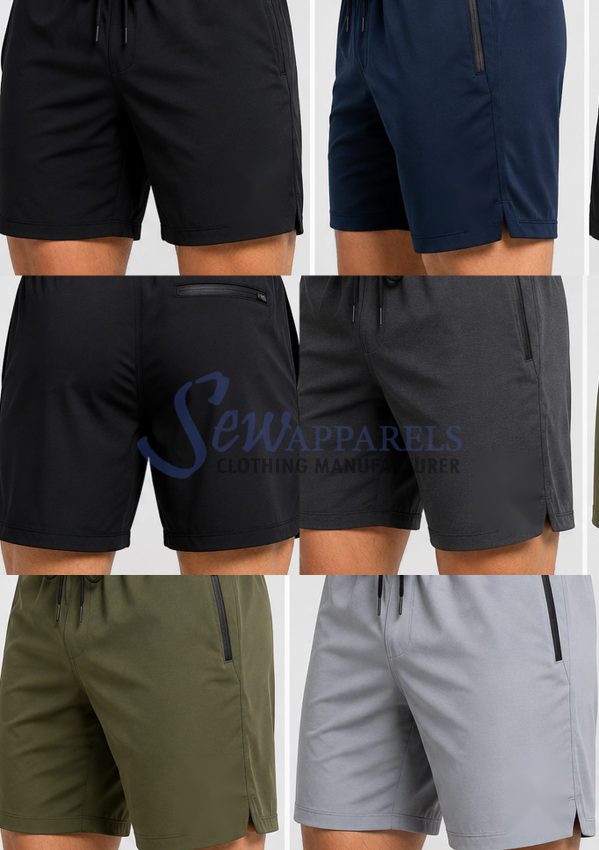
Why gym shorts drawcord retention after washing needs a separate review
A drawcord serves a different purpose from the elastic waistband. Elastic helps the garment recover around the body; the cord provides an adjustable closure. Successful waistband recovery therefore does not prove successful cord recovery. A missing end may leave the wearer unable to make the intended adjustment even when the shorts still measure within the agreed waist tolerance.
Gym short drawstring pull through can arise during washing, drying, unpacking or the first adjustment afterwards. Record when the problem appears rather than treating every displaced cord as a washing failure. Training shorts drawcord end retention also depends on the channel route, opening geometry, cord length and end finish. The development sample must represent those details, including any internal attachment.
1. Establish the adult garment scope and starting condition
Begin gym shorts drawcord retention after washing with a clear brief identifying the adult size range, intended adjustment and proposed care label. Photograph both exposed ends beside a scale before care. Record their lengths from the openings, the total cord specification, waistband size, channel construction and whether the cord is removable, anchored or continuous. Use sample identifiers that survive the trial without changing the cord behaviour.
During cord path inspection, check for a folded channel, crossed seam allowance or a rough opening that catches the cord. Check that the drawstring can move as intended before washing. If the new sample already has unequal ends or restricted movement, correct or document that condition first. Otherwise, a post-care comparison may attribute an existing construction issue to laundering.
The adult drawcord brief scope matters. The CPSC guidance on children’s upper outerwear drawstrings addresses a different garment and age scope. Its provisions should not be presented as an adult shorts retention specification. A children’s version needs its own applicable market and product safety review; passing this adult development exercise would not establish that compliance.
2. Define a comparable washing and drying sequence
For gym shorts drawcord retention after washing, specify washing and drying together. Record the machine or laboratory procedure, detergent, load arrangement, wash setting, drying method and number of cycles agreed for development. Describe how the cord enters care: loose, adjusted, tied or prepared according to the proposed instructions. Different preparation changes the question being tested, so avoid quietly changing it between samples.
ISO 6330:2021 domestic washing and drying procedures provides a framework for textile care testing. Its public scope covers fabrics and garments and explains that a complete test includes both washing and drying. The selected machine, detergent and drying parameters can influence results. The standard’s existence does not supply a drawcord retention pass limit or certify the shorts; the laboratory and buyer must identify the appropriate procedure and acceptance criteria.
Use equivalent samples when comparing constructions. Keep garment size, channel dimensions, cord material and starting exposed lengths consistent where practical. If an anchor trial also introduces a different cord and larger openings, it becomes a combined redesign comparison. That can be useful, but the report must not claim that the anchor alone caused the improvement.
3. Inspect migration before correcting the ends
The first observation in gym shorts drawcord retention after washing should happen before someone pulls the ends straight. Photograph the dried garment as received and measure each exposed end. Note a missing end, increased imbalance, twisting or cord bunching inside the channel. Gym shorts care trial cord displacement is most informative when the initial post-care state remains visible in the evidence.
End migration after care differs from cord shrinkage. If one end shortens while the other lengthens, migration is plausible; if both exposed ends shorten, examine channel dimensions, cord length and anchoring before deciding why. Gym shorts cord recovery after washing should describe both access and adjustment, rather than relying on a single photograph of neatly reset ends.
Specify the measurement state. An elastic waistband laid flat, lightly opened or stretched can expose different cord lengths. Use the same state before and after care and avoid stretching it unpredictably to make the result look better. Record any handling needed to reveal an end, because an end recovered only by a technician is different from one a wearer can immediately access.
4. Compare prevention options without losing adjustability
A practical gym shorts drawcord retention after washing review can compare the original sample with a controlled internal anchor trial or another justified construction change. Cord pull through prevention should preserve the intended adjustment and wearing comfort. An attachment that prevents migration but concentrates strain, blocks useful cord travel or creates an uncomfortable lump introduces another problem.
Inspect the proposed anchor location, stitch condition and surrounding fabric after the agreed sequence. Confirm that its position matches the approved construction specification. Assess the closure on the actual garment rather than assuming that a secure stitch automatically produces a usable waistband. Record whether the cord can still be adjusted and whether both ends remain reachable.
Review end treatments as components, not universal solutions. A larger end may resist entering an opening but can introduce bulk, damage or snagging concerns. The buyer should assess the complete construction and appropriate safety requirements. Do not add arbitrary knots, toggles or attachments purely to obtain a favourable trial result without agreeing the final product design and scope.
5. Check components and the post-care handling sequence
Include cord end component condition in gym shorts drawcord retention after washing. Examine end finishes for splitting, loosening, sharp edges or changes that obstruct ordinary handling. Check opening reinforcement and adjacent stitching. Photograph any defect close enough to identify the component and wide enough to show where it sits on the garment.
Post wash cord access should be assessed before and after the defined drawcord handling sequence. For example, a reviewer may first check visible ends, then attempt the normal adjustment described in the brief. Record the sequence and any intervention. Avoid reporting a simple pass if the end initially disappeared and was restored using a tool or by opening the channel.
Drawstring unequal ends are not necessarily the same severity in every design. Agree the allowable state, measurement method and practical adjustment requirement before the trial. A buyer-defined limit may be appropriate for this product, but it should be labelled as that product’s criterion. Do not invent a general industry tolerance or claim that any imbalance automatically proves defective manufacturing.
6. Close the comparison with a decision and clear limits
The outcome of gym shorts drawcord retention after washing should identify the retained cord comparison, sample versions, care conditions and observed differences. Separate accessibility, balance, adjustment and component condition in the result. This makes a redesign decision more useful than a single overall statement that the shorts passed washing.
Repair instruction evidence also needs review if the brand proposes recovery instructions. A drawing or written instruction should match the actual construction and a demonstrated recovery route. Instructions do not erase the initial failure, and a complex repair should not be presented as ordinary adjustment. Decide whether the product needs a construction revision, clearer care preparation or additional investigation.
Close open issues explicitly. Identify who will approve the revised sample, what details are frozen and which observations need repetition. Retest a material construction change under the agreed sequence before transferring the result to production. Keep the earlier failed sample record so the final approval explains the difference rather than concealing the development history.
A useful sample record for buyers and factories
Use one record per sample version with fields for adult size, cord specification, channel route, opening details, anchor condition and starting end lengths. Add the care sequence, drying method, photographs immediately after care and the later adjustment observations. Include the agreed acceptance criteria, measured result, reviewer and decision date. This record supports traceability without implying a certification.
A simple hypothetical comparison illustrates the distinction. Sample A returns with one end hidden; Sample B retains both ends but its anchor restricts adjustment. Neither observation alone identifies the best final product. The team should resolve Sample B’s adjustment problem and repeat the relevant comparison. These are example development outcomes, not Sew Apparels test results or a recommendation for a specific attachment.
Frequently asked development questions
Does a drawcord need an internal anchor?
That depends on the garment construction, intended adjustment, applicable requirements and evidence. Evaluate an anchor trial against the original construction instead of treating attachment as an automatic answer. The final specification should describe the approved route and attachment details clearly enough to reproduce them.
Can a cord be reset before the result is recorded?
Record its initial post-care state first. Resetting it can be a later documented handling step, but doing so before inspection hides migration and changes the evidence. A retained end and a recovered end should remain distinguishable in the report.
Does a care test prove lifetime retention?
No. The result applies to the identified samples and conditions. It does not establish all consumer care behaviour, every production lot or indefinite performance. Report the scope and avoid translating a chosen cycle count into a guaranteed number of months or workouts.
Turn the evidence into a manufacturing brief
For custom gym shorts manufacturing, send the chosen cord and channel details alongside the approval record, care proposal and unresolved questions. For private label gym shorts production, maintain that construction reference across size development and reorders. Request confirmation of sampling options and current commercial terms rather than assuming that a particular attachment or trial is already included.
Use the custom gym shorts manufacturing page to discuss the product brief. Consult the Gym Shorts Buying Guides for the related liner, pocket and material decisions. Keep gym shorts drawcord retention after washing as a distinct approval topic within the complete garment specification, supported by the actual sample record.
Review the accepted waistband within the chosen liner or unlined construction; the complete assembly and size remain part of the sample identity.