
SEW APPARELS · DEVELOPMENT RESOURCES
Sports Bra Buying Guides
Sports bra buying guides help activewear brands bring cup shape, underband stability and strap geometry into one development brief. A visual reference can show the desired style, but it cannot establish how the finished garment will fit or support the intended wearer. Begin with the activity, size range and coverage requirements, then evaluate the complete sample against an agreed review method.
Start the sports-bra review by recording the intended activity, support expectation, wearer range, cup or size system, fabric and lining route. Mark the measurement points used on the sample and note whether the garment is tested over the intended base layer. Review the band, straps, neckline, coverage, seam comfort and recovery together. Keep the approved sample and care conditions beside each comment so a change in elastic, fabric or pattern can be assessed without losing the original fit and support brief.
Use these sports bra buying guides to coordinate eight development decisions: support architecture, underband construction, moulded-cup tooling, size-set sampling, removable-pad care, returns analysis, strap-adjuster stability and support-claim evidence. Keep the articles beside the same approved garment and material list. Startup activewear brands can prioritise unresolved sample and quotation questions before committing to a larger collection; component approvals should remain connected to complete-garment fit and the intended wearer range.
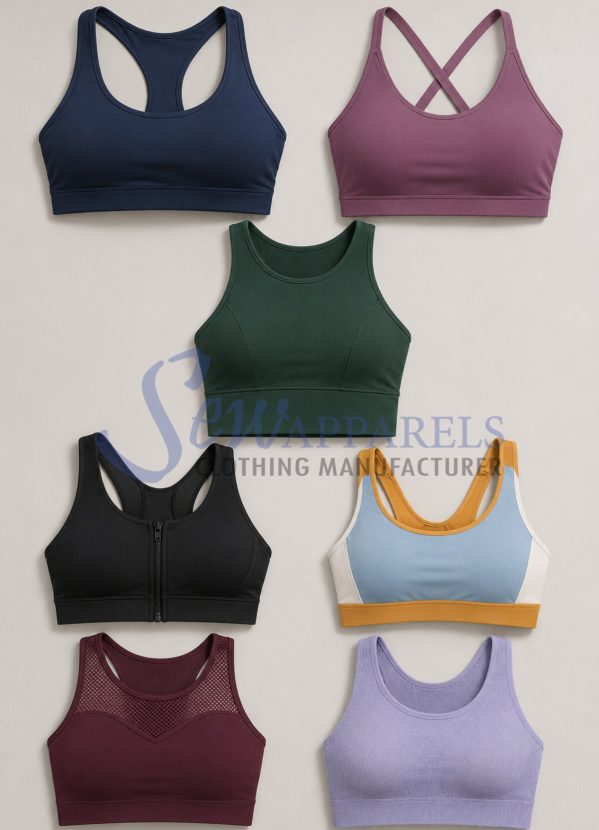
Existing finished sports bra product reference. This photograph does not demonstrate support performance, cup tooling or fit-test results. Evaluate the actual construction, wearer range and approved sample using the recorded development brief.
1. Compare support architectures
Review encapsulation, compression and combined concepts through cup shaping, strap placement and the complete garment. Separate the requested support experience from claims that require evidence, and record the construction chosen for sampling.
Read the support design guide2. Specify the underband assembly
Compare elastic width, finished band depth, seam placement and closure settings. Use a clear measurement condition and fitting sequence to turn band stability and comfort feedback into reproducible production instructions.
Read the underband construction guide3. Clarify moulded cup tooling charges
Compare existing and new cup forms, size coverage, prototype charges, ownership and repeat-order assumptions before committing development funds.
Read moulded cup tooling cost guide4. Plan size-set sampling and approval costs
Map size coverage, construction transitions, sample revisions and evidence services to an itemised budget before approving development work.
Read size set sampling budget guide5. Review removable pad care and retention
Check the supported care route, insert shape, folding, migration, drying and reinsertion before approving the complete pad and pocket system.
Read removable pad wash retention guide6. Analyse returns before changing the design
Separate fit, preference and verified defects, compare matching unit cohorts and use return evidence to approve targeted corrections.
Read sports bra return reason analysis7. Check strap adjuster setting stability
Distinguish slider migration from elastic extension, review strap and hardware compatibility, and record setting retention, care and damage checks.
Read strap adjuster slippage guide8. Match support claims to tested evidence
Review tested activity, wearer and size coverage, garment identity and motion findings before releasing support claims or approving product changes.
Read support claim evidence guideHow to Use These Sports Bra Buying Guides
Identify the intended wearer, activity and size coverage before choosing the support construction. Record whether the collection is intended for studio movement, general training or running, together with the desired coverage and dressing method. A pull-on style and an opening back can create different development requirements. Keep preferences separate from measurable approval criteria so the team knows which questions require a fitting trial.
Sports bra buying guides are most useful when each observation belongs to a named sample revision. Attach the fabric reference, lining, elastic, cup or pad specification and strap hardware to that record. Brooks’ run-bra development account describes both encapsulation and compressive designs alongside wear and laboratory testing. It illustrates why a construction name alone should not replace assessment of the actual finished garment.
Coordinate Cup Shape, Coverage and Strap Position
For an encapsulation-led concept, mark the cup depth, width, apex and containment boundary on the drawing. Identify whether shaping comes from seams, molded material or internal panels. A removable pad used for modesty is not automatically the supporting structure. For a compression-led concept, specify the complete panel and layer arrangement rather than assuming the outer fabric controls every aspect of fit.
Use sports bra buying guides to bring the strap path into the same review. Record front and back attachment positions, finished width, adjustment range and the intended wearing configuration. Inspect the sample for slipping, localized pressure and changes to front coverage during the agreed movement sequence. Tightening a strap to compensate for a different fit issue can obscure the cause, so record observations by location.
Make Underband and Closure Dimensions Reproducible
Distinguish elastic width from the depth of the finished band. Show whether the design uses exposed elastic, an enclosed channel or a fabric-covered assembly, and identify the material join. Define the relaxed measurement condition and any separate extension procedure. Where a back closure is used, mark the reference setting, overlap and component dimensions so different reviewers measure the same configuration.
These sports bra buying guides connect the flat specification with a complete-garment fitting review. Observe band position, rolling and recovery during the intended movements, and inspect the transition into the closure. A wider band does not guarantee a better result if its material, seam or location is unsuitable. Record the accepted elastic reference and sample size beside every comment before requesting a revision.
Check Seams, Layer Compatibility and Size-Set Approval
Map the seam intersections inside the bra, including the cup edge, strap attachment, lining and upper band join. Coats’ bra application guidance highlights thread strength, controlled elongation and a discreet seam, with options depending on the application. Sample the intended assembly with its actual thread and operation so a restrictive stitch line is not mistaken for a fabric or elastic problem.
Sports bra buying guides should lead to a controlled approval file. Review representative sizes for coverage, strap geometry, band position and the agreed comfort observations. Compare the accepted sample after the intended care procedure, recording dimensions and visible changes under consistent conditions. Keep material substitutions and unresolved comments visible; an alternative lining or elastic may require another targeted review even when it looks similar.
Low MOQ Sports Bra Manufacturer: Plan the First Collection
When comparing a low MOQ sports bra manufacturer, define the first order by design, color and size assortment. Sew Apparels currently lists a starting MOQ of 500 pieces per design and color, with the final arrangement confirmed against the specification. Custom elastics, cup development, lining and branding can affect the quotation. These sports bra buying guides help a new label prioritize a manageable collection and identify the decisions that need sampling before an order is committed.
Development Support for Startup Activewear Brands
Sew Apparels welcomes startup activewear brands and prioritizes clear early development discussions. Bring the target wearer, activity, reference garment, size range, budget and launch window to the conversation. Use these sports bra buying guides to separate styling choices from fit and material questions. Agree on sample charges, revision scope and approval responsibilities in writing, and keep the initial range focused enough to compare the effect of each change before moving into bulk production.
Turn your sports bra concept into a product brief
Bring the cup reference, band specification, strap drawing and sample feedback together before requesting development support. Our sports bra manufacturing team can review the product-specific options with you. Keep these sports bra buying guides beside the accepted sample and current material list so future size, color and repeat-order decisions remain traceable.
Explore sports bra manufacturing