
Sports bra removable pad wash retention review helps an activewear buyer assess how an insert, its pocket and the care instructions work together after the agreed cleaning procedure. A pad that sits neatly in a new sample may fold, rotate or become difficult to reinsert after care. Approval should therefore cover the complete pad system and the intended user procedure, rather than the pad material alone.
First establish whether the instructions require removing the inserts before washing. If pads are cleaned separately, staying inside the pocket during a wash is not the normal-use requirement. The relevant review includes removal, separate cleaning, drying and reinsertion. This guide explains six controls for identifying the system, defining care, inspecting shape, assessing migration, reviewing usability and documenting approval without inventing a universal wash method or durability promise.
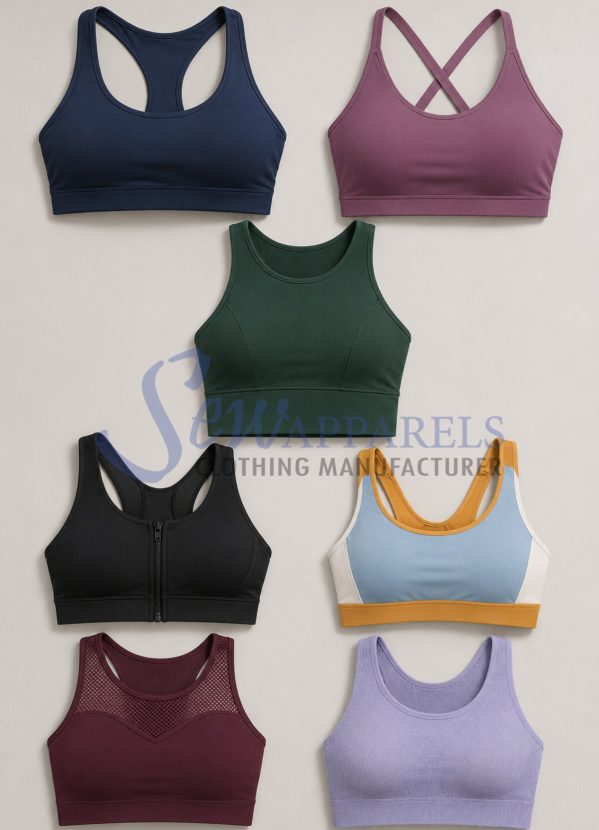
1. Define sports bra removable pad wash retention for the care route
Identify the insert reference, garment revision, pocket construction and sample size. Record whether the pad is symmetrical, shaped for a particular side or designed with a specified orientation. Insert left right identity matters when the parts are not interchangeable. The reviewer should know which insert belongs in each pocket before assessing a cared sample.
Nike’s January 2022 sports bra care guidance advises removing removable pads and washing them by hand. This illustrates a care route involving separate components. It does not establish the correct instructions for every sports bra or validate a Sew Apparels sample. Follow the instructions developed and supported for the actual garment and insert combination under review.
Sports bra removable pad wash retention should have a written definition for the particular programme. If the proposed instructions permit washing with inserts in place, identify that route explicitly and review it accordingly. If removal is required, assess the instructed sequence. Do not silently change the procedure to obtain a more favourable outcome or claim that an untested route is equally acceptable.
Identify the intended pad function
Record whether the insert is intended primarily for shaping, modesty or another specified purpose. A removable pad is not automatically the supporting structure of the sports bra. Keep its function distinct from the complete garment’s support architecture. A successful care review of an insert does not prove a performance claim about the finished bra during activity.
2. Document care conditions and the starting sample
Begin the sports bra pad pocket wash evaluation with a baseline inspection. Record the insert’s shape, visible surface condition, pocket opening and position within the garment. Inspect both sides and identify any starting fold, crease or damaged edge. Keep a suitable reference sample or record so later changes can be distinguished from pre-existing handling marks.
Sports bra removable pad wash retention comparisons need an agreed care procedure. Identify whether the pad is removed, the cleaning method, detergent, temperature, agitation and drying arrangement where relevant. State the number of cycles and inspection points. An internally chosen procedure should be described as such unless the programme actually uses a recognised method and appropriate documentation.
Use the actual proposed care instructions as the starting point. If a laboratory is involved, ask it to confirm the procedure, sample preparation and reporting scope. Do not substitute a generic harsh cycle and interpret the result as ordinary instructed care. Conversely, a very gentle informal rinse cannot support a broad claim covering more demanding cleaning conditions.
For US-market garments, the FTC’s care-labelling guidance explains the need for a reasonable basis for care instructions and evidence supporting the garment as a whole. That principle is relevant when the bra and removable inserts have different care needs. A component supplier’s advice should be reviewed against the complete product before the brand finalises its instructions. The guidance also addresses separate labelling for a detachable component needing different care; have the responsible reviewer check its application to the proposed insert.
Keep the care evidence attached to the sample
Record the garment, insert and procedure identifiers together. If a pad supplier changes the material or edge construction, mark the revised component and assess whether another review is necessary. Visually similar replacements may not behave identically. Avoid retaining an old care approval while silently substituting a different insert or pocket assembly.
3. Inspect folding, creases and post-wash shape
Sports bra pad folding after washing should be described precisely. Was the pad folded inside the pocket, creased after separate cleaning or temporarily bent during removal? These events suggest different questions. Record when the fold was first observed and whether the prescribed handling restored the shape. Do not assume every distortion has the same cause.
Sports bra removable pad wash retention observations should include a cup insert crease inspection under consistent conditions. Identify the location, visibility and persistence of the crease after the agreed drying and conditioning stage. Avoid assessing one pad while wet and another after complete drying, then comparing them as if their conditions were equivalent.
Post wash insert shape review can include the outline, depth, edge condition and any visible layer separation relevant to the component. Use an agreed measurement or comparison method and record its scope. A statement such as “still looks good” does not explain whether the insert meets the specification or sits correctly in the actual garment pocket.
Folded pad acceptance should be agreed before final approval. The buyer may reject a persistent visible crease, an insert that cannot be restored using the instructions or a distortion affecting its intended function. State the accepted condition and required handling clearly. Do not introduce a universal tolerance or assume the wearer should repeatedly reshape a defective component without guidance.
4. Assess migration within the pocket under the permitted route
A removable bra insert migration trial should identify whether the observation concerns care, handling or subsequent wear. For an in-pocket wash route that is actually permitted, record the starting orientation and inspect the position at the agreed stages. For a removal-before-wash route, review how the correctly reinserted pad sits after care and any defined follow-up movement.
Sports bra removable pad wash retention should distinguish rotation within the pocket from escape through the opening. Pad migration during care may include movement toward an edge, folding or partial emergence, but only the actual observations should be recorded. Identify the affected pocket and sample size. Do not combine different outcomes into one unexplained pass or fail.
Review the relationship between pad dimensions, pocket shape and access opening. An opening that is easy to use may need a separate retention check, while an overly restrictive opening can make removal difficult. Examine the complete construction against its intended procedure. Increasing pocket tightness is not automatically the right solution when the problem is orientation or usability.
If post-care wear observations are included, use a safe, defined movement sequence and the intended garment fit. Record whether the pad changes position and whether the wearer needs to adjust it. Keep those findings separate from wash observations. A pad remaining in place through one care trial does not establish retention during every activity or across the full size range.
Investigate the cause before revising the pocket
A migration result may involve component shape, pocket dimensions, opening position or the way the insert was fitted. Check the starting arrangement before requesting a construction change. If several variables are changed together, the next trial may not explain which change helped. Keep candidate revisions identifiable and compare them under the same agreed conditions.
5. Compare drying and reinsertion usability
Sports bra cup insert drying should follow the supported care route. Identify whether the insert dries separately or within the garment, how it is positioned and when the review takes place. Do not invent a fixed drying time applicable to every material and environment. Record the actual conditions when drying behaviour is part of the development question.
Sports bra removable pad wash retention review can include an insert drying comparison between agreed arrangements. Keep the component, starting wet condition and environment consistent where practical. Explain the limits of the comparison. A drying observation in one room cannot become an unrestricted quick-drying claim, and an apparently dry surface does not justify skipping the agreed conditioning stage.
Pad pocket access review should examine removal and reinsertion with the intended insert. Record whether the opening can be found, whether the pad catches on a seam and whether the user can establish the correct orientation. Pad reinsertion usability may be affected by shape, opening location and the information supplied with the garment. Review all three rather than assuming the component alone determines the experience.
Replacement insert instructions should identify a compatible component and the required orientation. If left and right inserts differ, explain how the user recognises them. Do not imply that any similarly sized pad is an approved replacement. A different shape, thickness or material may change fit, pocket retention or care behaviour and should be reviewed before acceptance.
6. Approve the complete system and preserve its evidence
Complete pad system approval should cover the insert, garment pocket, removal and reinsertion procedure, and supported care instructions. Identify the accepted sample revision and conditions reviewed. List unresolved changes separately. If a problem requires another development round, specify the proposed correction and the observations to repeat so the supplier has a clear target.
The insert care evidence record should contain the baseline condition, care exposure, drying arrangement and post-care observations. Keep shape changes, migration and usability feedback distinguishable. Record which sample sizes and component variants were assessed. Approval of one combination should not be extended automatically to another size, insert shape or pocket construction.
Use the Sports Bra Buying Guides to coordinate removable inserts with cup development, underband construction and size-set approval. Each review answers a different question. Pad care approval does not replace fitting evidence, and a satisfactory fitting sample does not establish that the insert system will behave as instructed through care. Connect the review to the size set sampling budget when additional sizes need assessment.
For custom sports bra manufacturing and private label sports bra production, share the complete pad specification and care brief with the custom sports bra manufacturer in Bangladesh. Startup activewear brands can use a focused sample programme to clarify the intended insert system. Agree component options, development charges, quantities and review stages in the supplier quotation.
Sports bra removable pad wash retention checklist
- The insert, pocket and garment revision are identifiable.
- Removal or in-pocket care follows the actual supported instructions.
- Folding, creases, migration and shape changes are recorded separately.
- Drying and inspection conditions are defined.
- Reinsertion and replacement guidance are usable and component-specific.
- The complete system approval matches the evidence held.
Sports bra removable pad wash retention review is complete when another developer can understand the accepted care route and its limitations from the record. Retain the approved components and revisit the decision when insert material, shape, pocket construction or care instructions change.