
SKIRT DEVELOPMENT LIBRARY
Skirts Buying Guides
A skirt lining should support comfort and drape without fighting the outer shell. If the two layers shrink differently, cling at the hem or resist movement at the seams, a sample may look good on a stand yet fail after wear and care. These Skirts Buying Guides help buyers set measurable expectations for lined styles. Begin with the approved silhouette, shell cloth, lining cloth and care claim. Then judge the complete garment, standing, walking and sitting, before approving fabric and pattern together. A smooth shell is not proof that the hidden layer has the right length or movement allowance.
These skirts buying guides connect six development decisions: lining compatibility, waist-facing stability, circular-skirt consumption, button-front openings, pleated production and wrap fastening. Begin with the intended silhouette and material behavior, then review the actual pattern, opening and closure on the sample. Compare quotation assumptions with the approved design and assess movement and care before release. Keep shell and lining lots, facing support, pattern revisions and approval evidence together so each decision refers to the same garment.
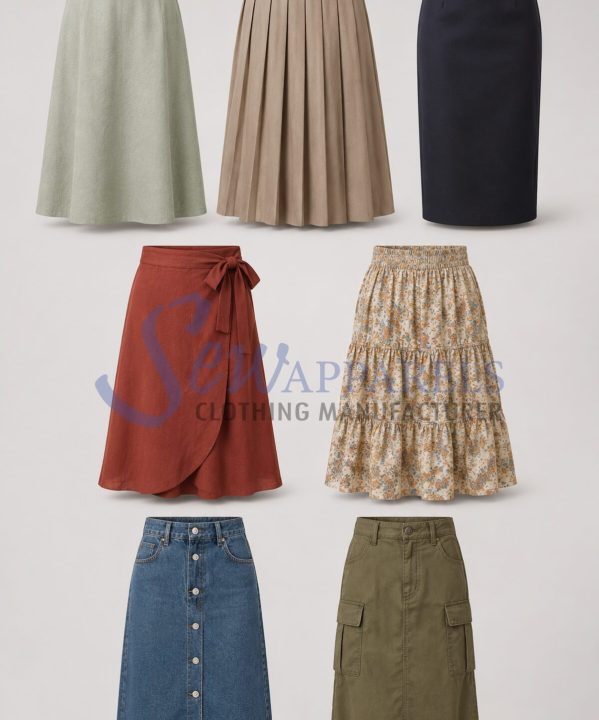
These Skirts Buying Guides use existing skirt style references to support development discussions. The image does not demonstrate lining shrinkage, fastening coverage, pleat retention, fabric consumption or an approved production sample.
Circular Skirt Fabric Consumption Quotation: Width and Layout
Compare circle shape, length, usable width and panel options against the identified pattern. Connect size ratios and layout evidence to separate fabric booking assumptions before accepting the quotation.
Review circular skirt consumptionButton Front Skirt Opening Specification: Coverage and Movement
Map functional buttons, overlap and the lower opening against the identified sample. Review sitting, walking, size-set behavior and closure operation after care before approving the construction.
Review button-front openingPleated Skirt Production Approval: Repeat, Junctions and Care
Connect the pleat repeat map to side seams, openings and panel allowances. Compare the worn silhouette and documented care result before approving the identified sample and construction.
Review pleated skirt approvalWrap Skirt Fastening Specification: Overlap and Closure
Map overlap and internal and external fastenings on the identified sample. Review closure reach, walking and sitting coverage, size grading, tie anchors and operation after care.
Review wrap skirt fasteningSkirts lining and shell compatibility
Compare lining and shell shrinkage, hem length and seam movement on the finished skirt before approving production.
Read the lining-compatibility guideSkirts waist facing stability
Choose compatible interlining, facing width and waist seam finishing for a smooth, comfortable skirt waist.
Read the waist-facing guideSkirts Buying Guides: Silhouette and Wear Review
Decide whether the skirt should hang close, flare, pleat or move freely over the legs. A lining that is comfortable inside a straight skirt may not behave the same way in a full or bias-cut style. Record the intended waistband placement, shell hem shape, lining hem shape and whether the lining is attached at the hem or hangs free. Check the garment on the intended wearer and underlayers. Ask the model to walk, sit and rise; observe whether the lining climbs, twists or pulls the outer layer inward. A lining should be assessed as part of the finished garment, not approved from a fabric swatch alone. Use these skirts buying guides to connect wearer observations with the sample’s identified construction.
List the two fabrics separately in the brief: fibre content, construction, weight, finish, stretch direction and care route. A similar hand feel does not guarantee matching behavior. Inspect transparency, static cling, seam impression and colour interaction as well as dimensional stability. If the shell is intended to be washed at home but the lining needs a different care method, the combined claim may be unrealistic. Test the chosen combination under the actual proposed care conditions and retain the pre-care measurement record for comparison.
Measure lining and shell dimensional change together
Mark a repeatable length and width reference on both shell and lining specimens, and measure the finished garment at waist, hip and hem before care. ISO 5077 describes a method for determining dimensional change in textile fabrics or garments after specified washing and drying; it is a testing framework, not a promise that two materials will shrink equally. State the laundering method, drying route, number of cycles and tolerance agreed with the buyer. Use the same conditions for both layers. A single supplier shrinkage percentage without the test route is not enough to predict how the sewn skirt will behave.
After care, measure both layers again and compare the difference, not only each individual result. If the shell shortens more, lining may become visible below the hem. If the lining shortens more, it can pull at an attached hem or distort a pleat. Observe changes at side seams, vent, waistband and zip opening too. Record any twisting or puckering. If the materials respond differently, options include changing the lining cloth, adjusting treatment or redesigning attachment and allowance. Approve the revised whole garment after the same care sequence. Within these skirts buying guides, the dimensional-change record supports the lining, facing and closure decisions together.
Set lining length relative to the visible shell
A buyer should specify lining length from named landmarks such as the waist seam to the finished lining hem and the finished shell hem. The required difference depends on silhouette, movement, hem construction and care claim; there is no universal fixed clearance for every skirt. In a vented style, show where the lining stops relative to the vent. In a flared style, check the lining’s sweep and where it falls while the wearer walks. A short lining may ride up; an overlong one can show or catch below the outer hem.
Photograph the garment from front, side and back while standing and seated. Mark the lining hem with a contrasting basting thread during sample review, then remove it from the approved garment. Record whether the lining is free at the bottom or joined to the shell, and where any thread chains or tacks allow movement. Recheck after care, because an initially hidden lining can emerge when the fabrics change dimensions at different rates. Keep measurements and images at the same size and posture across revisions.
Allow seam movement without losing control
The shell and lining do not always take the same path as the body moves. A lining attached too tightly at side seams, waist or vent can drag the shell, create diagonal pull lines or restrict a stride. Map the attachment points and inspect how each layer moves during sitting, walking and a moderate step. Coats’ seam-types guide distinguishes joining seams from edge-finishing constructions; choose a seam and finish that suit the layer, rather than treating every edge as interchangeable. The guide does not provide a universal movement allowance, so the wearer trial remains decisive.
Check the seam allowance, stitch type, lining ease and reinforcement at high-stress points such as zip base or vent top. The aim is controlled independence: enough freedom that the lining does not tug the shell, enough attachment that it does not twist or climb excessively. After pressing, look for seam show-through on the outer cloth. If the shell is thin, a bulky lining seam can mark the surface. Document the chosen construction in an inside-out photograph and a sample seam diagram so production can repeat it. Keep this construction record with the related approval notes from these skirts buying guides.
Use an annotated sample and buyer decision table
Mark A at the waist seam, B at the shell hem and C at the lining hem on the physical sample. Record A–B, A–C and the B–C clearance while the skirt hangs, then compare them after care and on the wearer. In a buyer decision table, give shrinkage, hem visibility, seam drag, vent freedom and comfort separate rows. Add the evidence photograph, agreed acceptance condition and next pattern or fabric action. A note saying only “lining too tight” cannot tell a sampling team which dimension or attachment caused the problem.
Plan low MOQ skirts for startup brands
A startup brand can simplify a small skirt launch by settling on one fit block and an identified shell fabric before multiplying colors or trims. For a low MOQ skirt enquiry, state the quantity, size curve, fabric sources, lining and facing construction. Include fullness and usable width for circular styles, button-opening coverage, pleat repeat or wrap overlap as relevant. Ask which combinations and development arrangements are feasible; minimums depend on sourcing and production conditions. Keep the approved sample, dimensional-change record, closure trial and quotation assumptions together so reorders preserve the chosen design.
Turn skirt lining and waist decisions into a product brief
Use these skirts buying guides to prepare one coordinated product brief. Share the wearer reference, shell and lining specifications, care method, waist-to-hem measures, seam attachment map, facing support and waist-seam construction. Add circular-skirt shape, usable width and marker assumptions where applicable; button-front overlap and opening points; the pleat repeat and care result; or wrap fastening positions and movement coverage. Include inside-out construction records and standing, walking and seated observations. Identify the pattern revision and unresolved decisions before requesting the manufacturing quotation.
Explore Skirts manufacturing