
WOVEN PAJAMAS • TECHNICAL BUYING GUIDES
Woven Pajamas Buying Guides
Woven pajamas need a calm, comfortable fit and durable details that still look neat after washing. This guide collects technical decisions for pajama brands developing a woven sleepwear set. It begins with piping construction: the visible piping width, the way a contrasting edge turns a collar or cuff corner, and the bulk that builds up where several seams meet. The sleepwear-ease guide covers how ease is shared across shoulder, seat and arm opening. These issues belong in one product brief, because a smooth trim cannot compensate for a restrictive garment and an easy fit does not excuse a lumpy neckline.
The piping article turns visible width, corner handling and seam bulk into a reproducible construction brief. The sleepwear-ease article adds the fit system: shoulder movement, seated trouser room and arm-opening balance. Read both before signing a complete set. One article prevents a decorative edge from becoming uncomfortable; the other checks that the pattern allows natural sleeping positions. Each has an annotated example and a buyer decision table. Use the separate cards below to open the relevant post. The original Woven Pajamas product page remains the manufacturing enquiry route, while this editable guide organizes technical decisions without crowding the existing product content.
These Woven Pajamas Buying Guides now connect six sample decisions: piping, sleepwear ease, seersucker fabric, adult buttons, gift-box packing and turned-up cuffs. Keep the accepted material and garment references together, and record the owner and evidence for each unresolved decision before release.
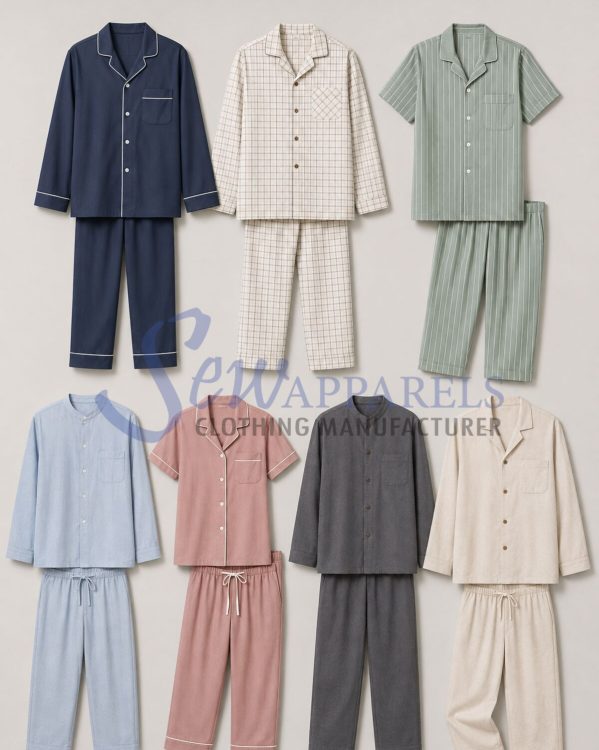
These Woven Pajamas Buying Guides use existing woven pajama style references to support development discussions. The image does not demonstrate verified seersucker construction, tested shrinkage, approved sleepwear ease, button attachment strength or gift-pack performance.
Woven Pajamas Piping Construction: 7 Best Checks
Specify the visible piping line, turn corners cleanly and control seam bulk at collars, cuffs and openings before approving a production sample.
Read the piping guideSeersucker Woven Pajama Fabric Approval: Texture and Care
Identify the actual puckered fabric and retain a clear texture reference. Review composition, finished width, cutting and seam trials, then compare after-care evidence before approving the pajama material.
Review seersucker fabric evidenceWoven Pajama Button Approval Checklist: Adult Fastening Evidence
Review adult pajama buttons as an assembled fastening. Compare edge finish, buttonhole operation, attachment evidence and care response, then record the accepted component and spare-button identities.
Review adult button approvalWoven Pajama Gift Box Packing Brief: Fit and Procurement
Trial the complete folded pajama set across sizes before ordering gift boxes. Review tissue, inserts, label access, barcode proof and measured carton arrangements, then approve an identified physical pack.
Review gift-pack approvalWoven Pajama Turned Up Cuff Specification: Fold and Care
Compare a true turn-up with an attached cuff, then define fold depth, fabric exposure and tacking. Review bulk, opening measurements and after-care appearance against an identified finished sample.
Review turned-up cuff approvalWoven Pajamas Sleepwear Ease Distribution: 7 Best Checks
Share the finished shell swatch, size chart and care results, plus piping cover and cord codes, approved visible width, collar and cuff corner photographs, seam cross-section, shoulder and seat movement notes, and arm-opening measurements. Add a signed fit sample and pattern version. These references help a supplier repeat a neat trim and comfortable fit. Use the original Woven Pajamas product page for manufacturing, sampling and order quantity.
Read the sleepwear-ease guideWoven Pajamas Buying Guides: Silhouette and Decorative Edges
A pajama top may have a notched collar, a straight camp collar or a simple binding; a trouser may carry piping at a side seam or cuff. Decide which edges are part of the visual identity and which should remain soft against the skin. Mark those locations on a flat technical drawing. Include a front and back view, because a trim that looks balanced at the neckline can feel distracting at a side seam during sleep. The approved sketch should identify where piping starts, stops and crosses an opening.
Select the shell cloth and finish before approving piping. A fluid plain weave, crisp poplin and brushed woven cloth do not hold an edge in the same way. Compare the piping cover fabric with the shell for shrinkage, colorfastness and care method. Place the trial cord or folded fill against the wearer side as well as the outside: an attractive contrast line should not become a hard ridge under the arm or behind the knee. Keep one signed physical sample for later trims and colorways. Woven Pajamas Buying Guides connect shell identity and decorative edges to the complete sample brief.
Make piping width measurable at the seamline
The visible piping width is the line seen after the seam is sewn and pressed, not simply the width of an unsewn strip. Define it on a finished sample and show the measurement point. Choose a range that suits the scale of the collar, placket and cuff. At a tight curve, a bulky cord can pull the shell or obscure the intended shape. At a wide flat edge, piping that is too fine may disappear. Ask the sample room to record the strip width, cord size if any, seam allowance and finished exposure separately.
The same piping should look consistent along a straight edge and around a corner. Use close photographs with a ruler next to the approved line. If a supplier changes cord or cover material, require a new finished sample rather than accepting a matching nominal measurement. The Utah State University Extension sewing instruction on piped prairie points demonstrates the basic method of placing piping between fabrics with aligned raw edges and sewing close to the piping. Translate that principle to the actual pajama construction, where comfort and repeated laundering govern the decision.
Turn corners without twisting the line
A collar point, notched lapel, pocket corner or cuff turn exposes uneven piping immediately. Mark the exact pivot or rounding on the pattern and decide whether the finished design needs a crisp point or a soft radius. Baste the trial edge first. At the turn, check that the piping follows the seamline without a kink, gap or doubled cord. The cover fabric should not drag the shell into a pucker. Photographs taken before pressing and after pressing help distinguish a stitching problem from a finishing problem.
For a sharp point, grade and clip seam allowances as the fabric permits, keeping the stitching secure. For a small radius, distribute the piping smoothly and avoid forcing a thick cord into a curve it cannot make. Utah State University Extension sewing projects illustrate pivoting at a corner with the needle held down and trimming a corner to reduce bulk. The pajama sample still needs its own approved construction method; use those educational examples as principles, not as a fixed production measurement for every fabric.
Control seam bulk where trims intersect
Bulk is often greatest where piping, facing, collar, placket and shell meet. Count the material layers at each intersection on the sample. A neat outside finish can hide a hard inside lump that rubs during sleep. Grade allowances, choose which layer receives the turn, and position the piping join away from a high-pressure point when the design allows. Press the seam with a suitable support so a thick allowance does not mark the right side. Check the finished garment both buttoned and open.
New Mexico State University clothing construction standards call for collars and facings to be smooth, flat and free from unnecessary bulk, with clipping or grading where needed. Apply that quality principle to each piped pajama edge. Test after laundering and gentle handling: a corner that looked sharp on the first sample can roll out or twist after care. Record the approved seam cross-section and edge photograph, not merely a visual comment such as “less bulky.” Use these Woven Pajamas Buying Guides to record the agreed edge evidence with the current garment revision.
Low MOQ woven pajamas and startup brand development
For a startup brand with a low minimum order quantity, a precise first sample reduces rework. Select one or two piping treatments to compare on the actual shell, then use the approved construction across relevant colorways. Decide early whether contrast piping is a signature feature or whether a plain finish better supports comfort and price. Provide a tech pack with trim code, placements, finished width, corner photographs and care test. A focused brief lets the manufacturer price and sample the product accurately without changing the original product page. Woven Pajamas Buying Guides help startup teams compare evidence before committing to an order; confirm the actual MOQ and sampling scope for the chosen configuration.
Turn the reviewed sample into a production standard
Review the set as a complete garment. Compare left and right collar edges, check that cuffs and pocket corners repeat the same piping width, and feel the inside seams for pressure points. Record failures and the repair tested on the next sample. Keep the approved sample, measurement sheet and photographs together. For the next related topic, add shoulder, seat and arm-opening ease to the same development brief so decorative construction and sleep comfort receive equal attention. This guide will link those separate articles through distinct cards as the topic expands. The Woven Pajamas Buying Guides now cover seersucker fabric, adult buttons, gift packaging and turned-up cuffs alongside piping and fit.
Turn piping and fit decisions into one pajama product brief
Share the woven shell swatch, size chart, flat sketch, piping cover and cord codes, approved visible width, collar and cuff corner photographs, seam cross-section and care-test result. Add fit comments and signed sample details. These references allow a supplier to reproduce a neat edge without sacrificing comfort. Use the original Woven Pajamas product page to discuss manufacturing, sampling and order quantity. Use the Woven Pajamas Buying Guides to add seersucker material identity, button references, approved gift-pack details and turned-up cuff observations to the same brief.
Explore custom woven pajamas