
Seersucker woven pajama fabric approval should identify the proposed cloth and demonstrate how its puckered surface behaves in the finished sleepwear. An attractive stripe swatch does not establish retained texture, cutting suitability or seam appearance. Buyers need an identified material reference, a clear account of the effect and representative garment evidence before accepting the fabric for an order.
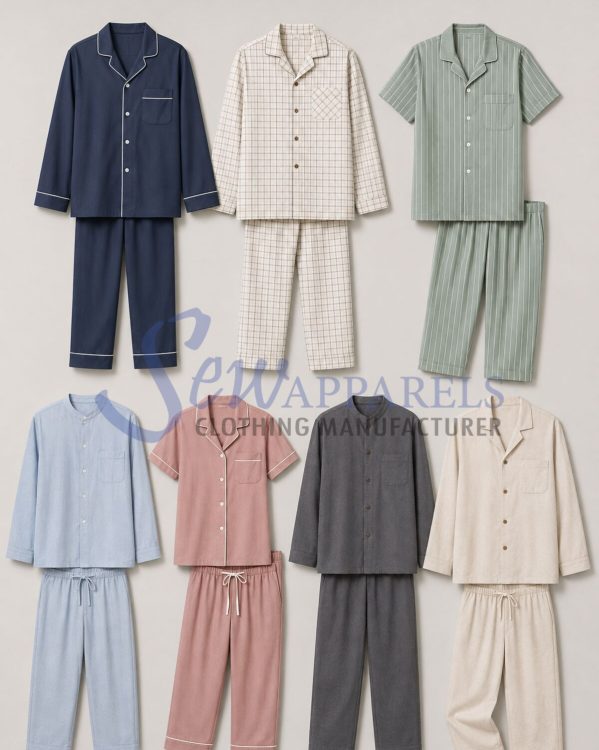
A practical seersucker woven pajama fabric approval brief connects the fabric card to the intended pajama silhouette and care route. Do not assume that every cloth sold under a textured-fabric name has the same construction. Equally, avoid treating the surface appearance as proof of cooling performance or a no-iron claim. Those are separate assertions requiring suitable evidence beyond a visual approval.
Use our custom woven pajamas manufacturing page to discuss the swatch and product brief. Confirm the actual material availability and sample-development scope for your project rather than assuming that a pictured fabric is already stocked or approved.
1. Identify the effect before seersucker woven pajama fabric approval
Ask the fabric supplier to explain the construction and finishing route responsible for the proposed puckered appearance. Request information that identifies the actual article, rather than accepting a general trade name as the specification. Record whether the supplier describes the effect as arising from the fabric structure, a finishing treatment or another declared combination. If the explanation is incomplete, keep that point open in the approval record.
The seersucker pajama structural versus finish effect question matters because two similarly textured swatches may behave differently during manufacturing and care. The buyer does not need to infer the route from touch alone. Ask for the relevant supplier declaration and compare it with evidence from the intended fabric. The appearance of a small reference is useful, but it cannot establish the origin or persistence of the effect by itself.
CottonWorks Learning Hub provides separate resources on weaving, finishing, garment construction and quality assurance. That separation is useful background when requesting information about a textured material. It does not identify your supplier’s cloth or provide a universal seersucker approval standard.
For a woven pajama puckered stripe material, identify both the raised pattern and any colour stripe. They may create related visual effects, but they should not be recorded as one undefined feature. A colour stripe reference can match while the surface texture differs from the original swatch. Describe which features must be preserved and how the sample review will compare them.
Seersucker woven pajama fabric approval should therefore begin with traceable identity and declared effect information. If a supplier proposes a different article later, review the new reference as a change. Do not assume that the same commercial name or colour description means the material is interchangeable.
2. Record composition, repeat and finished dimensions
The seersucker pajama material composition belongs on the fabric card with the relevant supplier reference. Keep the supplier’s declared information distinct from any independent verification the project requires. Do not infer an all-cotton composition from a traditional fabric name or a soft hand feel. If composition information is missing, ask for it before making product descriptions or accepting a quotation based on an assumed specification.
A seersucker pajama texture specification should describe the agreed surface character and pattern repeat in terms that the supplier and buyer can apply consistently. Retain an identified physical swatch where possible. If a measurement is used, agree the measurement condition and method; a textured cloth can look different when relaxed, tensioned or pressed. Avoid flattening it simply to obtain a neat-looking reference and then expecting that record to represent its intended surface.
Record seersucker sleepwear fabric width at the agreed finished condition, and distinguish nominal overall width from the usable width used for cutting planning. Ask the supplier and garment maker which definition applies to the quotation. The raised surface, selvedge and actual finished state should be understood before estimating consumption. This guide does not prescribe a universal width, relaxation period or fabric allowance.
A seersucker pajama colour stripe reference should identify the colour arrangement, repeat direction and physical standard used for comparison. Photographs can support communication, but lighting and display differences can change the appearance. Keep colour acceptance connected to an agreed reference and process. If matching across garment pieces is important, state which joins or areas require attention rather than implying an unrestricted matching requirement everywhere.
During seersucker woven pajama fabric approval, record the conditions under which these dimensions and visual features were reviewed. A buyer should be able to identify the same article and repeat in a later sample. An unlabeled swatch or a cropped image with no scale makes that comparison unnecessarily difficult.
3. Trial cutting direction and seam appearance
Seersucker pajama cutting direction should be considered alongside the repeat and intended garment design. Identify the direction used for the main pieces and any contrasting detail. Ask the garment maker to explain the proposed arrangement and its implications for matching and consumption. A development decision about stripes should be written into the brief rather than left to an assumption based on the sample photograph.
Use a woven pajama textured fabric swatch for early discussion, then move to an appropriate assembly or garment sample. A flat piece of fabric does not show how the texture interacts with a placket, pocket, waistband or seam. Choose trial areas that represent the actual design and explain what the buyer needs to observe. This is a material-development exercise, not a replacement for a complete fit review.
Review seersucker pajama seam appearance for unintended flattening, distortion, unevenness or a visible change beside the stitching. Compare the trial with the intended reference under consistent conditions. Ask the supplier to investigate any problem rather than immediately prescribing a sewing setting. The suitable construction and handling depend on the actual fabric and garment, so there is no universal stitch or pressing parameter in this checklist.
Seersucker pajama surface flattening should be recorded as an observation with a location and condition. Is it visible only at a seam, across a pressed area or throughout the sample? Is the surface being compared while stretched or relaxed? These distinctions help the supplier assess the issue. A broad comment such as “texture is wrong” does not show where to investigate or what improvement would satisfy the buyer.
A seersucker pajama finished sample should use identified materials and a recorded construction revision. If the early trial uses a substitute, declare it and state which approvals remain provisional. Seersucker woven pajama fabric approval is stronger when the final decision relates to a complete garment using the intended cloth, rather than a convenient sample whose material differences are undocumented.
4. Compare retained texture after the intended care route
Set the woven pajama seersucker care brief before evaluating the result. Identify the proposed care route, relevant conditions and the responsible reviewer. If the garment’s intended instructions are not yet established, keep that dependency visible. The trial should reflect the actual product brief instead of a convenient procedure chosen after the result is known.
Seersucker pajama after wash texture can be compared with an identified untreated reference under consistent observation conditions. Record the sample identity and care history. Review the raised pattern, colour arrangement and overall appearance, then compare relevant dimensions using the agreed method. Avoid calling any change automatically acceptable or unacceptable without referring to the project’s defined requirements.
CottonWorks quality testing guidance discusses dimensional stability and changes in appearance associated with care. Those considerations help frame the review, but the page does not supply a universal texture-retention limit for your seersucker pajamas. Agree the methods, criteria and evidence needed for the actual cloth.
In seersucker woven pajama fabric approval, texture observations and dimensional observations should remain distinct. The cloth can retain a recognizable raised surface while garment measurements change. Conversely, measurements may remain within agreed requirements while the surface no longer resembles the accepted reference. Record both outcomes so a successful result in one area does not conceal an unresolved issue in another.
Do not transform a pleasing after-care sample into an unsupported cooling or no-iron statement. Appearance evidence can support acceptance of the specific reviewed configuration, but consumer performance claims need their own basis. Confirm any proposed claims before they appear in packaging or sales copy, and keep them outside the fabric approval if the supporting evidence has not been established.
5. Retain the fabric card and document the decision
A seersucker pajama approval worksheet should combine supplier identity, composition information, effect description, repeat, finished-width definition and trial references. Include observations before and after the relevant care procedure, the sample configuration and open issues. Name the person who accepts the decision and connect it to the current product brief.
- Identity: supplier article reference and declared material composition.
- Effect: the supplier’s explanation of the puckered appearance and the agreed visual standard.
- Dimensions: repeat and finished usable-width definitions under recorded conditions.
- Assembly: identified cutting and seam trials on the intended fabric.
- Care evidence: comparison references, observations and the defined acceptance decision.
Seersucker pajama fabric quote inputs should use the same article and conditions as the approval brief. Tell the supplier which matching requirements, care evidence and sample stages are expected. Ask them to identify any assumptions or exclusions in the quotation. This helps buyers compare like-for-like proposals without inventing a standard price, consumption figure or minimum quantity.
For private label woven pajamas production, connect the retained fabric reference to the finished sample and current technical pack. If the supplier changes the article, finish or material information, review which approvals must be reopened. Seersucker woven pajama fabric approval should identify the accepted configuration clearly enough that later substitutions can be recognized rather than silently treated as the same cloth.
Example: resolve a texture mismatch before release
Imagine an illustrative pajama sample whose stripe colours resemble the approved swatch, but whose front opening appears noticeably flatter. The buyer records the location, sample identity and handling history, then asks the garment maker to compare the assembly with the retained cloth. They review the proposed correction on an identified trial and repeat the relevant care comparison. This example describes an evidence process, not a guaranteed cause or a prescribed production setting.
The final seersucker woven pajama fabric approval record can then state whether the corrected sample meets the agreed reference or which issue remains open. If the surface origin or care result is still unresolved, the decision should stay conditional. An attractive colour match should not be used to close a separate texture concern.
Carry the accepted cloth into woven pajamas sleepwear ease distribution. Compare fit and movement using the same material identity and care condition; a retained texture alone does not establish suitable garment ease.
Prepare your seersucker sleepwear brief
Share the identified swatch, supplier information, pajama silhouette and proposed care expectations. Ask Sew Apparels to confirm the material and development-review scope available for your project. Startup brands can use the same clear brief without assuming an unconfirmed fabric supply, minimum quantity or development timetable.
Explore the woven pajamas buying guides for related product decisions. Clear seersucker woven pajama fabric approval helps buyers assess the actual cloth, preserve the intended texture and connect the accepted material to representative finished-garment evidence.