
SEW APPARELS TECHNICAL LIBRARY
Compression Shorts Buying Guides
Compression shorts buying guides connect gusset geometry, stretch, seams, fit, grading, low MOQ startup development and production control. Use this technical library to prepare an evidence-based brief for custom compression shorts.
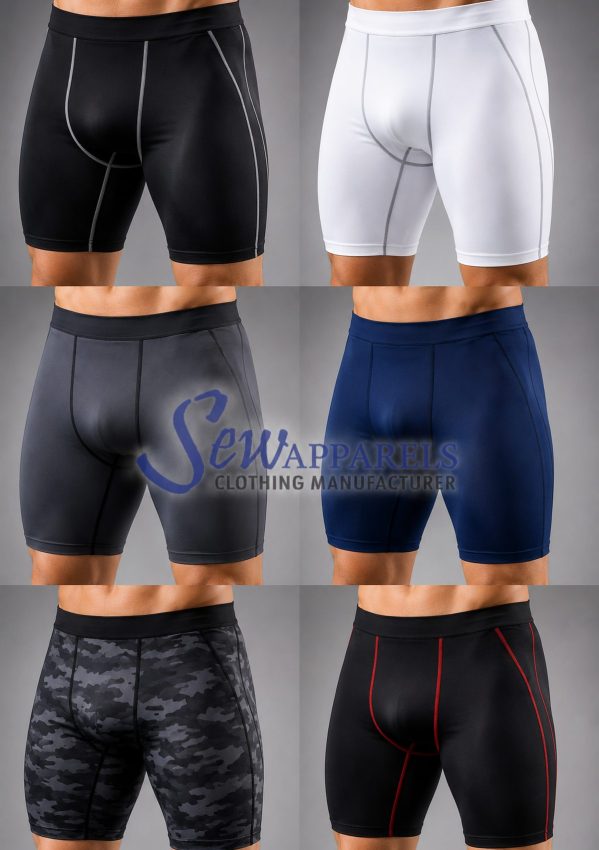
Existing compression shorts product reference showing several styles. Use it to discuss silhouette and panel direction; it does not establish garment pressure, marker yield or durability-test results.
Compression Shorts Buying Guides for Buyer-Led Development
The gusset sits where front rise, back rise, inner legs and high-motion fabric zones meet. Its outline redistributes seams and can reduce a bulky central intersection, but it also changes panel direction, seam length and fabric tension. A larger gusset is not automatically more comfortable; an overly wide insert can create folds or weaken compression. Define athlete profile, activity, fit intent, wearing duration, inseam and fabric family before choosing geometry. Evaluate the complete shorts during running, squatting, lunging, cycling and seated movement as relevant to the product brief. Use these compression shorts buying guides to translate the observations into a repeatable sample brief.
1. Map Crotch and Inner-Leg Movement
Use representative athletes in the base size and selected graded sizes. Observe relaxed stance, wide stance, deep squat, forward lunge, high knee, seated hip flexion and the sport-specific action. Mark front and back rise references, crotch depth, inner-thigh contact and seam pressure. Photograph identical positions for each sample. Record where the shell stretches, folds, migrates or rubs. Translate those findings into pattern landmarks and finished measurements. The map should guide gusset placement while preserving the approved waist, rise, leg opening and compression balance.
2. Specify Compression Shorts Gusset Width
Compression shorts gusset width needs defined measurement points because a tapered or diamond piece changes width along its length. The practical answer to how to specify gusset width for compression shorts is to state front, centre and back finished widths from seam line to seam line, plus length, shape and tolerance. Identify the corresponding pattern measurements and seam allowance separately. Check width relaxed and on-body during movement. A narrow centre can preserve compression but concentrate seams; excess width can fold or create a loose pocket. Approve geometry with production-intent fabric and seams.
3. Specify Compression Shorts Crotch Seam Route
Compression shorts crotch seam route should avoid a hard multi-seam junction at the highest pressure point while keeping front, back and leg panels stable. To explain how to specify crotch seam route for compression shorts, draw every seam through the rise and gusset, identify endpoints from stable pattern references, and state seam allowance, stitch and joining sequence. Show whether seams intersect, offset or continue into inner-leg panels. Inspect the route during squat, lunge and seated movement. Record how allowances are laid, trimmed or covered so operators reproduce the approved low-profile construction.
4. Specify Compression Shorts Inner Leg Panels
Compression shorts inner leg panels can move seams away from friction zones, control stretch direction and connect the gusset to the leg opening. The answer to how to specify inner leg panels for compression shorts is to define panel width, length, front and back endpoints, orientation, seam route and grade rule. State whether the panel narrows, continues to the hem or terminates above it. Check that endpoints do not create a pressure ridge and that the panel remains symmetrical. Evaluate thigh movement, leg opening stability and ride-up with the athlete in motion.
5. Control Material Stretch and Recovery
Compare shell, gusset and inner-leg fabrics for composition, finished weight, thickness, stretch direction, growth, recovery, shrinkage, colour and hand. ASTM D2594/D2594M-21 measures stretch and growth in low-power knitted fabrics; do not assume it validates high-support compression materials or garment pressure. This method is not recommended for commercial shipment acceptance because between-laboratory precision is poor. Agree a suitable method, load, direction, conditioning and recovery time with the laboratory. Mark the principal stretch axis on each pattern piece. These compression shorts buying guides also require sewn-assembly trials because seam elasticity and panel geometry change the response. Retain production-intent swatches, orientation maps, test records and a washed sealed sample.
6. Engineer Seam Strength Without Hard Ridges
State seam type, stitch density, thread, needle, allowance and finished profile for each gusset join. ISO 13935-2:2026 specifies maximum force to rupture a straight seam under perpendicular force using the grab method. Its scope primarily covers woven fabrics, including stretch woven fabrics; assess suitability before applying it to other constructions. Curved knit gusset seams and compression movement still need garment-specific assessment. Inspect thread breakage, skipped stitches, grin-through and fabric damage under stretch. These compression shorts buying guides balance strength with elasticity and skin comfort rather than choosing the highest force result alone.
7. Balance Compression Across Panel Boundaries
A gusset or inner-leg panel with different stretch can create abrupt changes in pressure. Define whether materials are identical or intentionally zoned, and record expected extension in the relevant direction. During fit trials, look for visible ridges, loose pockets, seam digging and panel migration. Compare the shorts relaxed and at representative body measurements. Avoid making unsupported medical or physiological claims from panel placement. Ordinary apparel development can validate fit, movement, recovery, seam comfort and durability; specialised compression or therapeutic claims require separate qualified evidence and acceptance criteria.
8. Grade Gusset Geometry by Landmark
Grade front rise, back rise, crotch depth, gusset length, widths, inner-leg endpoints, inseam and thigh together. Scaling the insert uniformly can move seams into pressure zones or create excess width in small sizes. Use stable pattern and body landmarks to define endpoints. Review selected small, middle and large shorts on appropriate athletes during identical movement routes. Record pattern dimensions and finished measurements by size, along with seam pressure and ride-up observations. If men's, women's and youth blocks are included, use separate geometry where body shape and fit expectations differ.
Low MOQ Compression Shorts Development for Startup Brands
Startup brands can prepare a focused brief for a low MOQ compression shorts manufacturer by defining the athlete, intended movement, size range and production-intent fabric. Discuss feasible quantities, sampling, material availability and costing with Sew Apparels; an exact minimum depends on the specification. These compression shorts buying guides help avoid a generic gusset, excessive centre width, pressure-point seam intersections and yield-driven changes to stretch direction. Preserve functional landmarks, orientation marks, grade rules, size-set trials, care validation and a sealed sample. Confirm each development decision before bulk production rather than assuming a small order removes technical risks.
Start with Gusset Geometry
GUIDE 01
Gusset Geometry: Compression Shorts
Control gusset width, crotch seam route, inner-leg panels, grading, movement and bulk quality with measurable development evidence.
Read the gusset geometry guideGUIDE 02
Waistband Roll Prevention: Compression Shorts
Compare waistband height, elastic construction, top-edge finish, grading, movement and bulk quality for a stable compression-short waistband.
Read the waistband roll prevention guideGUIDE 03
Compression Shorts Fabric Yield: Quotation Inputs
Compare approved patterns, usable width, size mix, stretch direction and separate allowances before approving material consumption.
Read the fabric yield quotation guideGUIDE 04
Compression Shorts Bonded Hem: Durability Approval
Review the adhesive and process, leg-opening extension, care exposure and suitable adhesion evidence before releasing a bonded hem.
Read the bonded hem durability guideGUIDE 05
Compression Shorts Leg Opening: Ride-Up Review
Record starting fit, movement, outer layers, comfort and care exposure before approving thigh coverage and hem stability.
Read the leg opening ride-up guideGUIDE 06
Compression Shorts Under Uniform: Layering Review
Compare the actual garment surfaces, movement, bunching, comfort and care exposure before approving a uniform pairing.
Read the under uniform friction guideTechnical References
ASTM D2594/D2594M-21 addresses stretch and growth of low-power knitted fabrics, not medical pressure or automatic approval of high-support compression. ISO 13935-2:2026 addresses straight-seam maximum force using a grab method, primarily for woven fabrics. Assess method suitability for knit compression shorts and validate curved seams through garment trials. These compression shorts buying guides use references within their stated scope.
Turn Your Development Decisions into a Product Brief
Bring athlete profile, fit intent, fabrics, gusset map, measurements, artwork, quantities and delivery timing together before sampling. A complete brief helps the factory identify stretch, seam, grading and care risks early and supports startup brands through controlled low MOQ development.
Discuss custom compression shorts