
WOVEN BOXER SHORTS DEVELOPMENT LIBRARY
Woven Boxer Shorts Buying Guides
Woven boxer shorts need room for movement without an uncontrolled, bulky silhouette. A standing fit can look acceptable yet feel tight at the seat and crotch after the wearer sits, bends or walks. These Woven Boxer Shorts Buying Guides help buyers turn a loose comfort claim into a measurable pattern, fabric and seam brief. Begin with the intended wearer, the wearing position at the waist, fabric behavior and the size range. Then test the actual garment in movement instead of judging a flat sample alone.
Begin with seated ease: assess seat width, rise depth and side-slit decisions on a worn sample. Then compare elastic width, casing seam and inner hand feel in the soft waistband article. Each card below opens a separate technical post, while the original Woven Boxer Shorts product page is the manufacturing route. This library grows by product-specific decisions without changing the already approved product content. These Woven Boxer Shorts Buying Guides also cover yarn-dyed fabric quotations, fly closures, multipack configuration and tamper-evident packaging. Keep material booking, construction approval and packing scope in separate records.
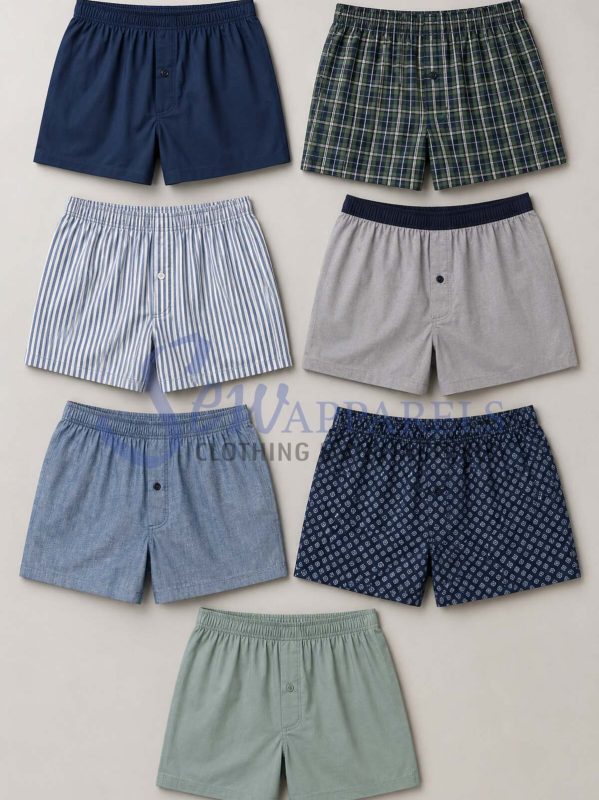
These Woven Boxer Shorts Buying Guides use existing boxer shorts style references to support development discussions. The image does not demonstrate a verified dyeing process, approved fabric lot, tested seated ease, fastening performance or packaging approval.
Woven Boxer Yarn Dyed Fabric Quotation: Colour and Commitments
Compare a custom check or stripe with confirmed fabric alternatives. Record colour commitments, sample approvals, availability, quotation scope and substitution rules before selecting the purchasing route.
Compare fabric quotation routesWoven Boxer Shorts Fly Closure Brief: Coverage and Operation
Specify the fly mechanism, overlap and opening references. Check inside contact, worn coverage, fastening operation and the cared sample before releasing the closure drawing.
Review fly closure approvalWoven Boxer Shorts Multipack Specification: Assortment and Counts
Define each pack's garment colours, sizes and identity. Confirm barcode and label placement, reconcile unit and carton counts, and approve the packed reference before release.
Review multipack configurationWoven Boxer Tamper Evident Packaging Brief: Seal Function and Trials
Specify the intended opening indication, package surface and seal position. Review label visibility, residue and handling trials, then approve the sealed sample and supported wording.
Review seal approval checksWoven Boxer Shorts Seated Ease Development
Compare seat width, rise depth and side slits on a worn sample. Learn what to mark in the tech pack and how to judge seated comfort without over-sizing the entire short.
Read the seated-ease guideWoven Boxer Shorts Soft Waistband Casing
Compare elastic width, casing depth and the inner seam on the actual fabric. Check waistband movement, skin-contact finish and shape after care before approving the sample.
Read the waistband casing guideWoven Boxer Shorts Buying Guides: Wearer and Movement Review
Start by stating whether the woven boxer short is intended as underwear, lounge clothing or a sleepwear layer. Record the waist position, desired leg opening, length and coverage. A wearer who spends long periods seated may notice pressure at the seat and front rise that is invisible on a hanger. Another wearer may prioritize a neat outline under trousers. The product brief should state these priorities before anyone alters the pattern. Use the proposed shell fabric and waistband construction in the fit sample so that movement observations correspond to the planned bulk fabric.
Build a simple assessment sequence: stand, sit in a chair, reach forward, walk, squat lightly and return to standing. Check for pulling across the seat, a waist that moves, a crotch seam under tension and leg openings that ride up. Photograph front, side and back in the same positions for each candidate sample. ISO 8559-1 describes anthropometric measurements for garment development, but a size chart based on body dimensions is a starting point rather than a final garment-ease prescription. The brand must establish its own functional allowance from the target fit.
Balance seat width with the complete pattern
Seat width is an important horizontal measure, yet simply adding width at the outside seams can create an oversized leg and a baggy standing outline. Mark the hip or seat level on the pattern and garment, then compare flat half-seat measures with the worn fit. Observe how the back panel, crotch extension and side seam share movement. If the back pulls when seated, determine whether the issue is circumference, back rise shape, seam position or fabric stiffness before adding width. Approval should specify where a measurement is taken and whether the fabric is relaxed.
A woven cloth may have little mechanical stretch, so movement ease often comes from pattern shape rather than recovery. Compare the approved fabric after the planned wash and dry route: shrinkage can reduce a carefully fitted allowance. Keep graded seat measurements consistent with the intended size curve, but do not assume the same numerical increment suits every body profile. A fitting on the smallest, base and largest sizes can reveal a change in pull lines or leg spread. Store the marked sample and measurement sheet together to protect the reason for the approved width. These Woven Boxer Shorts Buying Guides keep post-care material evidence tied to the approved fit.
Use side slits for mobility, not as a fit repair
A side slit can let the leg opening move more freely when the wearer sits or steps. Its effect depends on the short length, opening circumference, slit height and finished edge. The slit cannot correct an insufficient seat circumference or a rise that is too short; those problems must be addressed in the pattern. Mark the slit start and end on the flat sketch and check coverage in the intended wearing positions. A high opening may improve step length while revealing more than the brand planned.
Specify the seam finish and reinforcement at the slit end. The join is repeatedly pulled during wear and laundering, so inspect it on the real fabric rather than a drawing alone. Coats describes seam types and their applications, including low-bulk constructions where comfort matters near the skin. Use that resource as construction context, then choose and test the seam that works with this woven cloth and the brand’s desired hand feel. Check that the edge does not curl, scratch or distort after care.
Set rise depth and crotch shape together
Rise depth influences where the garment sits and how much room remains when the body bends. Measure the front and back rises from defined points and document the waistband top edge used in the measurement. A longer rise is not automatically more comfortable: extra fabric may fold under the waistband or bunch in front. A short back rise may pull the waist downward in sitting, while a front rise that is mis-shaped can feel restrictive even with ample seat width. Consider front and back pattern shapes as a coordinated system.
The crotch extension, inseam shape and seam finish also matter. On the sample, identify where tension is visible or felt during sitting and whether moving the seam would reduce pressure. Avoid giving a factory only a single total-rise number, because two patterns can share that number but distribute length differently. Add an annotated pattern view and seated fit photographs. When a correction is made, retest the waistband, seat and leg opening together; improving one area may shift tension into another. Use these Woven Boxer Shorts Buying Guides to record which pattern change resolved each observed restriction.
Plan low MOQ development for startup brands
A startup brand can begin with one fabric, one proven waistband, a limited size range and a clear base fit before adding prints or alternative openings. For low MOQ woven boxer shorts, discuss available stock materials, minimum quantities and any variation limits with the supplier rather than assuming every colour and fabric is equally practical. Giving facility to startup brands means helping them define a realistic test sample and document it. A small first order still needs a reliable graded measurement sheet, a signed fit sample and a clear care route. These are the references for a future repeat order.
Discuss custom woven boxer shorts manufacturing and private label woven boxer shorts production against the confirmed fabric, sample and order scope.
Approve a buyer decision record before bulk cutting
Record the wearer scenario, body-measurement basis, relaxed seat width, front and back rise, side-slit height, seam finish, fabric code and post-care measurements in one brief. Add a buyer table with the chosen option, the reason, the worn-sample observation and the action owner. Test the approved base size and boundary sizes in standing and seated positions. If a factory proposes a material or construction substitute, compare the new sample against the same acceptance checks. The goal is a comfortable, repeatable garment, not merely a flat measurement that matches a spreadsheet. Keep the final evidence record alongside the relevant Woven Boxer Shorts Buying Guides.
Turn fit and waistband decisions into a Woven Boxer Shorts brief
Share the target wearer, fabric and care route, approved seat and rise measurements, side-slit details, waistband specification, graded size range and signed standing and seated fit photographs. Include the construction notes and decision table so the sampling team can reproduce both coverage and movement comfort. Use the original Woven Boxer Shorts product page to discuss manufacturing and a realistic first order. Use these Woven Boxer Shorts Buying Guides to keep fabric sourcing, closure and packed-unit approvals identifiable.
Explore Woven Boxer Shorts manufacturing