
A woven boxer tamper evident packaging brief defines the visible indication that a retail pack has been opened. It should describe the seal mechanism, receiving surface, application position and accepted opening result. A sealed pack is not evidence that the garment is sterile, medically hygienic or protected from every form of interference.
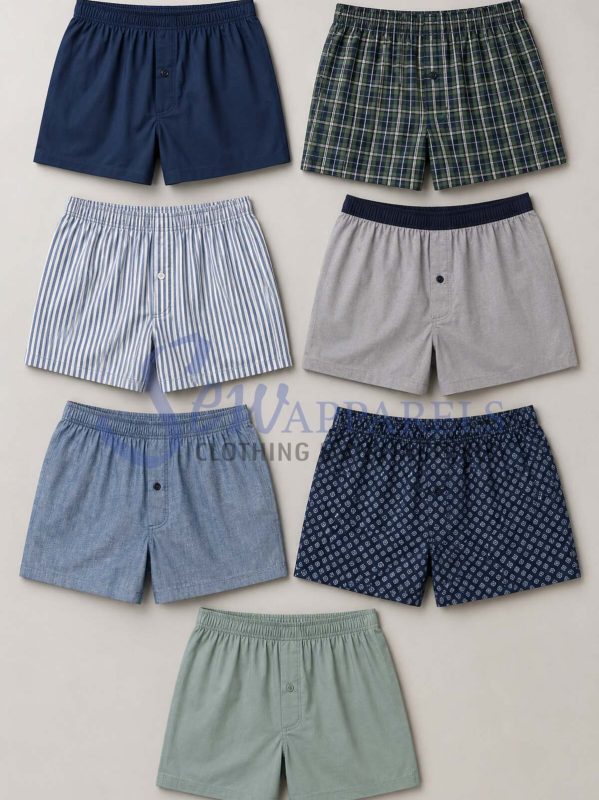
Buyers need to separate the retailer’s packaging requirement from unsupported product claims. This guide explains five checks for choosing and approving a seal on a woven boxer shorts pack. It focuses on opening evidence and label access; garment fit, waistband construction and multipack colour assortment remain separate development decisions.
For custom woven boxer shorts manufacturing, share the intended retail route and package concept before requesting a sealed sample. A woven boxer tamper evident packaging brief lets the buyer and packing team evaluate the actual combination instead of approving a seal from a catalogue photograph.
1. State the function in the woven boxer tamper evident packaging brief
Begin with the retailer’s written requirement. Identify which opening point must show an indication, who is expected to inspect it, and what that person should see after opening. A vague request for a secure bag does not explain whether the buyer expects a broken film, changed label or damaged closing strip.
For woven boxer hygiene seal packaging, clarify the intended meaning of the word hygiene in the retailer’s brief. Do not turn that phrase into a promise about microbiological condition. The practical specification should state the observable seal function and keep any unrelated health or cleanliness claims outside the approval.
Obtain boxer shorts retailer return policy input from the actual retailer or buyer. Record the packaging condition they want staff to assess. This is a sourcing input, not advice that a seal removes statutory consumer rights or permits a universal refusal of returns. The responsible retailer must confirm its own policy and market requirements.
Define woven boxer pack opening evidence with a before-and-after reference. Show what an intact sample looks like and what changes when the intended opening route is used. If there are several ways to access the contents, list them for evaluation rather than assuming a seal on one flap controls the whole package.
The woven boxer tamper evident packaging brief should distinguish opening indication from resistance to opening. A pack may be easy for the customer to open and still provide a clear irreversible change. Conversely, a difficult closure may be reopened without the indication the buyer expected.
2. Compare mechanisms on the real packaging surface
Choose a boxer shorts tamper evident label by its demonstrated behaviour on the proposed package. Ask whether the indication appears on the label, the surface beneath it, or through destruction of the material. Identify the label and adhesive references so the tested construction can be reproduced.
The Avery Dennison tamper-evident materials overview distinguishes transferable and non-transferable VOID constructions and destructible films. It describes where the indication remains after detachment and offers sample materials for application trials. These are material options, not proof that a particular boxer package performs correctly. Confirm the selected construction with its supplier and test the actual receiving surface.
Document the boxer short resealable bag seal distinction. A reclosable strip can provide convenient repeated access without necessarily showing previous opening. If reclosure and first-opening evidence are both required, describe the role of each feature and check them separately on a sample.
Request a woven boxer seal supplier declaration that identifies the supplied material, intended surface and relevant application guidance. Keep it with the sample record. Avoid treating a general catalogue statement as a guarantee for a different film, printed coating or storage route.
In the woven boxer tamper evident packaging brief, list the package material and printed or coated surface where the seal will sit. A change in the bag, carton sleeve or coating should trigger another compatibility review. Do not transfer approval automatically from one package material to another.
3. Position the seal without hiding identification
Mark woven boxer retail seal placement on a drawing and confirm it on the assembled pack. Show the closure line, overlap area and direction of opening. Keep the location clear enough for the packing team to reproduce without covering variable information or placing adhesive against the garment.
Check boxer shorts sealed pack SKU visibility with the seal applied and the contents folded. Confirm the size, pack identity and barcode are correctly mapped and remain accessible as required by the retail brief. A seal must not be used to conceal a label mismatch or make an incorrect pack appear approved.
For U.S. sales, the FTC textile labeling guide explains required textile information and provisions for packaged products. Its discussion includes conditions concerning information on items and packages and visibility through transparent packaging. Have the responsible reviewer apply the current rules to the actual retail arrangement. Do not assume a transparent area elsewhere on the bag resolves a label hidden by the seal or fold.
Consider how the customer will identify the correct opening point. Compare the sealed sample with the intended instructions and check whether opening exposes an adhesive edge near the clothing. Where the buyer requests an opening message, approve its wording and position together with the physical mechanism.
Keep the woven boxer tamper evident packaging brief connected to the final artwork revision. A revised barcode area or relocated size statement can change the available sealing position. Review the assembled presentation after either artwork or package dimensions change.
4. Trial adhesive, residue and handling behaviour
Evaluate woven boxer seal adhesive compatibility on the actual printed packaging. Record the material code, surface condition and supplier’s application instructions used in the trial. Adhesion observed on a plain test card does not settle performance on a flexible retail bag with a different coating.
Run a boxer shorts packaging residue trial by opening the sample through the agreed route and inspecting the label, receiving surface and nearby garment. Record the observed indication, any adhesive transfer and any contact with the fabric. Compare the result with the buyer’s accepted criteria rather than assuming all residue is either necessary or unacceptable.
Review boxer shorts pack closure durability under a handling sequence chosen for the intended route. Check whether ordinary movement, folding or stacking creates a false opening indication or lifts an edge. The buyer and packaging supplier should agree the trial conditions; this guide does not prescribe universal temperatures, dwell times or numbers of cycles.
Include an opening trial after the agreed conditioning or storage period where relevant. Record the conditions actually used and distinguish an untested proposal from an observed result. A pass on a freshly applied sample should not be described as proof of performance throughout an unassessed distribution environment.
The woven boxer tamper evident packaging brief should retain photographs of both successful and unsuccessful outcomes. Mark the cause being investigated and the proposed adjustment. If the label construction or surface changes, repeat the affected trial before accepting the revised sample.
5. Approve samples, wording and inspection instructions
Complete woven boxer sealed sample approval using the actual garment, package, seal and artwork. Identify the sealed reference and the opened comparison sample. Record which opening indication was accepted, how it was assessed and which deviations still require correction.
Plan woven boxer tamper seal inspection at a point where staff can see the relevant closure. Explain what an intact seal looks like, what counts as a defect, and how a suspect pack is separated. Avoid asking staff to infer product sterility from a visual packaging check.
Review boxer shorts package claim wording alongside the sample. Describe only the function supported by the selected construction and trials. Broad promises such as tamper-proof, contamination-free or medically hygienic need a separate evidence basis; they should not be added simply because the pack has an adhesive label.
A woven boxer seal specification worksheet can bring together the retailer requirement, package material, seal reference, placement drawing, application guidance, opening result, residue observation and artwork revision. Include the buyer’s acceptance and the action owner for any unresolved item.
Release the woven boxer tamper evident packaging brief only after the physical reference and written instructions agree. An attractive sealed sample with unspecified material is difficult to reproduce. A detailed worksheet without a matching sample has not shown that the proposed mechanism works on the real pack.
A buyer approval card that separates evidence from assumptions
Use one approval row for each proposed package and seal combination. Name the opening point, expected visible change, surface code and sample reference. In the observation column, describe what actually happened. Keep proposed changes in a separate action column so they cannot be mistaken for completed tests.
For example, if a candidate label lifts without the expected indication, record that result and investigate the material or application route. If another candidate gives a clear change but obscures the barcode, its opening result does not resolve the identity problem. Correct the placement and reassess the assembled sample.
Keep a woven boxer tamper evident packaging brief for each accepted configuration rather than combining results from unrelated packages. Where several sizes share packaging, confirm which common construction was assessed and which variants need their own check. A reference for one surface or closure must not quietly become approval for every variant.
Before approving seal placement, check the woven boxer shorts multipack specification for the exact contents, pack identity and artwork revision. Evaluate the seal on that assembled configuration so opening evidence, label visibility and component counts are reviewed together.
Questions buyers should settle before ordering
Does a seal prove the garment has never been handled?
No. It provides the agreed indication for the evaluated opening route. It does not establish the garment’s complete handling history or microbiological condition.
Can a resealable closure serve the same purpose?
Only if the proposed system demonstrates the required first-opening indication. Reclosure convenience and irreversible opening evidence are separate functions to assess.
What should a startup brand send?
Send the retailer requirement, package concept, garment identity, artwork and expected order scope. Ask about available materials, sampling and application constraints rather than assuming a custom seal is available at every quantity.
Prepare an evidence-based packaging enquiry
For private label woven boxer shorts production, combine the selected seal, assembled sample and acceptance record with the garment brief. Use the Woven Boxer Shorts Buying Guides to coordinate related product decisions. The finished brief should explain what the seal shows, how it was checked and which wording is supported before packing approval.