
A woven boxer shorts multipack specification identifies every garment in the retail pack and connects that assortment to its label, barcode and carton count. A pack can contain the correct number of units yet still be wrong because one size, colour or material identity differs from the approved combination. Buyers need a configuration that can be checked without guessing.
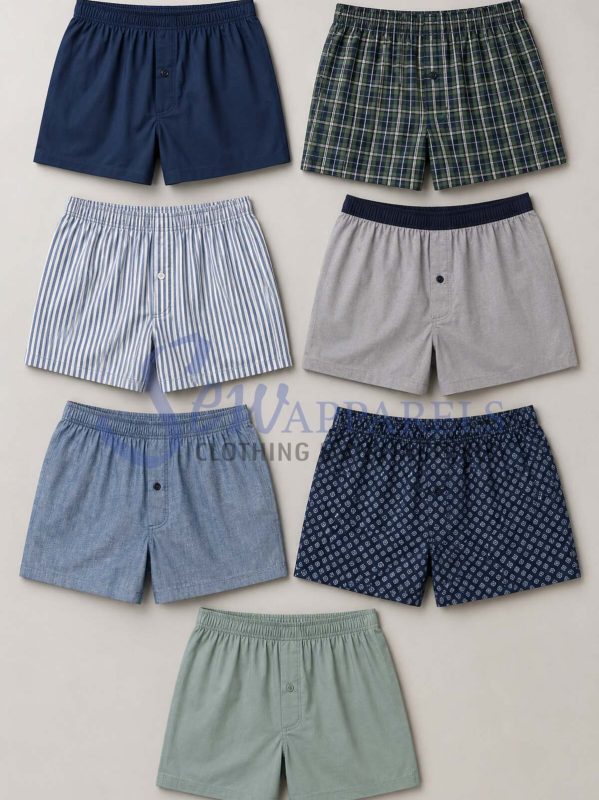
This guide explains six checks for pack assortment and counting. It keeps waistband construction and garment fit in their own development records. The packing brief starts with approved garment identities, then explains how those units become one retail pack and how packs are reconciled with the shipment.
For custom woven boxer shorts manufacturing, send the intended combinations, quantities and retail label requirements. A woven boxer shorts multipack specification gives the packing team a common reference for preparing a sample pack and confirming the final arrangement.
1. Define the assortment in the woven boxer shorts multipack specification
State the number of garment units in each pack and identify each permitted combination. Use material and colour codes rather than a description such as “assorted.” If a pack must contain a particular check, stripe or solid, list that identity separately. Do not allow an unspecified mix to stand in for an approved assortment.
For a woven boxer assorted colour pack, assign each unit a position or component reference in the configuration. Record whether colour order is fixed or whether any approved order is acceptable. The buyer should decide which feature matters to the retail presentation before the packing sample is prepared.
Keep woven boxer pack component identity connected to the approved garment records. A colour name alone may not distinguish fabrics, styles or revisions. Include the relevant style, material and size references so the team can confirm that the unit belongs in that pack.
Specify woven boxer bundle colour sequence where the visible arrangement matters. Show the intended front-facing unit and the sequence behind it. If the order can vary, state the permitted variation rather than leaving the operator to interpret a reference photograph.
The woven boxer shorts multipack specification should have one revision for the selected assortment. If a colour becomes unavailable, follow an agreed substitution review instead of filling the position with a similar unit. Update the configuration and label approval together when the pack identity changes.
2. Map garment sizes to pack identities
Build a boxer shorts multipack sku matrix with one row per approved retail configuration. Include the pack identity, units per pack, component colours or styles, garment sizes and quantity ordered. Keep the retail pack identifier separate from any internal identity used for an individual garment.
Use woven boxer pack size verification to compare the actual units with the configuration. If the pack is meant to contain one size throughout, state that clearly. If a mixed-size pack is intentionally proposed, list every permitted size combination rather than assuming the retail size printed on the outer label explains it.
Plan woven boxer size mix verification before closing the package. Check the garment identity and size at the point where the contents are still accessible. Define what record or check confirms the result and how an incorrect unit is separated for correction.
Confirm which barcode and SKU belong to each approved combination with the buyer or retailer. Do not invent retail identifiers or reuse a code merely because another pack looks similar. Keep the approved identity source available to the artwork and packing teams.
The woven boxer shorts multipack specification should connect the order row, pack configuration and outer label reference. When a pack size or assortment changes, review the identity mapping again. A corrected contents table with an unchanged, incorrect label is still an incomplete change.
3. Choose folding, bundling and barcode positions
Agree the folding and bundling arrangement using the actual garment and proposed packaging. Specify which surface is visible and how units are held together. Compare the arrangement with the required information and barcode positions before accepting a presentation solely because it looks compact.
Prepare a woven boxer pack barcode proof on the proposed label and package. Match its encoded identity and readable text to the approved configuration. Ask the buyer or retailer which verification process applies; a code that looks clear on screen has not yet been shown to work on the final printed pack.
Record the barcode location, label orientation and print reference. Check whether a fold, seam, closure or outer wrap affects the area. If the package material or label position changes, review the printed sample again instead of assuming the original proof remains suitable.
Confirm boxer shorts bundle label requirements as part of the destination and retailer brief. Separate the retail presentation, product information and logistics labels so each has a defined purpose. Do not treat a carton label as a substitute for the information needed on the retail pack.
Add these details to the woven boxer shorts multipack specification. Retain a labelled sample or approved visual reference showing the chosen orientation. Avoid claiming moisture, transit or other packaging performance that has not been assessed for the actual materials and distribution route.
4. Review fibre and care information visibility
Check woven boxer package label visibility with the pack fully assembled. Identify the information required for the intended destination and sales route, then check whether consumers can access it as required. A label that is visible before folding can be concealed by the final bundle or opaque sleeve.
For a U.S. programme, the FTC textile labeling guide discusses fibre content, origin and responsible-business identification, including provisions for packaged products. Its package discussion distinguishes information on items from information on the package, with conditions and exceptions. Have the responsible reviewer confirm how the current rules apply to the proposed multipack rather than importing an exception for another product.
The FTC care labeling guide explains that care instructions need reliable support and addresses additional care information when packaging obstructs the label. This is U.S. guidance, not a universal label template for every market. Confirm the destination requirements and the actual garment’s care evidence before approving artwork.
Keep the contents and label information consistent. If garments in the pack differ in composition or care requirements, send those differences to the responsible reviewer. Do not approve a shared statement that inaccurately describes one of the included units.
The woven boxer shorts multipack specification should name the final approved artwork and any required garment labels. Record who checked the information and which market brief was used. A successful barcode check does not by itself confirm the correctness of fibre, origin or care wording.
5. Reconcile garments, packs and cartons
State woven boxer pack unit count in garment units and keep the pack count separate. Define the planned number of retail packs for each configuration. Use consistent units in the order and packing records so “quantity” cannot mean garments in one place and packs in another.
Agree woven boxer multipack carton ratio for the actual order. Specify how many approved packs belong in a carton and whether cartons contain one configuration or a listed mixture. These quantities need buyer confirmation; there is no standard carton ratio that automatically suits every boxer programme.
A woven boxer pack reconciliation sheet should show configuration, garments per pack, pack quantity and the resulting garment requirement. Add carton allocation separately. For a hypothetical illustration only, three garments per pack and ten packs require thirty garments; this arithmetic is not a recommendation for the customer’s pack size or carton arrangement.
Reconcile each component colour and size, not only the overall garment total. A shipment can have the correct total while missing one colour from several packs. Compare the component requirement from the configuration with the units assigned to packing.
Record damaged, rejected, replacement or unpacked units separately according to the agreed checking process. Avoid adding them to finished-pack totals before they are actually part of an approved pack. Resolve any difference before releasing the affected packing record.
Keep the calculations in the woven boxer shorts multipack specification traceable to the approved order revision. If the pack configuration changes, recalculate the component, pack and carton requirements together. Updating only the outer label can leave the physical count and purchasing records out of step.
6. Approve the packed reference and checking sequence
Prepare a woven boxer assorted pack reference with the actual selected garments, labels and packaging. Identify its configuration and revision. Review the contents before sealing and the finished appearance afterwards, then record what the buyer accepted.
Use a woven boxer multipack packing checklist that follows the real sequence: identify units, confirm size and colour, count contents, arrange the bundle, check artwork and barcode, close the pack, and assign it to the carton. Adapt the sequence to the actual packing method rather than treating the list as proof that a check occurred.
Complete a woven boxer multipack release checklist with the accepted sample, order revision, label reference and reconciliation record. Define which deviations need correction or buyer review. Keep the action owner visible so an unresolved mismatch is not passed to the next stage as complete.
A configuration example for buyer review
Create separate rows for Pack A and Pack B if their contents differ. Each row names the approved colours, sizes, units per pack, retail identity and artwork reference. Use placeholders for unassigned identifiers until the buyer supplies them; do not issue made-up codes as if they were retailer-approved.
Compare each packed sample with its own row. If Pack A contains the correct colours but the wrong size, record the size mismatch even when its barcode scans correctly. If Pack B has the correct contents but uses Pack A’s label, correct the label assignment and repeat the relevant check.
Retain the accepted configuration and sample with the woven boxer shorts multipack specification. During a reorder, confirm that the assortment, identities and packaging remain current. Review changes before using the earlier packed reference for a different retail programme.
If the assortment depends on a particular check or stripe, retain the material code from the woven boxer yarn-dyed fabric quotation. Confirm the approved colour route and availability before accepting any component substitution in the retail pack.
Questions before packing approval
Does the correct unit count prove the pack is right?
No. Check component identities, sizes, colours and label mapping as well as the count. Each belongs in the approved configuration.
Can the factory choose the colours in an assorted pack?
Only within an explicitly approved assortment rule. List fixed combinations or permitted variations before packing. Unspecified substitutions need review.
What should a startup brand send?
Provide the intended combinations, pack quantities, market and retailer instructions, and available artwork. Ask for a packed sample proposal and confirm material availability and costs for the enquiry.
Send a complete multipack brief
For private label woven boxer shorts production, combine the configuration, identity mapping, artwork and count reconciliation. Use the Woven Boxer Shorts Buying Guides to coordinate related garment decisions. A complete woven boxer shorts multipack specification helps the buyer approve the actual contents and the retail presentation together.