
Knit pajama sets top bottom fabric balance determines whether the two-piece garment still looks coordinated after movement, laundering and repeat production. A top can be approved for softness while the bottom changes length, the waistband shifts or the print drifts away from the intended repeat. Buyers need one development method that connects matched shrinkage, fabric weight, print alignment, colour continuity and fit before bulk cutting. This guide keeps those decisions in one article so a product team can compare samples with evidence instead of relying on a quick visual impression.
The target is a comfortable set in which the top and bottom share a deliberate relationship in GSM, hand feel, stretch, recovery, shade and artwork. Different fabrics may be used by design, but any difference should be recorded and approved. The examples below are development references rather than universal tolerances. The approved tech pack, fabric tests, size chart, wash protocol and signed sample remain the controlling documents for production.
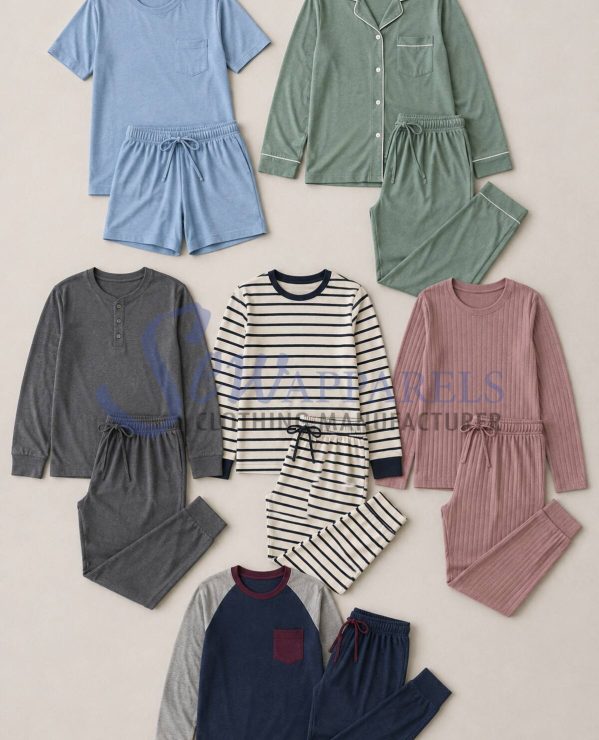
Why top-bottom balance deserves its own specification
A knit pajama set moves as a pair. The wearer sits, bends, turns and sleeps, so small changes in length or width become visible when the top and bottom are viewed together. If the top shrinks more than the bottom, the hem and waistband relationship changes. If the bottom is heavier, it may pull the top during movement. If a print repeat is placed without a panel map, the set can look mismatched even when both pieces are individually acceptable.
The nine checks to approve before bulk production
| Check | What to define | What to inspect |
|---|---|---|
| 1. Matched shrinkage | Length and width change by component | Top and bottom remain proportionate after wash |
| 2. Fabric weight | GSM range and conditioning method | Hand feel and drape stay intentional |
| 3. Fabric direction | Course, wale and maximum stretch direction | Pieces respond consistently in wear |
| 4. Print scale | Repeat width, motif size and artwork file | Pattern reads correctly on both pieces |
| 5. Print alignment | Panel marks, seam joins and placement points | Stripes or motifs do not drift unexpectedly |
| 6. Shade continuity | Colour standard and lot approval | Top and bottom look like one set |
| 7. Fit relationship | Ease, rise, hem and waistband balance | Movement remains comfortable |
| 8. Care response | Wash, dry and measurement checkpoints | Set keeps shape and appearance |
| 9. Approval record | Photos, measurements and revision number | Bulk reference is traceable |
1. How to specify matched shrinkage for knit pajama sets
Matched shrinkage means comparing the top and bottom using the same fabric conditioning, wash route and measurement method. Record body length, chest or width, sleeve or leg length, rise, waistband and hem before laundering. Repeat the measurements after the agreed treatment and calculate the change for each component. The goal is not to force every measurement to be identical; it is to keep the approved proportion between the pieces.
When a buyer asks how to specify matched shrinkage for knit pajama sets, the brief should name the fabric lot, care label, water temperature, drying route, number of cycles and measurement points. Note whether the top and bottom use the same fabric or different constructions. If the bottom uses a rib waistband or cuff, measure the sewn assembly as well as the fabric because recovery and seam tension can change the final result.
AATCC TM135-2025 describes dimensional changes of fabrics after home laundering under defined temperature, agitation and drying parameters. Use the AATCC TM135 laundering reference to structure a comparable fabric check, then repeat the agreed method on the complete pajama set. The standard supports consistent comparison; it does not set a universal tolerance for every brand or silhouette.
2. Control knit pajama sets fabric weight before sampling
GSM affects drape, opacity, warmth, drying time and perceived quality. A top and bottom can share a fibre composition and still feel different if one is knitted heavier, finished differently or conditioned for a different moisture level. Write the target GSM range, test condition, fabric width and whether the result includes or excludes selvage. Do not approve a set only because the colour is correct.
Knit pajama sets fabric weight should be checked on the actual production-intent fabric. ASTM D3776/D3776M covers measurement of fabric mass per unit area and provides different options for full-piece, full-width and small-swatches. Read the ASTM D3776 fabric-weight reference with the laboratory or supplier and select the option that matches the commercial decision. The reported result should identify the specimen and conditioning so a small swatch is not mistaken for the whole lot.
If the design intentionally pairs a lighter top with a denser bottom, record the reason in the tech pack. A warm sleep bottom may need additional weight, while a summer top may need a lighter hand. The decision is acceptable when the set remains comfortable, visually balanced and consistent after washing.
3. Confirm fabric direction and stretch response
Single jersey, interlock, rib and elastane blends can respond differently along the course, wale and crosswise directions. Mark the direction on the fabric card and pattern. Check how the top body, sleeves, trouser legs and waistband are oriented. A rotated panel may change length, recovery or print appearance even when the nominal GSM is unchanged.
Stretch the top and bottom at the same marked points, release them and observe recovery after a defined pause. Check the garment on the body or form in sitting and lying movement. Record whether the bottom pulls the waistband forward, whether the top rides up, and whether the two pieces return to the same visual relationship after movement.
4. Plan print scale before cutting
Print scale should be approved against the finished garment, not only an artwork screen. A small motif may disappear on a large front panel, while a large repeat can be interrupted by a side seam or waistband. State the repeat width, repeat height, motif size, rotation and the parts that must remain free of important artwork.
For an all-over print, show a placement map with top front, top back, sleeve, bottom front, bottom back and waistband. For a placement print, show the distance from neck, hem, pocket or side seam. Keep the same artwork version attached to the sample comments so a later file change cannot be confused with a fabric-balance issue.
5. How to specify print alignment for knit pajama sets
How to specify print alignment for knit pajama sets starts with a decision about where alignment matters. A stripe may need to meet at a side seam; a check may need a controlled match at the pocket; a directional motif may need to face the same way on both pieces. Mark match points on the pattern and allow for seam and shrinkage movement before cutting.
Inspect the printed panels relaxed, on the table and on the form. Review the top and bottom together at the same light source. Note whether the print appears darker on one component because of fabric construction, whether the repeat changes after washing, and whether the intended margin remains visible at the hem. If perfect matching is not required, write that as an intentional allowance rather than leaving the operator to guess.
6. Keep shade and trim decisions connected
Colour continuity is more than a shade name. Approve a physical standard, light source, lot reference and acceptable variation. Compare the top and bottom after printing, washing and finishing because pigment, reactive, discharge and digital processes can change the surface differently. Record the thread, elastic, drawcord, label and packaging colours beside the fabric standard.
Trims can also change perceived balance. A heavy drawcord or thick waistband can pull a lightweight bottom, while a contrast binding can make a top look darker. Approve the complete set rather than treating each trim as a separate purchase decision.
7. Check fit relationship in natural movement
Measure the top and bottom as a set: shoulder and chest ease, body length, sleeve length, waist, rise, inseam, leg opening and hem. Review the base size and at least one adjacent size. Grading can create a balanced base sample but an uncomfortable larger set if the rise, waistband or top length does not move with the same logic.
Ask the wearer or fit model to sit, bend, walk, turn and lie down. Observe whether the top exposes the waist, whether the bottom drags the top, whether the waistband twists and whether the print stays in the intended position. Record comments with the measurement sheet so “make it more relaxed” becomes a specific construction change.
8. Review care response before bulk
Washing may change length, width, skew, print appearance, hand feel and recovery. Record the care label, wash temperature, agitation, drying method and number of cycles. Measure the same points before and after the test. Photograph the top and bottom together so a change in proportion can be seen quickly.
When one component changes more than the other, decide whether the fabric, pattern, finishing or care instruction should be revised. Do not correct the issue by changing only the garment measurement without identifying the cause. A repeatable pre-production check is faster and safer than a bulk correction after cutting.
9. Keep a traceable approval record
A complete approval pack includes the fabric swatches, GSM results, shrinkage measurements, artwork and repeat map, shade standard, size chart, trim list, wash method, photographs and comment history. Number the sample revision and state which decisions are fixed for bulk. Keep the same record with the quotation, purchase order and inspection plan.
Common knit pajama sets top-bottom fabric balance mistakes
The most common knit pajama sets top bottom fabric balance mistakes are approving the top and bottom separately, using a different wash route for each fabric, leaving GSM undefined, changing the artwork file without a revision note, and checking print alignment only on a flat table. Other mistakes include ignoring fabric direction, grading the waist and rise independently, matching shade under different lighting, and forgetting that elastane recovery can change after laundering.
Pause the sample when the two pieces no longer look like one set, when a print drifts beyond the approved margin, when the waistband or hem changes proportion, or when one fabric feels noticeably heavier without an approved design reason. One written decision, one controlled revision and one repeat check usually reduce more risk than multiple informal comments.
Buyer checklist for sampling and bulk
- Confirm composition, knit structure, GSM range and conditioning method.
- Record pre-wash and post-wash measurements for both pieces.
- Define the care protocol and the accepted matched-shrinkage relationship.
- Approve artwork repeat, motif scale, direction and match points.
- Compare shade, print surface, trims and labels under the agreed light.
- Review top and bottom fit in standing, sitting, bending and lying movement.
- Check the base size and at least one adjacent graded size.
- Keep swatches, photos, comments and revision numbers with the bulk reference.
For the connected product-development route, review our Knit Pajama Sets Buying Guides. When you are ready to discuss fabrics, private labels, sampling or repeat production, contact our Custom Knit Pajama Set Manufacturer team.
Final decision
Knit pajama sets top bottom fabric balance should be approved as one coordinated system: matched shrinkage, GSM, fabric direction, print scale, alignment, shade, fit and care response. When those decisions are written into the same sample record, the factory can reproduce the approved comfort and appearance across sizes, colours and repeat orders. This protects the wearer’s experience, reduces late revisions and gives established buyers and startup brands a clear route from one controlled sample to dependable bulk production.
Sample revision and release handover
Keep one release sheet linking sample codes, material lots, artwork and care results. Mark unresolved items as held. When fabric, elastic or printing changes, repeat the affected comparisons on the complete set. Record the accepted revision, reviewer, date and limitations before cutting. Give sourcing, pattern, sewing and inspection teams that same reference so substitutions remain visible.
