
A school cardigan drying shape assessment helps buyers decide whether proposed care instructions preserve the approved garment’s dimensions and appearance under the conditions actually examined. A cardigan can look balanced before washing yet finish with elongated shoulders, uneven fronts or a stretched body after drying. The useful question is not which drying route sounds gentlest. It is which documented route produces acceptable results for this yarn, knit construction, size range and complete garment.
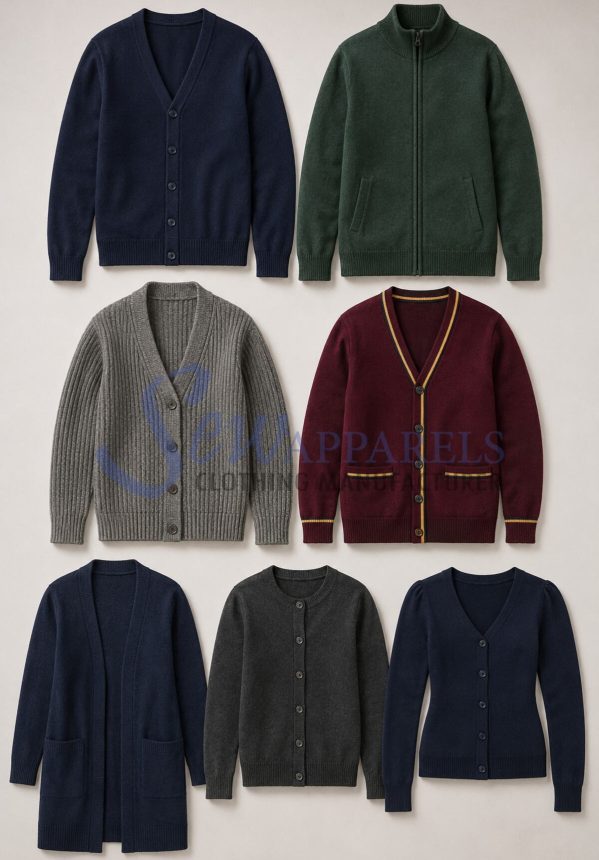
For custom school cardigan manufacturing, drying should be evaluated alongside the wash procedure and sample identity. Record the route, garment position and assessment interval before treatment. Keep the observations tied to a controlled sample rather than turning a favourable pilot into a promise about every fibre or years of wear. The five checks below explain how to build a comparison sheet, separate competing causes and support an instruction decision with whole-garment evidence.
Five critical checks for a school cardigan drying shape assessment
- Measure the approved cardigan before treatment.
- Agree the care routes and handling conditions to compare.
- Separate body stretching from trim recovery.
- Inspect shoulders and front-edge balance after drying.
- Approve instructions using the complete evidence record.
1. Establish a measurable, traceable starting point
Identify the garment style, sample revision, size, yarn reference, knitting program, component references and finishing history. Include buttons, pockets, embroidery and supporting materials in the record. Two samples described as the same cardigan may have different relaxation histories or construction changes. Without these details, a drying comparison can mistake an initial sample difference for an effect of the care route.
For school cardigans cardigan unwashed measurements, establish named reference points and a consistent measurement method. Record body length, chest width, sleeve length, shoulder span, front-band length and hem level. Photographing a sample for the buyer’s internal record can help document shape, but a written observation and the retained sample should still identify the exact assessment state. Agree how the garment will rest before measurements; do not invent a universal waiting period.
A school cardigan body length after care result is meaningful only when its before-and-after points match. Avoid stretching the knit flat to make it resemble the approved dimensions. State whether the cardigan is fastened and how the surface supports it. Record visible asymmetry before treatment, since an existing uneven front cannot fairly be attributed to drying alone.
2. Define comparable care routes before the pilot
A school cardigan flat dry comparison needs a complete route description, including washing, extraction, transfer, support and drying conditions. If one sample is washed differently or handled while wet for much longer, the comparison includes more than garment position. Decide which variables stay constant and which route variable the pilot intentionally changes. Keep separate identifiers for each sample and treatment.
ISO 6330:2021 provides domestic washing and drying procedures for textile testing. Its public abstract describes multiple drying procedures and treats washing together with drying as a complete test. The buyer and laboratory should agree the applicable procedure and parameters; citing the standard alone does not mean this cardigan has been tested or passed an acceptance limit.
For school cardigans yarn care route comparison, first confirm which candidate routes are appropriate to investigate for the actual yarn and assembled garment. Do not expose a sample to an unsuitable treatment merely to obtain a dramatic comparison. A supplier recommendation can inform the plan, but the proposed care wording should be evaluated against relevant evidence and the target market’s requirements.
Use a school cardigans drying garment position record to describe support beneath the body and sleeves, fastening state, hanger type if applicable and any deliberate reshaping. “Dried normally” is too vague to repeat. Where handling is part of the intended instruction, record it precisely so an acceptable result is not dependent on an undocumented intervention.
3. Separate body length changes from local trim recovery
During a school cardigan drying shape assessment, measure the body and relevant trims separately. A ribbed hem may recover while the body remains elongated, or the body may retain its length while the band becomes wavy. An overall impression that the cardigan “looks smaller” does not identify which dimensions changed or whether the change remains within the buyer’s agreed tolerance.
Record school cardigans knit body length care change against the initial reference points, with the treatment and assessment state attached. If a percentage is useful, calculate it from the recorded baseline and identify the sign convention. For example, a hypothetical length of 60 cm becoming 61.2 cm represents a 2% increase. This is an arithmetic illustration, not a recommended tolerance or a result for Sew Apparels.
The school cardigans body stretch versus rib change entry should distinguish body, cuff, hem and band observations. Check whether pulling a recovering hem flat changes the apparent body measurement. Do not use pressing or tension to hide an unfavourable result unless that intervention was already part of the route being assessed and is clearly recorded.
This topic concerns whole-garment drying shape. Rib proportion, button operation and replacement-button quantities answer different development questions. Keeping the school cardigan drying shape assessment focused prevents one evidence sheet from claiming to approve unrelated features. Where several issues appear together, assign each observation to the relevant component or construction decision.
4. Review shoulders, front edges and appearance together
School cardigan hanger distortion should be assessed through identifiable observations rather than assumed from the word “hanging.” Record support location, shoulder contour, sleeve position and any local extension. Compare the treated sample with its own baseline and, when available, a suitably controlled alternative route. Different hanger geometry or wet handling can make otherwise similar routes difficult to compare.
For school cardigans shoulder distortion after drying, inspect both shoulders and note whether the change is local or accompanied by body extension. Review the garment on the agreed assessment surface and, if the plan requires it, on an appropriate form. Do not conceal an uneven shoulder by changing how the cardigan is displayed between before and after assessments.
A school cardigans flat versus hanging observation should identify what was actually seen, such as shoulder peaks, asymmetric fronts or length differences. A small pilot may justify further investigation without proving the mechanism. Avoid attributing every difference to gravity, fibre composition or knit gauge without sufficient evidence to distinguish those explanations.
Include school cardigans front edge balance after care in the same review. Fasten the cardigan as agreed and inspect front lengths, overlap, neckline transitions and hem alignment. If one front is longer, check its starting dimensions, band construction and treatment record before proposing a correction. Appearance assessment should also note twisting, pocket position and changes around decoration.
5. Decide whether the evidence supports the proposed instructions
School knitwear drying approval should combine dimensional results, appearance observations and the limits of the pilot. Define acceptance criteria with the buyer before reviewing results. Do not select a route solely because it performed better than another route: both may still fail the agreed requirements. Identify any unresolved observation and the additional work needed to make a supported decision.
For U.S.-bound garments, the FTC care-labeling guidance explains the need for reliable support for care instructions and consideration of the complete garment. It is a useful reference for school cardigans drying instruction support. Market applicability and the final wording require appropriate review; a successful drying observation alone does not establish compliance with every labeling obligation.
Use school cardigans drying appearance approval to record the decision as accepted, revision required or further evidence required. State which route, sample revision and assessment conditions the decision covers. If an alternative instruction is proposed, confirm its evidence rather than assuming that one acceptable route automatically validates every alternative.
A practical school cardigan drying shape assessment sheet
Create one sheet per sample and route. Keep the fields below consistent across the school cardigans whole garment drying pilot so differences remain visible. This is a planning tool, not a replacement for an agreed laboratory method or buyer specification.
- Identity: style, revision, size, yarn lot and relevant component references.
- Baseline: named dimension points, initial readings and existing appearance observations.
- Care route: agreed wash, extraction and drying procedure, with the intentionally varied parameter.
- Position and handling: body and sleeve support, fastening state, transfer and any permitted reshaping.
- Assessment: resting conditions, measurement method, post-care dimensions and shoulder/front observations.
- Decision: agreed criteria, result, instruction wording, limitations and responsible approval.
If a sample requires revision, retain the original evidence and assign a new revision identity. Change one relevant variable at a time when practical, or state clearly when several changes prevent attribution. A corrected garment should be reassessed through the relevant care route; a visually improved unwashed sample does not resolve the earlier post-care concern.
School cardigan drying shape assessment: buyer questions
Is flat drying automatically the best choice?
No single route is universally suitable for all cardigan fibres, finishes and constructions. A school cardigan drying shape assessment should evaluate suitable candidate instructions for the actual garment. The comparison needs controlled handling and complete evidence, rather than an automatic recommendation based on a generic material description.
Can one successful sample prove long-term stability?
A pilot supports a decision only within its examined conditions. It cannot establish lifetime stability across every wearer, size, yarn lot or household routine. State the coverage and agree any additional sizes, repeated care or production-intent samples needed. Avoid converting limited observations into an unrestricted performance claim.
What should buyers submit for a review?
Provide the yarn composition, construction details, size range, approved measurements, proposed care instructions and existing sample observations. For private label school cardigan production, include decoration, trims and market expectations. These details help separate a measurement problem from an instruction, handling or construction problem before the next sample is requested.
Use a school cardigan drying shape assessment in the development brief
Use the existing School Cardigans Buying Guides library to organise related development decisions without mixing their acceptance criteria. Carry the drying sheet, retained sample identity and instruction decision into the approved brief. Reopen the affected review if yarn, knitting, finishing or relevant components change.
For a manufacturing enquiry, share the controlled brief through the school cardigan product page. A clear school cardigan drying shape assessment gives the development team a repeatable question: does this proposed care route preserve the agreed whole-garment shape under the documented conditions? The answer should come from traceable evidence and explicit limits, not from an unsupported assurance.