
Seamless body vs seamed undershirt sourcing is a manufacturing-route decision, not a shortcut for choosing whichever sample looks smoothest. A body without conventional side seams may come from body-sized circular knitting, continuous tubular fabric or another specialised route, while a seamed undershirt normally uses cut panels joined at the sides. Each route changes the available shaping, size architecture, material choices, sampling evidence and quotation scope.
This guide helps buyers compare those routes without claiming that either construction is always cheaper, more comfortable or more durable. Use the undershirts buying guides for connected development decisions. For product-specific sourcing support, visit the custom undershirt manufacturing page.
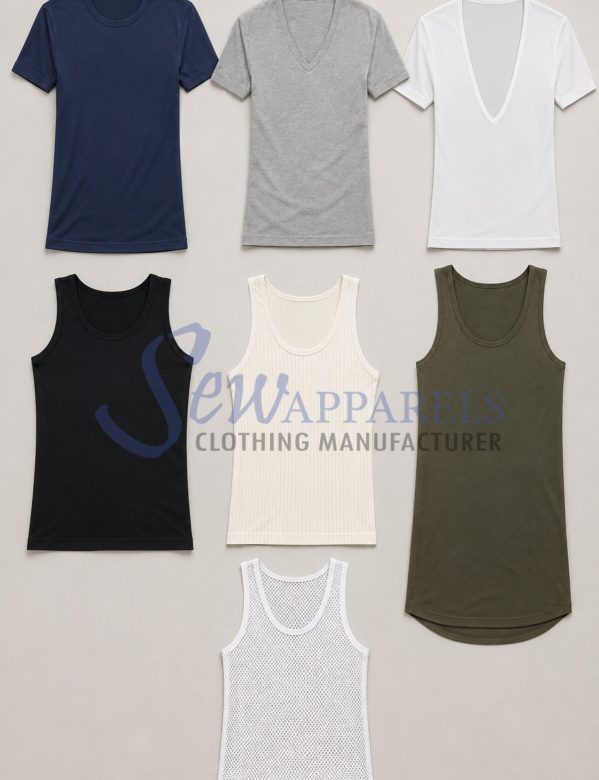
1. Seamless body vs seamed undershirt sourcing terminology
Begin by identifying exactly which seams are absent. A supplier may use “seamless” for a body without side seams even when the shoulders, neckline, armholes and hem still require sewing. Another programme may use a circularly knitted garment piece with engineered zones and fewer assembly operations. The undershirt seamless terminology clarification should list every remaining seam, finish and attachment so the buyer does not compare different constructions under one label.
For seamless body vs seamed undershirt sourcing, request a construction sketch from each supplier. Mark the side body, shoulder, neckline, armhole and hem. State whether the enquiry concerns a finished seamless garment, a tubular body blank or tubular fabric that will still be cut and assembled.
2. Compare the required body silhouette
A straight undershirt body may suit a tube-based route when the circumference and stretch support the intended fit. A shaped cut-and-sew body can use curved side seams, different front and back widths, waist suppression or controlled flare. Record chest, waist, hem, body length, armhole depth and shoulder measurements by size. Seamless body vs seamed undershirt sourcing should reflect the approved silhouette rather than an assumption that fewer seams automatically create better fit.
Use an undershirt shaped side seam option when panel shaping is necessary, and document the undershirt tubular versus shaped panels comparison when both routes remain possible. Review front, side and back balance on the intended wearer or form. Use the undershirt hem length and tuck retention guide for the lower-body fit decision alongside this route comparison. A tube that fits one size well may not reproduce the same proportions across the complete range.
3. Confirm machine diameter and size capability
Circular knitting machinery forms fabric around a cylinder, so machine diameter, gauge, yarn, stitch length and finishing influence the available tube. CottonWorks explains that circular knitting creates a fabric tube and that cylinder diameter and gauge are machine variables. Its seamless-knitting overview also notes that body-sized cylinders can restrict production size ranges. Use this technical background as a question framework, then require the proposed supplier to confirm its actual equipment and route.
An undershirt seamless body size capability statement should identify which garment sizes use which machine or tube, the expected finished circumference and the allowed tolerance. Include an undershirt knitted tube diameter brief with relaxed and conditioned measurements. Do not assume that stretch yarn will compensate for every size or that one tube can serve the entire grade without changing fit character.
4. Separate raw tubular fabric from finished body construction
Tubular raw fabric does not by itself prove that the finished undershirt will have no side seams. A mill may deliver a tube that is slit open, spread, finished and cut into conventional panels. Conversely, a body-sized tube can be cut to length and finished with shoulder, neck, armhole and hem operations. Ask the supplier to map the material from knitting through finishing, cutting and garment assembly.
The undershirt tubular body sourcing record should show whether the tube remains intact. Add the undershirt tube body fabric restriction section for usable fibre blends, structures, gauges, widths, finishes, colours and shrinkage controls.
5. Compare cut-and-sew fit control
Cut panels allow the pattern team to shape front and back pieces independently and adjust the side seam during fitting. They can also support different grading rules through chest, waist and hem. That control still depends on accurate patterns, stable material, cutting quality and sewing. A side seam can twist or become uncomfortable if grain, feed, stitch or finishing is poorly controlled, so the presence of a seam is not evidence of weak quality.
Create an undershirt cut and sew fit control table with pattern revision, point-of-measure targets, seam allowance, stitch type, differential feed and graded observations. Record the undershirt side seam construction choice, including seam class, thread, stitch density, skin-side bulk and stretch expectation. Compare the complete garment after the intended care route.
6. Review materials by route
Do not approve a construction route before confirming that the nominated fibre, yarn, knit structure, weight, stretch, recovery, colour and finish can be produced consistently through it. Seamless circular systems may use specialised yarn placement or stretch to support body mapping and flexible sizing. Conventional cut-and-sew production can use a broader set of available piece goods, but the real options depend on the supplier and programme.
An undershirt body route material options schedule should list confirmed materials, development materials and excluded materials separately. Ask for supplier evidence instead of copying a generic machinery description into the specification. For seamless body vs seamed undershirt sourcing, evaluate the garment route and material route together because a change in one may invalidate the approved fit and costing basis.
7. Request representative samples from both routes
A valid comparison uses samples that match the intended fibre, weight, stretch, finish, size and fit closely enough to answer the buyer’s question. A random seamless sports top and a basic cotton undershirt do not form a controlled comparison. Request a route-specific prototype or a clearly labelled reference with documented differences. Photograph the sample front, side, back and inside, and retain measurements before and after the agreed care process.
The undershirt body construction sample record should identify machine or fabric route, size, material, colour, finishing, seam map and revision. Include pass, conditional and rejected decisions with reasons.
8. Test fit, movement and care performance
Review standing fit, arm elevation, forward reach, dressing and normal body movement. Observe shoulder position, armhole contact, neckline stability, body cling, waist shaping, hem behaviour and any pressure or bulk at seams. Use the same wearer, base layer and conditioning method where practical. Record observations by size instead of declaring one route universally more comfortable.
After the proposed washing and drying cycle, remeasure length and circumferences and review twisting, spirality, seam appearance, recovery and surface change. CottonWorks’ knit-machinery resource explains how circular, flat and seamless systems differ, while its garment-construction resource provides context for seams and stitches. Programme-specific acceptance criteria still need buyer and supplier agreement.
9. Build a size-range route matrix
Map every required size against the proposed construction, material and machine or panel route. If one body-sized tube cannot cover all sizes, ask whether the supplier proposes additional diameters, stretch adjustments, pattern changes or a mixed route. A mixed route may create visible and fit differences that require separate approval. Do not hide those differences inside a single sample status.
The undershirt size range manufacturing route matrix should show base sizes, extreme sizes, fit blocks and required samples. It should also state whether the route changes across the range.
10. Verify supplier capability before costing
Ask which operations the supplier controls directly and which are subcontracted. Request the machine type or fabric source, gauge or construction range, available diameters, finishing route, sample lead process and quality controls relevant to the proposed item. Capability evidence may include current material swatches, representative garments, measurement records and a process map. It should not require disclosure of confidential customer information.
An undershirt construction supplier capability file should distinguish confirmed capacity from a future development proposal. If a supplier cannot confirm the specified seamless route, request an alternative rather than implying that a conventional tubular fabric equals a body-sized seamless garment. No quotation should promise technology, comfort or fit that has not been demonstrated for the actual programme.
11. Make route-specific quotations comparable
Issue the same commercial brief but allow each route to list its distinct cost drivers and exclusions. Provide silhouette, measurements, size ratio, material, colours, labels, packaging, testing, quantity and destination. Ask for sampling, material commitment, minimum quantities, production lead assumptions and any size-dependent route changes. Avoid comparing only the unit price when development, material or machine commitments differ.
The undershirt seam free body quotation should state exactly which body seams are removed and which sewing operations remain. Request a separate cut-and-sew option when technically feasible. Keep unconfirmed taxes, freight and testing outside the comparison until their basis is known. Seamless body vs seamed undershirt sourcing becomes a commercial decision only after the technical scope is aligned.
12. Low MOQ undershirt manufacturer planning
A low MOQ undershirt manufacturer enquiry should begin with confirmed material and machine availability. Special body-sized tubes, colours, yarns or finishes may create different minimum commitments from stocked piece goods, while a cut-and-sew route may offer another allocation structure. Ask the supplier to state the actual minimum by construction, colour and size rather than assuming that one route is automatically suitable for a small launch.
13. Development support for startup brands
For private label undershirt production, Sew Apparels reviews garment feasibility using supplier-made fabrics. It does not manufacture fabric or claim an owned seamless-knitting line. Confirm the proposed supplier’s machine route, material availability, development charges and order conditions. Provide the target wearer, body silhouette, measurements, material direction, size range, colours, quantity and destination before requesting route approval.
14. Complete the sourcing decision sheet
The undershirt body sourcing decision sheet should include seam definition, route description, machine or fabric basis, silhouette, measurements, sizes, material options, finishing, sample evidence, care results, capability confirmation, minimums, lead assumptions, quotation exclusions and approval owner. Add links to the current technical pack and sealed sample references. Use one version number and one status field for each route.
For seamless body vs seamed undershirt sourcing, score only criteria the buyer has defined and keep critical failures visible. A total score should not allow an unavailable size or unconfirmed machine route to disappear behind good marks elsewhere. Record the chosen route, the rejected alternative and the evidence supporting the decision.
15. Avoid common sourcing errors
Common errors include using “seamless” without a seam map, treating tubular fabric as proof of a seamless finished body, ignoring machine diameter, approving only one size, comparing different materials, assuming comfort or cost superiority, and accepting a quotation without route-specific exclusions. Another mistake is asking suppliers to copy a sample without providing measurements or expected care performance.
16. Final seamless body vs seamed undershirt sourcing gate
Approve the route when the seam scope is unambiguous, the silhouette and complete size range are feasible, material options are confirmed, representative samples have been reviewed, care-state fit is acceptable, supplier capability is evidenced and quotations use the same commercial brief. Document unresolved conditions before any commitment. The deliverable should be a body-construction comparison sheet covering seam scope, shaping, sizes, materials and confirmed capability.
Seamless body vs seamed undershirt sourcing works when buyers compare like with like and preserve the decision trail. Review our undershirt manufacturing service, then share your silhouette and size range for a quotation with the proposed construction route clearly identified.