
Tracksuit matched set wash change comparison checks whether a jacket and trouser still work as a coordinated product after the intended care routine. One piece can shorten, change shade or develop a different surface appearance while the other remains closer to its starting condition. Reviewing only individual pass results can miss a visible imbalance in the complete set.
A tracksuit jacket/trousers shrinkage comparison needs separate measurements for both garments and a paired appearance decision. Tracksuit set wash appearance parity matters too: matching fabric names or nominal weights do not establish identical after-care behaviour. A jacket may contain facing, zipper tape and rib that influence its shape, while trouser proportions, waistband and knee areas create a different construction.
This guide explains six checks for sportswear brands, clubs and sourcing managers. It covers starting references, controlled care, directional dimensional change, shade and surface comparison, divergent results and paired sample release. The review should represent the production-intent set and the buyer’s intended use, rather than an unspecified wash that happens to produce an attractive sample.
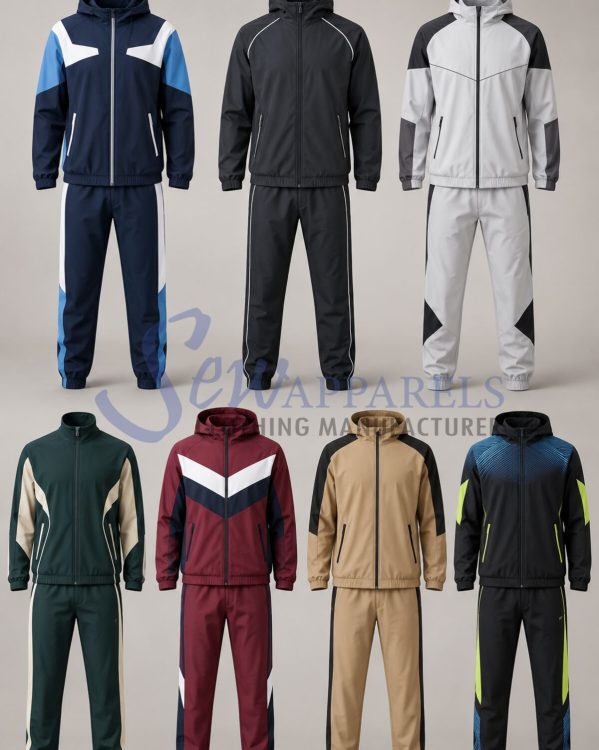
1. Establish tracksuit matched set wash change comparison baselines
Define the tracksuit matching pieces care trial by identifying the exact jacket and trouser pair. Record style and pattern revisions, material codes, colour lots, trims, decoration and sample size. State whether the pieces share a material or use coordinated fabrics with different constructions. Keep those distinctions visible so the team does not describe a combined result as evidence for an untested substitution.
Create a jacket/trouser measurement reference at named landmarks using the agreed preparation and placement. Jacket points may include body length, chest, sleeve and hem, while trouser points can include waist, rise, inseam, hip and leg opening. Choose points relevant to the specification and record how elasticated areas are measured. Do not mix relaxed and stretched measurements without identifying their conditions.
For tracksuit matched set wash change comparison, photograph the new versus washed set consistently, with each piece also shown separately. Use consistent light, viewing distance, garment positioning and camera settings as practical. Include the zipper line, rib joins, stripes, decoration and the relationship between jacket hem and trouser waist on the intended wearer.
Retain an unwashed reference pair or another agreed physical reference where the evidence plan requires it. Mark its identity and protect it from accidental care or wear. A memory of the original navy shade or jacket length is not an adequate baseline for a later approval meeting.
Record the starting condition
Note any previous handling, pressing or storage that may affect appearance. If a sample has already been washed, it should not be described as new. Use the appropriate baseline for that state and keep it distinct from an unwashed comparison.
2. Use a defined care routine for both pieces
ISO 6330:2021 provides domestic washing and drying procedures for textile testing. Its public scope covers fabrics and garments, includes reference detergent and ballast provisions, and notes that equipment and other parameters can affect results. A complete test includes washing and drying. Ask the laboratory to identify the selected procedures and conditions rather than reporting only that a set was washed.
In tracksuit matched set wash change comparison, confirm that both pieces’ same care routine is appropriate for their materials and the intended label instructions. Record cycle count, washing procedure, drying method and relevant preparation. If the jacket and trouser require incompatible care, resolve the product brief or explicitly document that difference instead of exposing one piece to an unsuitable routine merely to create a common test.
Decide whether the comparison uses the pieces in the same load or separately under equivalent controlled conditions. Record the arrangement, load composition and any relevant differences. Washing together can reveal interactions, while separate treatment can help investigate a difference. Neither arrangement should be silently substituted for the approved evidence plan.
Do not invent a generic temperature, drying setting or cycle count for all tracksuits. The technical team should choose the route for the actual materials, trims and care claim. A workshop comparison must not be labelled as an ISO test unless the applicable procedure has genuinely been followed and documented.
Preserve treatment history
Give each care stage an identifier and record when it occurred. Keep the same sample identity through washing, drying, conditioning and assessment. If a sample receives extra pressing or an additional cycle, record it so its results cannot be confused with the planned sequence.
3. Compare directional dimensional change separately
ISO 5077:2007, which ISO lists as confirmed in 2022, concerns dimensional change after appropriate specified washing and drying procedures. It applies to fabrics, garments and other textile articles. The reference supports an appropriate measurement plan, but it does not establish a universal acceptable percentage or prove that this tracksuit has passed.
During tracksuit matched set wash change comparison, remeasure the selected points after the agreed drying and conditioning. Use the same landmarks, preparation and measurement method as the baseline. Keep a directional shrinkage record with length and width directions separate. A shortened jacket body and a widened trouser waist should not disappear into an average called overall shrinkage.
For an illustrative jacket/trouser dimensional change calculation, subtract the starting measurement from the final measurement, divide by the starting measurement and multiply by one hundred. A fictional jacket length changing from sixty to fifty-eight centimetres gives about minus 3.3 percent, indicating a reduction in that measurement. If a fictional trouser inseam changes from eighty to seventy-nine centimetres, the result is minus 1.25 percent. These are examples, not Sew Apparels test results or pass limits.
For tracksuit after-wash set balance, the two percentages describe different garment points. Do not subtract them and call the result the set’s physical mismatch without explaining the relationship being assessed. Compare each point with its own specification, then judge whether the changed proportions still meet the paired appearance and fit brief.
Keep measurement uncertainty visible
Small differences can depend on placement, tension or the person measuring. Use a consistent method, appropriate repeats and agreed tolerances. If the difference is close to the decision boundary, investigate the repeatability instead of treating every decimal as exact evidence.
4. Assess paired shade, surface and proportions
For paired shade change assessment, place the cared jacket and trouser together under the agreed viewing conditions. Compare them with their own starting references and with each other. Note body panels, sleeves, hood if present, rib, waistband and stripes. The review needs to show whether both pieces changed similarly or one now looks noticeably different.
Include a set surface change comparison in tracksuit matched set wash change comparison. Record fuzzing, pilling, flattening, sheen changes, seam distortion and decoration condition as relevant. Similar measured dimensions do not guarantee a coordinated appearance if the jacket develops a different texture from the trouser. Describe observed changes precisely rather than assigning every surface issue to shrinkage.
Check the complete set on a suitable wearer when proportions and fit are part of approval. Observe jacket hem position, sleeve length, trouser length, waist relationship and mobility. A jacket that still meets its own minimum length can look unbalanced against a trouser that changed less. Photograph the same front, side and back views used at the baseline.
A dimensional-change method does not automatically grade shade or pilling. If the buyer needs standardised evidence for those properties, the technical team should select the relevant methods and report their scope separately. Keep the visual paired comparison as an identified review, with agreed references and decision criteria.
5. Investigate divergent components before revising both pieces
A useful tracksuit matched set wash change comparison supports divergent component investigation by identifying where the difference starts. Check whether a jacket front is affected by zipper tape, facing or rib rather than assuming the shell alone caused it. Inspect whether trouser leg change follows fabric direction, seam construction or a different material lot.
Review the component list and process history. Compare material finishing, pattern placement, sewing conditions and any relevant pressing before care. Review tracksuit zip-front waviness prevention when the front distorts. If a trim and shell respond differently, changing both fabrics may be an unnecessary correction. Keep the investigation linked to the specific observations that prompted it.
Use targeted revised samples when a cause is plausible. If only rib is changed, record that revision and repeat the affected care and fit checks. If several components change together, state that the result evaluates the combined revision. Do not claim the trial isolated a single cause when it did not.
In tracksuit matched set wash change comparison, retain the earlier sample and record alongside the revised one. This lets the buyer see whether the correction addressed the original issue without introducing another imbalance. A visually improved new sample still needs a traceable care history and measurement record.
Keep failures distinct from preferences
A result outside the agreed specification is different from a buyer’s preference for a looser silhouette. Record both clearly. If the specification changes after the review, preserve the reason and new approval rather than retroactively describing the original result as passing the old requirement.
6. Release the paired sample with complete evidence
Complete tracksuit matched set wash change comparison with separate garment findings and a final paired-set decision. State which sample identities, sizes, colours and care conditions the evidence represents. Record set appearance acceptance, revision or further investigation against the pre-agreed criteria. Avoid extending one pair’s result to every untested material or colour combination.
For custom tracksuit manufacturing, bring the paired material references, measurement specification, care brief and appearance criteria into development. Startup teamwear brands can keep an initial range focused while still approving the complete set. Private label tracksuit production needs a clear sealed jacket and trouser record, with commercial quantities and sampling options confirmed for the actual enquiry.
For complete set care evidence, archive baseline and cared photographs, point measurements, care-stage records, report references, component revisions and the buyer’s release decision. Keep care wording connected to the approved product evidence. If a later order substitutes fabric, rib, zipper or decoration, review the affected checks before carrying forward the earlier set approval.
Questions buyers should settle before testing
Must the jacket and trouser shrink by exactly the same percentage?
Not necessarily. They have different dimensions and functions. Agree individual limits and the acceptable paired balance before testing. Matching one percentage does not prove that the complete set has retained its fit or appearance.
Can two individual passes replace paired approval?
No. Individual results can support release, but the coordinated set still needs review against the buyer’s intended proportions, shade and surface appearance. Keep the two decisions visible in the final evidence package.
Is an unwashed photo enough for a colour comparison?
A photo can support the record, but its appearance depends on lighting and capture conditions. Use the agreed physical references and controlled viewing arrangement where a shade decision matters. Do not promise colour accuracy from an uncontrolled image alone.
Bring paired care into the production brief
Tracksuit matched set wash change comparison turns separate garment observations into a coordinated approval. Keep the baseline, care routine, directional measurements, paired appearance and revision history together. The Tracksuits Buying Guides connect this review with fabric selection, rib commitments and replacement-piece control so the set remains one coherent product through development and repeat orders.