
Undershirt perspiration colourfastness testing begins with a practical risk: a dark base layer may change shade or transfer colour to a light shirt, lining, label or trim when moisture and friction are present. Buyers need to separate colour change on the undershirt from staining on adjacent material, because the two observations answer different quality questions.
This guide helps private label undershirt production teams build a traceable request for perspiration, rubbing and care-related evidence without treating fibre content or a dark shade as proof of performance. Use the undershirts buying guides for related development decisions. For product sampling and quotation support, visit the custom undershirt manufacturing page.
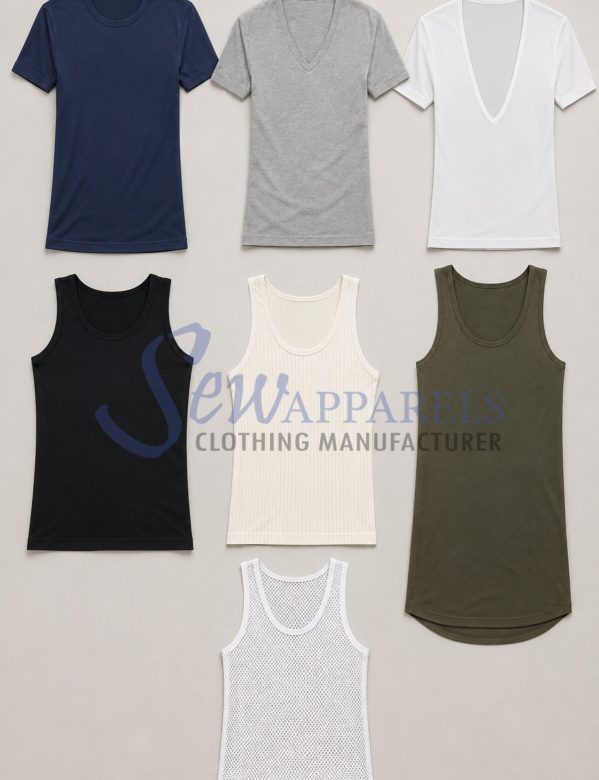
1. Define the actual colour-transfer risk
Record the undershirt colour, fibre blend, knit structure, finished weight, dye or finish route, intended outer garment, wearer activity, climate and care instruction. A black cotton-rich base layer beneath a white business shirt creates a different contact system from a pale undershirt beneath a dark uniform. State the commercial concern before selecting any laboratory method.
The dark undershirt colour transfer question should identify where contact occurs: neckline, armhole, shoulder, side seam, waistband or the whole body. Note whether the expected moisture comes from perspiration, washing, damp storage or another defined condition.
2. Separate colour change from staining
Colour change describes what happens to the tested undershirt specimen. Staining describes colour transferred to an adjacent reference fabric or another named material. A report can show acceptable shade retention while still recording undesirable transfer, or the reverse.
An undershirt colour change versus staining table should preserve the method, scale, exposure condition, original shade, result and acceptance decision in separate columns. For undershirt perspiration colourfastness testing, ask the laboratory to explain which ratings concern the test specimen and which concern each adjacent fibre or material.
3. Map every adjacent material
A standard multifibre adjacent fabric can provide structured evidence, but the buyer may also care about a specific white shirting, printed lining, elastic, label or trim. List the materials likely to touch the undershirt during wear and care, then ask a qualified laboratory which standard and supplementary evaluations are suitable. Keep standard evidence and product-specific observations clearly labelled.
The undershirt test adjacent fabric field should name the reference material, fibre composition, colour, construction, supplier code and specimen orientation. For undershirt adjacent garment staining, retain a sample or controlled description of the actual outer layer so development comments do not depend on memory or an untraceable photograph.
4. Distinguish perspiration from rubbing
Perspiration exposure and rubbing are related commercial risks but different test questions. One examines colour behaviour under defined perspiration conditions; another examines transfer caused by controlled rubbing. A successful result in one category does not automatically prove the other. Use the undershirt moisture management test brief for absorption, transport and drying questions; these are separate from colour transfer. The intended wearer, contact pressure, moisture state and outer fabric determine why both may be relevant.
The undershirt dry wet rubbing distinction must remain visible in the request and report. An undershirt wet rubbing test may expose transfer that is not apparent in a dry evaluation, while a perspiration procedure uses its own specified preparation and assessment. Ask the laboratory to select current applicable methods rather than copying an old method number without review.
5. Write a complete laboratory request
An undershirt perspiration colourfastness testing request should identify the style, colourway, material code, production stage, destination market, intended care route, contact materials and commercial decision. Include the exact report fields required, who may approve deviations and whether original photographs or tested remnants must be returned.
The undershirt perspiration lab request should state that the laboratory must confirm the current method designation, edition, specimen preparation, exposure conditions, adjacent material, rating scales and any limitation. Do not instruct a laboratory to claim suitability for every market or end use when the evidence covers only a defined specimen and condition.
6. Control specimen identity and conditioning
Connect every tested specimen to the approved product. Record supplier, fabric code, fibre content, yarn details where relevant, knit structure, finished weight, finish, colour standard, dye lot, date, wash status and face or back orientation. If the tested material differs from the nominated production fabric, label the result as development evidence rather than bulk approval.
For an undershirt perspiration staining report, request the laboratory name, report number, test date, specimen identification, conditioning, method, results and observations. CottonWorks notes that reliable textile testing depends on proper sampling and conditioning; use that principle to reject unlabelled swatches and screenshots detached from the original report.
7. Build a colourway test matrix
Testing every possible combination may be impractical, but selecting only the lightest shade can miss the highest transfer risk. List all proposed colours, dye routes, lots, finishes and adjacent materials. Ask the laboratory or technical specialist to justify the chosen representatives and state which decisions the evidence can support.
An undershirt colourway test matrix should show proposed shade, material source, finish, test stage, perspiration condition, dry and wet rubbing scope, adjacent fabric and status. The undershirt dark shade report scope should identify whether black, navy, deep red or another nominated colour was actually tested rather than assuming one dark shade represents all recipes.
8. Keep care conditions connected to the claim
Colour behaviour can change after washing, drying, finishing or repeated care. Define whether evidence is required before care, after one cycle, or after a stated sequence that reflects the intended label. Preserve water temperature, detergent or process details where relevant, drying route and conditioning so the test state can be reproduced.
The undershirt dye transfer care conditions section should distinguish wear-related exposure from laundering and damp-contact risks. The US FTC’s Care Labeling Rule guidance states that care instructions and warnings need a reasonable basis, and it gives “wash with like colors” or “wash separately” as examples where a product is not colourfast. Applicable requirements still depend on product and market.
9. Undershirt perspiration colourfastness testing: review report ratings
Ratings must be interpreted against a documented requirement. Record the numerical or descriptive result exactly as issued, the scale direction, individual adjacent-fibre ratings, colour-change rating, test conditions and uncertainty or qualification.
The undershirt staining result review should flag the lowest relevant rating, not hide it inside an average. For undershirt perspiration colourfastness testing, do not infer acceptance from fibre blend, country of origin, supplier reputation or visual inspection. Evidence must relate to the proposed shade, finish, specimen and commercial use.
10. Undershirt perspiration colourfastness testing: set acceptance criteria
Agree the acceptance basis with the buyer’s technical team before samples reach the laboratory. The criterion may depend on method, product type, colour depth, intended outer garment, destination market and retailer requirement. Avoid creating a universal threshold in an article or copying a number from an unrelated programme.
The undershirt colourfastness acceptance record should name the responsible approver, required ratings, conditional rules, retest route and consequences of failure. If the supplier proposes an exception, document the actual result, commercial reason, affected quantity and signed approval rather than silently changing the target after testing.
11. Approve the sample with its evidence
Visual shade approval and colourfastness evidence are complementary. A colour can match the standard yet transfer under moisture, or perform well in testing while missing the approved hue. Link the lab dip, finished swatch, development garment, report and current technical pack so each decision refers to the same material revision.
The undershirt colourfastness sample approval file should contain the sealed shade standard, tested specimen code, report, comments, care state and approval date. Preserve undershirt approved colour evidence by colourway and lot where required, and state when bulk verification will occur. Do not reuse a report after a material, recipe or finish change without technical review.
12. Investigate a result before correcting production
If staining or colour change is unacceptable, isolate the affected colourway and confirm specimen identity first. Review dye selection, fixation, rinsing, finishing, contamination, pH, lot control and care state with qualified technical teams. Do not prescribe one universal chemical correction, because the appropriate action depends on the material and process.
Repeat undershirt perspiration colourfastness testing only after the correction is documented and the new specimen is uniquely labelled. Retain failed and corrected evidence together.
13. Low MOQ undershirt manufacturer planning
A low MOQ undershirt manufacturer enquiry still requires colour evidence, but the plan should focus on confirmed commercial options. Reduce unnecessary colour variation, nominate one fabric and finish route, and identify the darkest or most critical combinations early. Ask which reports already exist and whether their specimens match the proposed production material.
Share quantities, colours, size ratio, destination market, outer-garment contact, care wording and approval criteria before quotation. A small order does not justify unsupported colourfastness claims or missing traceability.
14. Development support for startup brands
Undershirt perspiration colourfastness testing can be planned efficiently for startup brands when the first collection uses a controlled colour palette and one responsible approval file. Separate essential launch shades from later options, choose representative risks with technical input and keep all results attached to the exact swatches.
A startup should avoid promising “no colour transfer” without suitable evidence. Use precise, conservative wording and preserve unresolved questions. Sew Apparels can discuss feasibility subject to confirmed material availability, development charges and order conditions. Qualified laboratories and market specialists should address test interpretation and regulatory decisions.
15. Use authoritative quality principles
CottonWorks defines colourfastness as resistance to colour change and transfer of colorant to adjacent materials during processing, testing, storage or use. Its quality-testing resource also explains that colourfastness assessments commonly compare specimens before and after exposure and that reliable testing depends on sampling and conditioning.
Ask the laboratory and buyer’s quality team to confirm the current methods, report format and decision rule for the actual programme.
16. Final colour-transfer evidence gate
Approve the colour brief only when the nominated colourways and adjacent materials are identified; perspiration, rubbing and care questions are separated; specimen identity is traceable; methods and rating scales are recorded; colour change and staining are reviewed independently; acceptance criteria were agreed; and any exception is signed.
Undershirt perspiration colourfastness testing is useful when every rating remains connected to its sample and condition. The final deliverable should be a colour-transfer request matrix pairing undershirt colourways with contact materials, moisture conditions, care states, required evidence, results and approval status.
17. Prepare the supplier handoff
Send the supplier the colour standards, fabric codes, outer-layer examples, care route, test matrix, required report fields and approval owner. Request confirmation of sample availability, laboratory route, timing and exclusions. State that substitutions, dye-recipe changes or finish changes require documented review before production proceeds.
For final undershirt perspiration colourfastness testing approval, archive the request, quotation, tested swatches, complete reports, decisions and bulk follow-up in one controlled folder. Review our undershirt manufacturing service, then share your colours and outer layers for quotation with the evidence request clearly identified.