
Baby romper wholesale carton allocation turns an approved order into an identifiable packing plan. The task is to show which size and colour goes into each shipping carton, how the counts reconcile with the purchase order and what happens when the actual packed quantity differs from the plan.
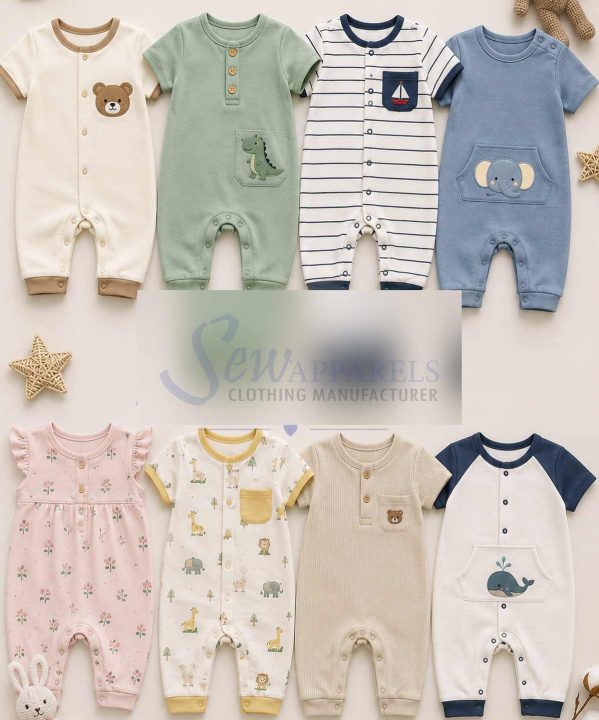
This guide explains baby romper wholesale carton allocation through five checks. Define the retailer’s received unit, separate garment variants from cartons, build an assortment matrix, reconcile quantities and document exceptions. A carton total alone does not demonstrate that the buyer will receive the correct variant mix.
1. Define baby romper wholesale carton allocation units
Start with the purchase order and the retailer’s current packing instructions. Identify whether the buyer receives individual garments, defined retail packs or another approved unit. A shipping carton can contain several units, so the order quantity and carton quantity must not be treated as interchangeable.
The baby romper retailer pack unit entry should state the unit name, its contents and the quantity basis used by the buyer. If an order is expressed in packs, record how many garments each pack contains. If it is expressed in pieces, keep that piece count visible throughout the packing records.
For infant romper purchase order packing, confirm the style, size and colour references accepted by the buyer. Use the same identifiers in the order, allocation plan and packing list. Keep the accepted material and style choices from baby romper knit versus woven range planning distinguishable when those variants enter the carton matrix; a shared size or colour does not make them the same ordered item. Similar colour descriptions should not be treated as equivalent without checking their actual references.
Confirm whether the retailer requires solid-size cartons, mixed-size cartons or another defined assortment. These are possible planning configurations, not a claim that every supplier offers them. Ask the packing team to assess the requested arrangement and its documentation needs before approval.
Keep the received-unit definition attached to baby romper wholesale carton allocation. An instruction such as “ten per carton” is incomplete when the team does not know whether ten means garments or retail packs. Resolve that ambiguity before issuing the packing plan.
2. Separate variants from shipping cartons
A romper variant shipping identity should identify the actual garment or approved retail unit. Record style, size, colour and any other distinguishing order attributes. The carton reference identifies the shipping container; it does not replace the identity of the products inside it.
For baby romper mixed size case planning, state the count of each size within the case. If colours are also mixed, define the size-colour combination separately. A total that matches the required carton capacity can still contain the wrong assortment.
The GS1 GTIN Management Standard distinguishes trade-item and packaging levels. Within the GS1 system, changes to case quantities and predefined assortments can require new identification at the affected levels. The responsible team should assess the actual configuration under the relevant rules; a carton serial reference should not automatically be treated as a trade-item identifier.
For baby romper wholesale carton allocation, confirm which identification system the trading partners use and who supplies the approved references. Keep an internal style code, a trade-item identifier and a shipment-specific carton number in separate fields where each is relevant.
If a proposed assortment changes, do not reuse an earlier description without review. Update the contents and ask the responsible team whether its trade-item records also need revision. A corrected packing list and correct product identification are related tasks, but one does not automatically complete the other.
3. Build the approved carton assortment matrix
A romper shipping assortment matrix should contain one clearly defined row for each allocation entry. Include the purchase-order line, variant reference, planned quantity, carton reference and planned packed count. If several variants share a carton, show those entries against the same carton without losing their individual identities.
The romper size colour carton allocation should use the approved order quantities. Begin with the size-colour totals and then distribute them into the requested carton arrangement. Do not change the order mix merely to make every carton look identical.
For baby romper wholesale carton mix, distinguish a repeating carton configuration from an individual carton record. A standard assortment can be referenced for several cartons, but the actual cartons still need identifiable records and verified counts. The final document should reveal which cartons follow that configuration.
The romper assortment packing instruction should specify the approved contents, any relevant unit packaging and the method for recording checks. Assign an owner for resolving uncertainty. A packing operator should not have to decide an unapproved substitution from an informal message.
Use baby romper wholesale carton allocation to review the complete proposed shipment before packing begins. Check that each order variant has an allocation and that every planned carton has defined contents. This review helps expose missing rows without pretending that the goods have already been physically verified.
4. Reconcile packed quantities with the order
Romper carton count reconciliation needs both variant totals and carton totals. Add the packed count for each size-colour reference across all cartons, then compare it with the approved purchase-order quantity. Also confirm that each carton’s individual entries add to its stated contents.
A baby romper packed quantity audit should use actual recorded counts. A completed plan is not evidence that the same quantities were packed. Record who checked the contents, which packing-list revision was used and how any discrepancy was handled.
For romper bulk delivery size split, review shortages and excesses by variant. An extra garment in one size does not automatically compensate for a missing garment in another. Ask the buyer to approve any change to the order mix rather than silently offsetting differences in the grand total.
In baby romper wholesale carton allocation, compare the order, allocation matrix and final packing list on the same unit basis. If the order uses retail packs and the packing team records pieces, show the conversion clearly. Do not allow a unit mismatch to appear as a quantity discrepancy or to conceal one.
Keep counts separate from physical carton measurements. Weight and dimensions may be needed for the shipment, but they do not independently prove the size-colour assortment. Verify and record each required input through the agreed process.
5. Record partial cartons and approved exceptions
A romper partial carton record should state the actual contents of a carton that does not follow the standard quantity. Identify its carton number, variant counts and reason for the difference. Avoid using a standard assortment label when the recorded contents differ from it.
For romper packing exception approval, record the proposed change, the approving party and the affected order lines. Keep the original requirement visible beside the approved exception. A supplier note describing a change does not establish that the buyer accepted it.
The baby romper carton reference should remain unique within the agreed shipment records. When contents are repacked, update the affected records together. A carton with a reused description and revised physical contents can create confusion during receiving.
Baby romper wholesale carton allocation should make partial cartons easy to recognise on the final packing list. Confirm the retailer’s instructions for their identification and handling. Do not invent a universal label format or assume that the retailer accepts every proposed exception.
Before release, check that the final list matches the physically approved packing state. Unresolved differences should have an assigned action rather than disappear into a general “complete” status. Shipment documentation should describe what is actually ready to deliver.
A worked allocation example
The following figures are fictional and illustrate reconciliation only. Suppose an order contains 24 blue rompers in size A and 12 blue rompers in size B, all counted as individual garments. The buyer approves a mixed carton containing four size-A pieces and two size-B pieces.
Six cartons of that approved configuration account for 24 size-A pieces and 12 size-B pieces, or 36 garments in total. The matrix would identify each carton and show its two variant entries. The example does not prescribe a commercial carton capacity, a minimum order or an arrangement currently offered by a factory.
If one carton is found to contain three size-A pieces and three size-B pieces, its total remains six. However, the shipment now contains 23 size-A pieces and 13 size-B pieces. A grand-total check alone would miss the difference. Reconcile each variant, correct the physical packing or obtain an approved exception, then refresh the record.
For baby romper wholesale carton allocation, this simple calculation shows why totals must be reviewed at more than one level. The final check should answer both “How many garments are packed?” and “Which ordered garments are packed?” Keep those questions separate until both agree with the approved order.
Keep traceability information connected
An infant romper carton master can link carton contents with relevant production references. Identify the batch or run records associated with the garments where required by the agreed process. A shipping number alone does not establish the production source of every item inside the carton.
The CPSC tracking label guidance describes identifying information for children’s products and packaging to the extent practicable, including production location, date and batch or similar references. Carton allocation records can support the organisation of related information, but they do not replace applicable product and packaging marks or prove compliance with other safety requirements.
Keep the commercial packing identity and production-source information distinguishable. If several production runs are included in one shipment, the records should make their relationship to the packed goods understandable. Ask the responsible team which records and markings are required for the actual market and product.
Questions buyers often ask
Is a matching shipment total enough?
No. Check the quantity for every ordered variant and the contents of each carton. An excess in one size can hide a shortage in another when only the total garment count is reviewed.
Can partial cartons use the standard assortment description?
The documentation should state their actual contents. Follow the retailer’s agreed instructions and record any exception. A familiar description should not imply that an incomplete carton contains the full standard assortment.
Does a carton number replace a garment identifier?
It identifies a shipping container within the agreed records. Keep the contents’ variant and any relevant trade-item or production references separately identifiable. Confirm the required identification approach with the trading partners.
Prepare the packing brief
For custom baby romper manufacturing, share the retailer purchase order, received-unit definition and proposed carton matrix. Buyers planning private label baby romper production can include their unit packaging and identification requirements in the same brief. Packing feasibility, documentation scope and commercial terms need confirmation for the project.
Explore the related baby romper buying guides for other development decisions. Keep the final baby romper wholesale carton allocation record with the approved order and checked packing list. Accurate variant counts, identifiable cartons and documented exceptions give the receiving team a clearer account of the shipment.