
Baby romper knit versus woven range planning helps a buyer decide why each romper belongs in a collection. A knit and a woven option should not be added simply to fill two fabric categories. Each needs a clear wearer occasion, a defined appearance and a development brief supported by physical samples.
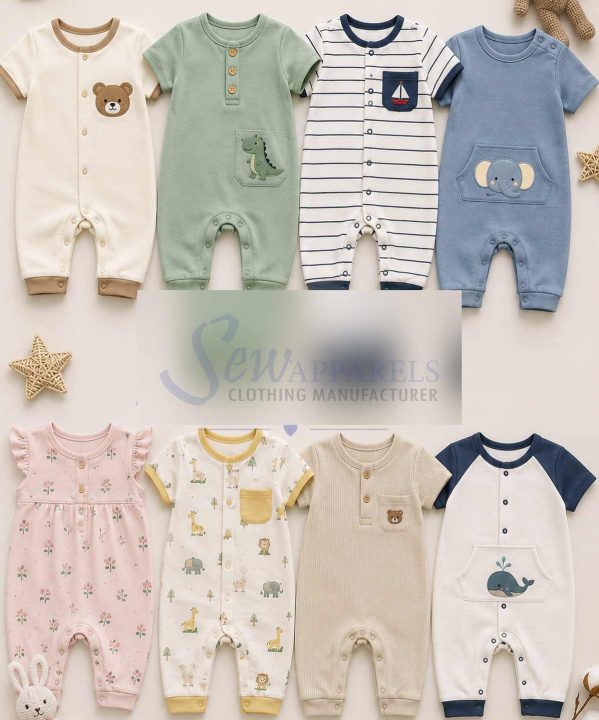
This guide approaches baby romper knit versus woven range planning through five decisions: assign collection roles, compare sample hand and movement, record care expectations, identify fit-development needs and remove unnecessary duplication. Fabric construction alone does not establish that a garment is safer, cooler or softer. The actual material, design and evidence matter.
1. Define baby romper knit versus woven range planning roles
Begin with the collection’s intended customer, age range and season. Describe what each proposed romper is meant to offer. A daily outfit, a dressed-up collection piece and a coordinated gift option may have different design briefs, but these roles should reflect the brand’s actual plan rather than assumed consumer demand.
For knit woven romper assortment roles, write one sentence explaining the reason to include each style. Identify the appearance, use context and relationship to other products in the range. If two options have the same explanation, investigate whether their differences are meaningful to the buyer.
A baby rompers knit woven occasion comparison should compare actual proposals. Show the chosen materials, garment drawings and relevant samples together. A knit category can contain different structures and finishes; a woven category can also include very different fabrics. Avoid reducing either to a single performance promise.
The infant romper seasonal range brief should state the intended launch period and selling markets. Season is a planning input, not proof that a particular material provides suitable thermal performance. Ask the development team which evidence is needed for the actual garment and any intended claims.
Keep these roles visible in baby romper knit versus woven range planning. They guide which samples deserve development effort and which questions matter during review. A clear role also helps the team avoid adding another colour or fabric version without a defined reason.
2. Compare hand and movement on physical samples
For baby rompers physical fabric comparison, obtain identified samples of the proposed materials. Record the supplier reference, composition information, construction, finish and any other agreed specification. An unlabelled swatch can create confusion when the team requests a garment sample later.
The baby rompers knit romper sample hand discussion should describe what reviewers actually observe. Consider the agreed appearance and handling requirements rather than using a broad word such as “premium.” Keep subjective preferences separate from measured properties and from claims that would require substantiation.
Use a baby romper material comparison matrix to record both proposals on the same basis. Include the sample reference, visual appearance, handling observations, intended garment role and open development questions. Record who reviewed the samples and whether the observations concern fabric alone or an assembled romper.
Compare how the material behaves within the intended garment construction. A fabric swatch does not show the complete effect of seams, openings, lining or other components. Ask for an appropriate garment sample where those details are necessary to make a range decision.
In baby romper knit versus woven range planning, do not transfer a favourable observation from one material to every knit or woven option. The selected reference should remain identifiable throughout development. If a vendor substitutes another material, request a fresh review before treating it as equivalent.
3. Record care expectations for each garment
The baby rompers woven romper care needs entry should identify the buyer’s intended care expectations and the evidence still required. A preferred care route belongs in the development brief, but the final instruction must be supported for the finished garment. Do not infer it from the word “woven.”
Use the same approach for the knit proposal. Consider every relevant component and finish when planning the review. An easy-care objective can help define the product brief, but it is not an approved label instruction or a universal characteristic of a fabric category.
The FTC care labeling guidance explains that covered garments need care instructions supported by a reasonable basis. For garments containing several components, reliable evidence must support the garment as a whole. Buyers should therefore keep the proposed care route connected with the actual assembled sample and its supporting records.
For baby romper knit versus woven range planning, note whether the care expectations differ between the options. That difference can affect how the brand presents the range and how it organises development. It should not be hidden by a shared product description that implies all options have the same instructions.
Record the agreed review procedure and acceptance criteria for appearance and relevant garment changes after care. Qualified review should determine the required evidence for the target market. An informal observation may help identify a development concern, but it should not be presented as a product-safety approval.
4. Identify separate fit-development needs
The baby rompers romper separate fit blocks question belongs with the pattern team. Ask whether the chosen materials and silhouettes can use the same development basis or need separate blocks and sample routes. Do not assume one pattern can be transferred unchanged because both garments are called rompers.
For baby rompers romper construction development needs, list the intended silhouette, openings, seam arrangements and component references. Record closure requirements alongside the other garment specifications. The range decision should establish which development work each proposed SKU requires.
Keep material behaviour and fit objectives distinct. If the design relies on movement or extension, ask how that requirement will be assessed for the actual sample. Do not prescribe universal ease additions or claim a fixed stretch property from the construction name.
A shared measurement chart may be useful as a starting reference, but the team should confirm how it applies to each approved garment. Record the pattern revision, sample size and comments for each option. Use the baby romper one-piece fit balance review to connect body length and movement observations with that material-specific sample. A correction accepted for one fabric should not automatically become an instruction for another.
Baby romper knit versus woven range planning should show these separate development requirements before the sample list is finalised. This lets the buyer understand why two visually related options may still need different pattern or material reviews. It also prevents unfinished development assumptions from being hidden inside a single collection row.
5. Limit duplication before sampling
The baby rompers collection duplicate style review should ask whether each proposal contributes a distinct role. Compare the intended occasion, silhouette, material appearance, care expectations and development needs. Different construction names alone do not prove that two products offer a useful distinction.
For baby rompers range role differentiation, keep the buyer’s reason for inclusion visible. A woven option might be proposed for a specific visual expression while a knit option follows another brief, but those decisions need sample review. Avoid assigning universal comfort or quality rankings to the categories.
The baby romper collection fabric split should follow the accepted roles rather than a fixed percentage. There is no requirement to divide the range equally between knit and woven. A brand can choose one category, both categories or a smaller test range according to its actual collection plan and development evidence.
For baby romper knit versus woven range planning, label unresolved proposals as candidates. Record what must be learned before they are included. This keeps the sample programme focused without pretending that market demand or commercial performance has already been validated.
Review the proposed colours and print versions after the core roles are clear. An additional version may require another material, artwork or care review. The team should understand the development consequence of each addition rather than treat it as an administrative colour change.
Build a range-role matrix
For baby romper knit versus woven range planning, a baby rompers occasion based romper assortment matrix connects collection decisions with development tasks. Use one row for each proposed SKU and record the following fields. Keep unknown inputs visible so that the team can assign the next review instead of interpreting a blank as approval.
- Role: intended occasion, customer context and reason to include the style.
- Material: identified knit or woven reference and current sample status.
- Appearance: agreed silhouette, colour or print direction and relevant sample observations.
- Care: intended expectations, evidence references and unresolved questions.
- Fit development: block or pattern reference, required sample route and review owner.
- Range decision: retain, revise or hold, with the reason and next action.
For baby rompers fabric construction collection choice, compare two candidate rows with the same intended role. Ask whether both remain necessary after physical sample review. If the roles differ, state how. If they do not, decide whether one candidate should be held until there is a clearer reason to develop it.
A hypothetical brand might retain one everyday candidate and hold another until its intended gift presentation is defined. That example demonstrates decision organisation only. It does not predict sales, prescribe an assortment ratio or prove that a material suits a particular wearing occasion.
Keep material identity consistent across the range
The baby rompers seasonal romper material brief should retain the actual material references accepted during review. If a supplier proposes another fabric, update the affected matrix row and identify which appearance, fit or care decisions need revisiting. A similar colour does not establish equivalence.
The FTC textile labeling guidance addresses fiber content, country of origin and responsible-business identification for covered US textile products. Keep the material identity and proposed disclosures connected with the actual product. A knit or woven description alone does not supply all required labeling information.
For baby romper knit versus woven range planning, maintain separate records for accepted samples and rejected alternatives. Purchasing, development and product-description teams need to recognise the chosen version. This reduces the chance that an early candidate’s attributes are copied into the final range brief after another material has been approved.
Questions buyers often ask
Must a babywear collection include both knit and woven rompers?
No fixed mix is required for every collection. Define the roles first and develop the options that support them. Review the actual samples and evidence before deciding whether both categories add useful variety.
Is knit automatically softer or safer?
A construction label does not prove either claim. Compare the selected material and garment samples against the agreed requirements. Any safety or performance representation needs appropriate product-specific evidence and review.
Can one sample approve both material options?
It can communicate part of the design, but it does not establish that another material produces the same garment result. Ask the pattern and development teams which separate reviews are required and record the decision.
Prepare the collection development brief
For custom baby romper manufacturing, share the target season, identified material proposals and range-role matrix. Buyers planning private label baby romper production can include their presentation, labeling and care objectives with the same brief. Sample scope, material availability and commercial terms require confirmation for the actual project.
Explore the baby romper buying guides for related development decisions. Keep baby romper knit versus woven range planning focused on the reason for each style, the physical evidence reviewed and the work still needed before approval. That record gives the collection a clearer basis than adding fabric categories without defined roles.