
“Warm” sounds simple, but it can refer to insulation, resistance to moving air, moisture management, coverage, fit or the wearer’s subjective experience. A beanie cannot responsibly receive a temperature rating from fabric weight or air permeability alone. Beanie warmth claim substantiation starts by defining the exact statement and matching it to evidence from an identified finished assembly.
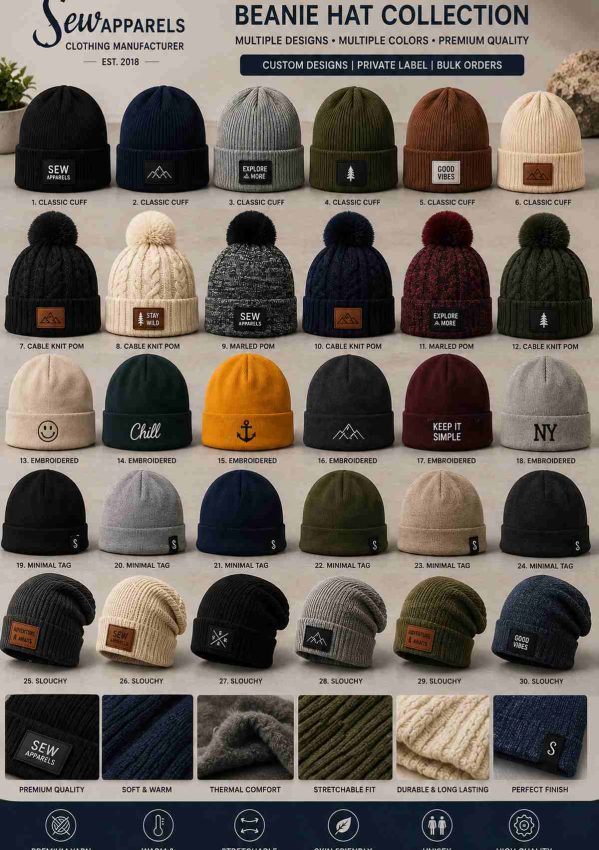
This six-step brief helps buyers compare samples without inventing laboratory results or consumer outcomes. It separates material measurements from wear feedback and keeps every conclusion within the conditions actually assessed.
1. Define the Proposed Warmth Statement
Write the exact marketing sentence before choosing a test. “Double-layer construction,” “warmer than our single-layer version,” “thermal resistance measured under stated conditions” and “suitable for sub-zero temperatures” are different claims. Each requires different support, and the last may require extensive product, environment and use evidence.
Create a winter beanie warmth comparison brief that identifies the product, comparator, target wearer, intended conditions, construction and proposed wording. Mark whether the claim is descriptive, comparative or quantitative. Do not let a general product-development observation become an unrestricted advertising promise.
A knitted hat insulation claim review should list the facts behind the statement: yarn, fibre composition, knit structure, thickness, layers, lining, coverage, fit and any tested thermal property. Record which facts are specifications and which are measured results.
Beanie warmth claim substantiation should also define exclusions. If no evidence supports a precise outdoor temperature, duration of protection or performance in rain, state that those claims are not approved. Clear exclusions prevent a limited comparison from expanding during copywriting.
2. Separate Insulation from Airflow
Thermal resistance and air permeability describe different properties. Air can move through a fabric while heat transfer also depends on thickness, trapped air, moisture and the complete assembly. A beanie warmth claim airflow versus insulation evidence record should keep the measurements in separate columns and explain what each can and cannot show.
ASTM D737-18(2023) is a test method for air permeability of textile fabrics. Its result may help compare how readily air passes through controlled specimens, but it is not by itself a temperature rating or a complete insulation result. Confirm the current edition, specimen suitability and buyer requirement with a qualified laboratory. Construction and finishing can alter the airflow path, and a different face orientation can change a result. Compare identified specimens using the same direction and reported conditions; an apparent airflow advantage cannot be promoted as a quantified warmth advantage.
For thermal and water-vapour resistance, ISO 11092:2026 specifies steady-state measurement methods for textile materials and multilayer assemblies using a sweating guarded hotplate. ISO also states that its test conditions do not represent specific comfort situations and that the standard does not specify physiological-comfort performance. This boundary is central to responsible interpretation.
A beanie warmth claim thermal test scope should therefore state the property, method, specimen form, conditioning, laboratory, environmental settings and reporting units. The chosen test must match the planned wording; collecting a number first and inventing a claim afterward reverses the correct process.
3. Compare Equivalent Finished Assemblies
Yarn data alone may not represent the finished hat. Knit density, layer count, crown joining, cuff overlap, lining, finishing and fit can change the thermal system. A beanie warmth claim finished hat thermal comparison should use identified assemblies that differ only in the intended comparison variable where practical.
Record a sample code, yarn lot, fibre content, yarn description, gauge reference, structure, mass, thickness, layer arrangement, cuff position, lining and finish. If testing requires flat specimens, document how those specimens represent the finished construction and what product features they omit.
Use beanie thermal performance evidence from the actual tested specimens. Do not attach a supplier data sheet for a different yarn, colour, finish or construction and treat it as finished-product proof. If the evidence is component-level only, label it accordingly.
For a comparative statement, use the same method, laboratory conditions and reporting basis for both samples. Beanie warmth claim substantiation should show the comparator identity, the measured difference and whether the difference is meaningful for the proposed claim. A numerical difference does not automatically establish a perceptible consumer benefit.
Check repeatability before approving a headline conclusion. Ask whether multiple specimens were tested, whether results varied across positions and whether the report describes any anomaly. If only one specimen was measured, state that limitation. The beanie warmth claim substantiation record should not hide variation behind a rounded value or select the most favourable specimen without a documented reason.
4. Define Wind and Moisture Context
Moving air can change how a wearer experiences a beanie. Prepare a beanie wind exposure test scope that defines wind speed, direction, duration, temperature, humidity, head form or participant position and the property being observed. Avoid using an indoor still-air comparison to support an unrestricted wind-protection statement.
If a wear exercise is included, use a beanie warmth claim wind context wear trial. Record participant codes, head measurements, hair or base-layer conditions where relevant, activity, fit, exposure and the questions asked. Feedback should be reported as subjective observations, not laboratory thermal values.
Moisture can come from precipitation, perspiration or damp storage, and each route can affect the assembly differently. A beanie warmth claim wet condition performance brief should define the wetting method, moisture level, exposure, measurement or observation, drying state and safety controls. Do not imply waterproofness or retained insulation when those properties were not tested.
Keep the dry, windy and wet scenarios separate. A beanie that performs relatively well in one comparison may rank differently in another. The purpose is to qualify the claim, not to hide inconvenient conditions.
5. Separate Wearer Feedback from Laboratory Findings
Beanie warmth claim subjective warmth feedback can reveal fit, pressure, coverage and perceived comfort issues that a material test will not show. It remains subjective and can be affected by the participant, activity, acclimatization, expectations and environment.
Use neutral sample codes and randomize comparison order where practical. Ask specific questions about perceived warmth, airflow, dampness and pressure rather than inviting a general preference. Preserve individual comments and describe the limited sample; do not present an average score as proof for every wearer.
Laboratory findings should remain linked to their method, specimen and conditions. Wear-trial comments should remain linked to participants and scenarios. Beanie warmth claim substantiation can discuss whether the two evidence streams point in the same direction, but it must not combine them into a fabricated universal rating.
Include safety and ethics controls for any human wear exercise. Use appropriate supervision, informed participation and conservative environmental limits. Stop if a participant reports excessive cold, discomfort or another concern. A product-development trial is not a reason to expose people to hazardous conditions, and it does not replace specialist assessment for protective products.
Prepare a beanie warmth claim temperature rating evidence gap statement whenever no validated protocol supports a specific temperature. It should identify the missing environmental, activity, exposure-duration, physiology, complete-assembly and safety evidence. The approved copy must avoid that rating until the gap is resolved.
6. Beanie Warmth Claim Substantiation: Approval Record
Use beanie warmth claim claim wording qualification to connect each phrase with its support. Examples of qualifications may identify the comparator, tested construction, method and conditions. Legal and market review should confirm the final wording for the target jurisdiction.
Create a beanie warmth claim insulation data request containing:
- the exact proposed claim and sales markets;
- the complete product and comparator specifications;
- the property to be measured and the proposed method;
- specimen form, conditioning and environmental settings;
- individual results, reported result and uncertainty where supplied;
- wind, moisture and wear-trial context;
- approved wording, exclusions, owner and review date.
The beanie warmth claim thermal report sample identity must be unambiguous. Record style, sample code, yarn, lot, colour, knit, gauge, finish, layers, lining, cuff configuration and date. A report without reliable sample identity cannot support controlled repeat production.
Add beanie warmth claim warmth comparison limitations beside the approved wording. These may include flat-specimen testing, still-air conditions, dry samples, one colour, a limited participant group or an untested finished feature. Limitations belong in the approval record even if they do not all appear in consumer copy.
Set a review owner and expiry trigger. New evidence, a changed standard, a revised market claim, a supplier substitution or a complaint pattern should reopen beanie warmth claim substantiation. The owner should archive superseded copy so old claims do not return to packaging, product pages or sales documents after a technical change.
Review beanie warmth claim substantiation when a yarn, gauge, finish, lining, construction, fit or care instruction changes. Preserve the earlier evidence for its original sample rather than silently applying it to the revision.
Low MOQ Beanie Development
Low-MOQ programmes should define the claim before ordering expensive testing. In custom beanie manufacturing, controlled development samples can narrow the assembly first, after which the buyer can seek appropriate evidence for the final construction. No factory or supplier should be assumed to provide a universal temperature rating.
Giving Priority to Startup Brands
Startup brands can use careful, qualified language instead of unsupported superlatives. During private label beanie production, keep the claim brief, reports and approved physical sample together. This protects the brand from relying on a generic yarn statement that does not represent its finished hat. Confirm material availability, applicable order minima and any sample, testing or development charges in the actual written proposal before committing to the programme.
Use the rib knit construction review to identify the assembly represented by each thermal result. Gauge, finishing and layer changes require a review of the evidence; a shared yarn name does not make two hats thermally equivalent.
Connect Warmth Evidence with Knit Construction
Use the Beanie Buying Guides to organize related development decisions. Share the identified construction and claim brief with the custom beanie manufacturing team to discuss sample feasibility before commissioning evidence for a final assembly.
A responsible beanie warmth claim substantiation file ends with a precise decision: approved wording, supporting evidence, sample identity, defined conditions, explicit limitations and retest triggers. It gives marketing and production teams one controlled reference without pretending that a single airflow or thermal result predicts every wearer and environment.