
A chef coat replacement trim quotation brief should identify the coat, the component being replaced and the work included in the supplier’s price. A request for “matching spare buttons” leaves important questions unanswered: which button reference, how many pieces, whether attachment labour is included, and whether the replacement has been checked against the existing garment and care route.
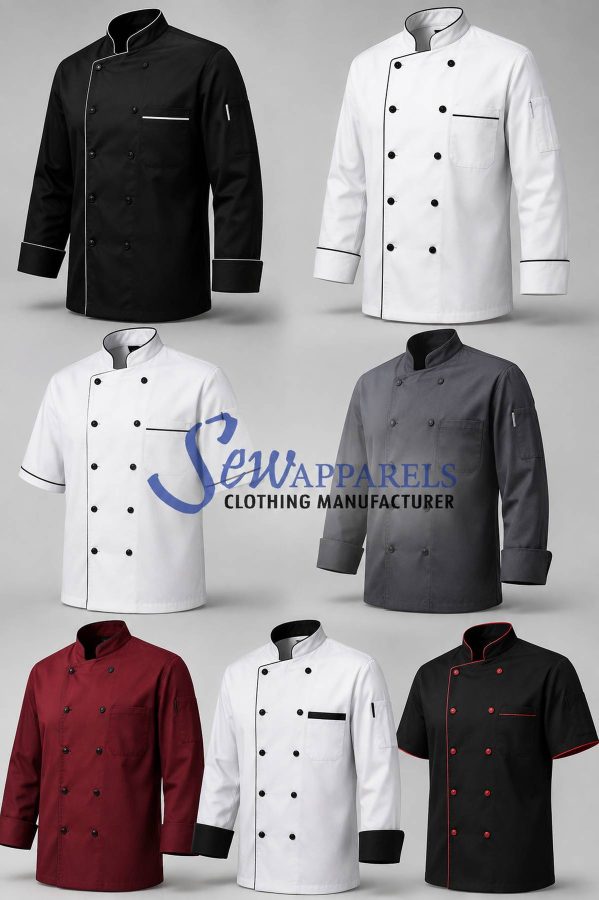
For custom chef coat manufacturing, keep replacement components connected to the approved coat specification. This guide covers six buying checks for defining compatibility, sample approval, quotation assumptions and spare-part continuity. It does not assume that a supplier offers repair services or that an available trim will match every previously supplied chef jacket.
1. Define the chef coat replacement trim quotation brief by garment revision
Begin with the garment reference, size range, fabric and relevant closure arrangement. Record whether the request concerns a current production style, an older coat or several revisions in use. The chef coats component revision code should identify the version to which the replacement applies. An old purchasing description may not distinguish later changes to the button or attachment method.
The kitchen coat spare trim register should list the component name, supplier part code, colour, finish and relevant dimensions. Keep photographs alongside those references rather than relying on photographs alone. Identify whether the requested item is a removable button, an attached button or another closure component. Their replacement operations and compatibility checks can differ.
A chef coat replacement trim quotation brief should state whether the buyer needs identical original parts or is willing to evaluate an alternative. If the original reference is unavailable, record that fact and request a proposed substitute with clear identification. Do not describe a similar-looking alternative as an exact match before the buyer has reviewed the relevant sample and evidence.
For hospitality uniform repair components, identify the affected programme and coat condition. A sound coat with a missing component presents a different question from a coat with damaged attachment fabric. Keep the request focused on the observed need. A trim quotation is not a determination that every worn garment is suitable for repair or that replacing one part restores the original condition.
2. Specify fit, appearance and attachment compatibility
The chef coat replacement button specification should describe dimensions, shape, attachment details and the intended closure interface. Check how the component works with the actual buttonhole, receiving part or garment construction. A nominal diameter alone may not establish compatibility. Record the agreed measurement method and reference sample so the supplier can assess the same details.
Chef coats repair button compatibility should be evaluated through the intended opening and closing action. Inspect alignment, ease of operation and the fabric around the fastening point. Do not assume a tighter component is automatically more secure or that a looser one is acceptable because it passes through the opening easily. Agree the required function and inspect the assembled result.
For chef coats replacement trim material match, distinguish confirmed material information from visual similarity. Compare colour, finish, texture and relevant component construction under consistent viewing conditions. A new trim may not look identical to a coat that has undergone repeated care. Record the appearance requirement and any accepted difference rather than promising an invisible repair.
A chef coat replacement trim quotation brief should include the proposed attachment operation where it affects cost or suitability. State who supplies thread or other required materials, who performs the work and what the sample review covers. Check attachment fabric condition before agreeing a repair. Do not infer attachment strength from appearance or a single manual closure check.
3. Keep care compatibility within the sample approval
The chef coats repair sample care trial should use the intended garment and replacement component combination. Record the relevant wash and drying or finishing route, sample identity and agreed observations. Retain the initial appearance and closure condition for comparison. A component tested separately does not show how it interacts with the repaired coat assembly.
GINETEX care-labelling guidance includes accessories such as buttons and zips when considering the article’s care treatment. This supports reviewing a replacement alongside the complete garment. It does not identify which spare button fits a particular chef coat or certify a repair. Keep the proposed part and approved care information connected.
Where industrial laundering is intended, ISO 15797:2017 provides washing and finishing procedures for evaluating workwear. The selected procedure and its scope must be identified, and actual intended laundry conditions may need further compatibility assessment. Referencing this standard does not establish a universal wash count, a repair-service promise or approval for every laundry operation.
Chef jacket repair sample approval should record appearance, closure operation, fabric contact and relevant attachment observations before and after the agreed care assessment. Identify any discoloration, staining, distortion or damage separately. If a different component or attachment method is introduced, review whether the previous evidence still applies rather than copying the old approval unchanged.
A chef coat replacement trim quotation brief should allocate sampling and care-assessment costs explicitly. Ask whether the quote covers one development sample, additional revisions and the agreed evaluation, or whether these items are separate. A component unit price should not be compared with a price that includes sample development and inspection without accounting for the scope difference.
4. Request a quotation with transparent quantity and cost assumptions
The chef coats replacement component quotation should identify the approved or proposed reference and the ordered quantity. State how pieces are counted, whether packaging quantities affect the order and whether different colours or references require separate quantities. Request confirmed minimums and availability for the actual enquiry. Do not assume spare parts use the same commercial conditions as a full garment order.
Chef coats spare trim order assumptions should include delivery destination, required timing and packaging requirements. Ask which charges are included: component supply, sampling, attachment materials, repair labour, inspection, packing and transport. Confirm applicable taxes or other commercial charges through the actual quotation. The brief should make competing offers comparable without inventing a standard price structure.
A chef coat replacement trim quotation brief should separate parts supplied loose from garments returned for work. If coats must be sent to a service provider, identify receiving arrangements, condition review and return logistics. Clarify the provider’s acceptance process before shipping. An offer to supply spare trim is not an agreement to receive, repair or return used garments.
For a fictional comparison, one supplier might price loose components while another includes attachment labour on an agreed number of coats. The first total may look lower even though the buyer must arrange the repair separately. Compare the included activities and assumptions before selecting an offer. This example is not a Sew Apparels quotation or a statement that either service is available.
5. Agree repair authorization, responsibility and acceptance
Chef coats repair service scope questions should identify who determines whether the garment can be repaired, who performs the work and who approves the result. State whether the scope includes only component attachment or also fabric repair. If a coat has a broader defect, a trim replacement alone may not resolve it. Record the limitation before accepting the service.
The chef coats repair authorization record should identify the coat group, approved component, agreed operation and any accepted appearance difference. Include the sample approval reference and responsibility for exceptions. A supplier should not apply a different trim or broaden the work informally. Keep authorizations traceable so the buyer can understand what was actually approved.
A chef coat replacement trim quotation brief should specify acceptance observations appropriate to the repair. These can include component identity, placement, closure operation, attachment appearance and the agreed care evidence. Identify where additional assessment is required. Avoid treating a visual inspection as proof of unlimited service life, protective performance or the condition of every unexamined coat.
Where a garment has a declared protective function, ordinary hospitality repair approval does not establish that protection remains valid. Obtain the applicable product requirements and authorized repair route separately. Do not use a routine spare-button assessment to approve changes to a protective garment. The quotation must remain within the service and product evidence actually agreed.
6. Preserve spare-part continuity and revision control
The chef coats approved replacement part register should connect the accepted component with the relevant coat revisions. Retain supplier reference, dimensions, appearance record, sample decision and applicable care assessment. Mark whether the part is an identical original reference or an approved alternative. This distinction matters when later staff request replacements using an older sample or photograph.
A chef coats spare part continuity request should ask about current availability, expected lead time and the process for notifying changes. Any longer-term supply commitment needs explicit commercial agreement. A spare-parts enquiry does not guarantee indefinite stock or future availability. Plan the required quantity and review continuity alongside the actual supplier response.
For private label chef coat production, the chef coats spare trim supplier reference should remain tied to purchasing and garment documentation. If the component changes, update the affected revision record and obtain the necessary approval. Similar appearance does not prove equivalent fit, material or care behavior. Clearly identify which replacement applies to each coat version.
A chef coat replacement trim quotation brief should close with a documented buying decision. Confirm the supplied part, quantity, included activities, sample approval, delivery terms and responsibility for any unresolved finding. If compatibility remains unverified, request the missing evidence before release. This makes the spare-trim order repeatable and keeps the final price connected to the work the buyer actually needs.
Use the chef coats double breasted closure design review to identify the garment interface before approving a replacement fastening or changing its position.
Replacement trim enquiry checklist
- Identify the coat revision and exact component requested.
- Record dimensions, material information and closure compatibility.
- Agree sample and care-assessment scope.
- Separate loose parts, repair labour, inspection and logistics.
- Document repair authorization and acceptance observations.
- Retain the approved part register and continuity agreement.
Discuss the component enquiry through the chef coats manufacturing page and use the Chef Coats Buying Guides for related development decisions. A chef coat replacement trim quotation brief should leave a clear record of what is supplied, what is approved and which activities are included in the price.
Frequently asked questions
Does a spare-button price include repair labour? Not automatically. The chef coat replacement trim quotation brief should state whether the offer covers loose parts, attachment work or both.
Can a similar-looking button replace the original? Evaluate its dimensions, closure operation, appearance and care compatibility before approval. Record it as an alternative where appropriate.
Does ordering spare trim guarantee long-term availability? No. Confirm current supply and negotiate any continuity commitment explicitly rather than assuming indefinite stock.