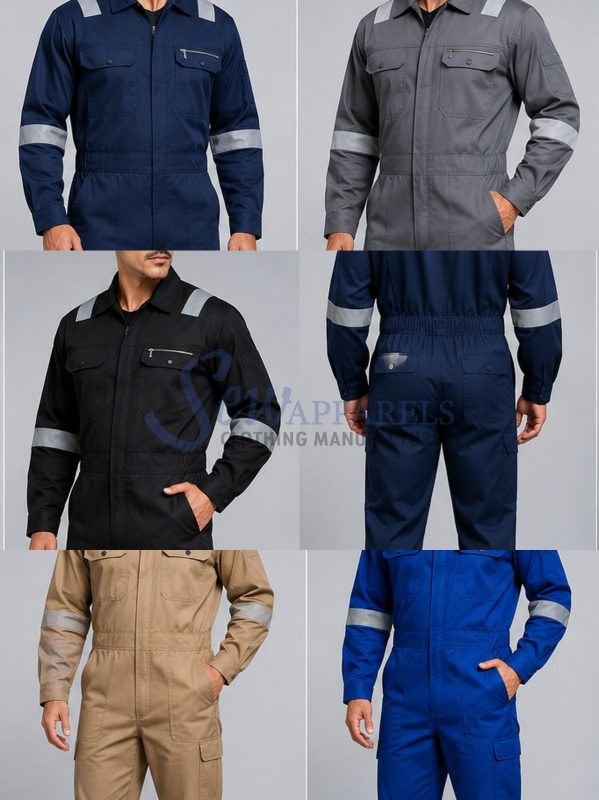
Movement Allowance Design
Plan action back pleats, crotch reach and sleeve mobility around overhead work, kneeling, climbing, twisting and layered use. The article includes a construction example and buyer approval table.
Read the movement allowance guide
Front Fastening Configuration
Specify zip guards, storm flaps and two-way openings with clear movement, access and production approval checks.
Read the front fastening guide
Coverall Fabric Blend Quotes: Comparable Specifications and Cost Scope
Compare identified cotton and polycotton offers on the same garment, quantity, size allocation, finishing, assessment and delivery basis before selecting a material.
Read the fabric blend quotation guide
Coveralls Height Size Ranges: Torso Blocks, Inseams and Order Allocation
Plan chest sizes, torso proportions, inseam options and sample coverage in an approved quantity matrix before releasing a one-piece workwear order.
Read the height size range guide
Coverall Leg Openings: Boot Entry, Closures and Hem Compatibility
Assess the stated dressing sequence, identified boots, ankle fastening operation and finished hem position through a controlled sample review before bulk approval.
Read the leg opening access guide
Women’s Coverall Fit Blocks: Proportions, Sample Trials and Size Allocation
Compare body proportions, torso balance and wearer feedback through identified samples, then allocate approved blocks and sizes in a traceable order matrix.
Read the women’s fit block guide
Coveralls Industrial Wash Stability: Garment Measurements and Care Scope
Compare identified garments before and after a defined treatment, recording torso, sleeve, chest, seat and leg changes against agreed approval criteria.
Read the industrial wash stability guide
Coveralls Identification Labels: Asset Codes, Laundry Readability and Reassignment
Separate garment identity from wearer assignment, approve label placement and care evidence, and reconcile packing and replacement records before release.
Read the identification label guide
Fabric, closure and trim decisions
These Coveralls Buying Guides connect material choices to the complete garment specification. Coveralls are often expected to manage several demands at once: durable wear, comfortable movement, practical pocket access, easy entry and a consistent branded appearance. The fabric should be chosen with the end use in mind. Record composition, target weight, colour, finish, shrinkage expectation and any performance requirement in the brief. If a woven fabric is stiff, the pattern may need more deliberate articulation. If it has mechanical give, test recovery after repeated movement instead of assuming stretch will solve every fit issue.
Closure selection also changes how the wearer experiences the garment. A front zipper, snaps or a protected combination affects donning, repair, ventilation and the way force travels across the front. Check the closure while sitting and bending. A storm flap should remain flat, and pocket bags should not catch the teeth or pull the front panel out of line. When reflective tape, badges or embroidery are added, check their edge distance and alignment after the garment is worn, not only on a flat table.
For repeat production, identify which details are fixed and which may change by colour, size or customer programme. Keep the approved trim list, placement drawing and packing instruction with the measurement chart. A controlled revision record helps the factory understand whether a comment changes the pattern, material, sewing method or inspection point.
Sampling and quality review sequence
Use the Coveralls Buying Guides alongside a controlled sample-development record. A useful coverall development sequence starts with a paper or digital pattern review, followed by a first sample in the closest available fabric. Test the sample on representative wearers and mark pull lines, pressure points, hem movement, cuff position and closure comfort. Revise the pattern and repeat only the measurements that changed. After the fit is accepted, approve a size set so grading can be checked across the full range. Then confirm the production fabric, trims, labels and packing on a pre-production sample.
Quality review should connect the approved sample to bulk checks. Incoming fabric inspection, measurement checks, seam appearance, pocket attachment, closure operation, branding placement, finishing and carton identification should be listed according to the buyer’s acceptance plan. If the coverall is used with other protective equipment, check the interface again. A garment that passes in isolation may behave differently under a vest, harness, glove or jacket. Keep the pass observations factual and repeatable so the same standard can be used at inline and final inspection.
After the agreed care route, review shrinkage, colour change, seam behaviour and movement recovery. If the care route changes, the garment should be reviewed again before bulk approval. These steps give a startup brand or established uniform buyer a clear record of what was approved and why.
Questions to send with an inquiry
• What work actions must the wearer perform during a normal shift?
• Which base layer or protective equipment will be worn underneath or over the coverall?
• What fabric composition, target weight, finish and colour route do you expect?
• Which closure, pocket, reflective, label and branding details are required?
• What is the planned quantity by style, colour and size?
• Which inspection, packing, documentation and delivery requirements apply?
Providing these answers at the beginning makes the first review more useful. It lets the manufacturing team separate a pattern question from a fabric question, and a sampling requirement from a bulk production requirement. It also gives buyers a clearer basis for comparing quotations because the suppliers are responding to the same defined scope.
How to use these Coveralls Buying Guides
The Coveralls Buying Guides help you choose the next review without duplicating an existing article. Read the article that matches the current product decision, then add its checklist to your tech pack or buyer review sheet. Keep the product page and guide page separate in your information architecture: the product page explains the manufacturing service, while each guide article answers one technical development question. Link from the article to the relevant product page and return from the product or guide hub where the connection helps a reader move from learning to an inquiry.
For fit work, test the actual base layer and the real work positions. For fabric and care decisions, confirm weight, composition, finish and the intended wash route before bulk approval. For branding, review label, embroidery, reflective tape and pocket placement in the garment’s most extended position. Clear evidence makes later revisions easier to price and reduces interpretation between design, merchandising, production and quality teams.
Movement, comfort and protective function
Coverall development needs evidence appropriate to the question being answered. ISO 8559-1:2017 defines body-measurement terminology relevant to clothing development; it does not prescribe a finished coverall allowance or prove universal fit. Keep body references separate from garment dimensions, identify the base layer and review reaching, crouching, sitting and the stated dressing sequence with representative wearers.
ISO 15797:2017 provides industrial washing and finishing procedures for evaluating workwear. It is not an operating recipe for an industrial laundry or certification of an untested coat. Agree the appropriate complete-garment assessment with technical parties, retaining process identity, measurements and appearance observations. Ordinary coveralls must not be presented as hazard-specific protective clothing without the applicable assessment and evidence.
Low MOQ coveralls manufacturer for startup brands
For startup teams, the Coveralls Buying Guides provide a starting point for a focused enquiry. Startup brands can prepare a focused coverall brief without creating unnecessary style variants. Share the target quantity by style and colour, fabric expectations, size range, artwork, labels, packing and delivery country. Discuss whether the proposed small order is feasible for the selected material and construction; the phrase low MOQ coveralls manufacturer does not establish a fixed minimum for every project. Confirm current quantities, material availability, development scope and timing directly.
Give each sample comment a garment revision, location and observable requirement. Separate a torso-fit correction from a fabric substitution or an identification-label change so the technical review has a clear purpose. Keep quotation assumptions and unresolved evidence visible before release. A startup-friendly enquiry provides enough detail to assess the actual project without assuming priority service, free development or a guaranteed production slot.