
Coveralls wearer identification label planning should connect each garment with the correct operational record without confusing its size, asset identity and current wearer. A label that survives laundry but points to the wrong assignment can still cause an issue problem. Buyers need a defined identifier, suitable placement, a care evaluation and controlled record changes before bulk labelling.
This guide explains a practical brief for ordinary workwear identification. It does not promise a tracking technology or certify a label for every process. Use the Coveralls product page for manufacturing enquiries and confirm the required identification scope when discussing custom coveralls manufacturing.
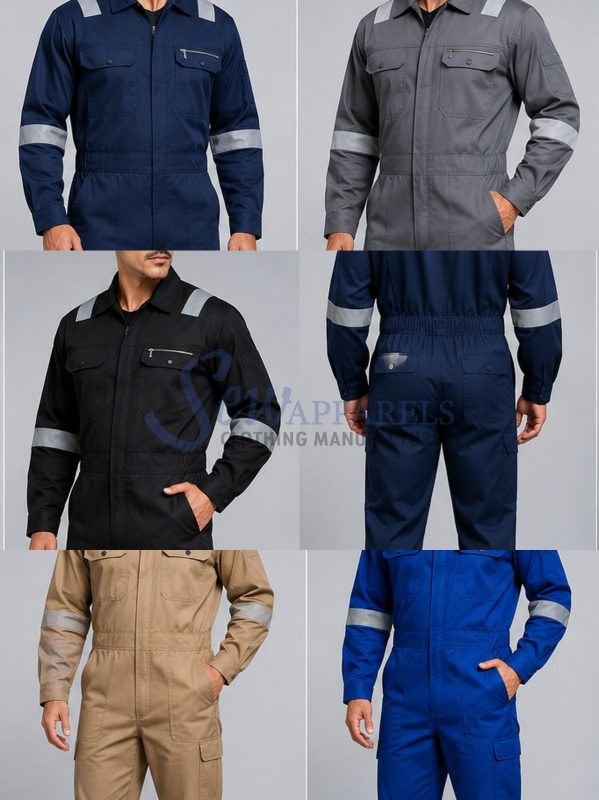
1. Define coveralls wearer identification label planning by the operational purpose
Start with the action the label must support. A laundry operator may need to identify an individual garment, while an issue team needs the correct current allocation. A stock team also needs size and style information. Those purposes overlap, but they should not be collapsed into one ambiguous number.
Coveralls asset identifier data fields should be defined before artwork is prepared. An asset ID can identify the garment throughout its service history. A wearer assignment can change when the garment is returned or reissued. Keeping these concepts separate makes it possible to preserve the garment record while updating the current allocation.
Review the coveralls size versus wearer label relationship. A size label describes the approved garment designation; it does not identify the person currently using it. Avoid using a wearer code as a substitute for size information needed by the warehouse or issue team. Agree which details appear physically on the garment and which are held in the authorised record.
If a code can be linked to an individual, it may still be personal data rather than anonymous information. ICO data minimisation guidance explains the UK principle of holding information appropriate to a defined purpose without unnecessary detail. The guidance is under review following legislative changes. Use it as a scoped reference and obtain advice for the rules applicable to the actual operation.
Do not place personal contact details or unrelated employee information on a garment simply because the label has space. Agree the minimum useful content, the purpose of the linked record and who needs access. This article does not determine the legal basis or compliance obligations for a particular organisation.
2. Separate garment identity from assignment and packing data
A coveralls wearer identification label planning record should show how codes are generated, checked and issued. Define whether the asset ID is permanent and whether a wearer code is displayed separately. Confirm how duplicate codes are detected before production or application.
For a fictional example, garment A-014 could remain asset A-014 while its allocation changes from wearer W-021 to W-035. These codes are illustrations only, not real staff records or Sew Apparels system identifiers. The important distinction is that reassignment changes the operational link rather than silently rewriting the garment’s history.
Coveralls garment record lookup should return the fields required by the authorised user. An issue team might need the current assignment and garment size, while a laundry team may need an agreed routing status. Do not assume every operator requires access to the full employee record.
Specify how the garment ID connects to the packing list. If cartons are organised by wearer allocation, reconcile the garment identifiers and quantities before dispatch. If garments are packed by size, state how assignment happens later. A label printed correctly can still be misallocated during packing.
Where a barcode, machine-readable code or electronic tag is proposed, confirm the system requirements with the relevant provider. This guide does not assume that any scanner, reader or software accepts every format. Compatibility needs evidence for the actual label, equipment and workflow.
3. Choose placement and attachment through garment trials
Coveralls wearer identification label planning should consider wearer comfort and operator access together. A convenient scanning position may be uncomfortable against the body, difficult to reach during sorting or unsuitable near a seam. Identify the proposed location on a drawing and confirm it on a finished sample.
Workwear wearer code placement should not cover existing size, care or other required information. Check how the label behaves when the garment is worn, folded and handled in the intended process. Consider whether the label is visible when necessary without displaying more personal information than the operation needs.
A coveralls identification attachment trial should use the proposed label material, application method and garment construction. Record the stitch, adhesive or other accepted method as applicable. Do not infer compatibility from a loose label that has never been attached to the actual garment.
For coveralls identification system garment compatibility, inspect fabric distortion, raised edges, rough areas and interference with closures or pockets. If the garment is protective clothing, any label application or modification requires the appropriate competent review. An ordinary workwear sample trial does not authorise changes that could affect certified performance.
A coverall laundry identification label needs a clear attachment specification. A label vendor’s general durability statement may not cover the exact substrate or application. Confirm the vendor’s evidence and assess the assembled sample under the agreed conditions before accepting the construction.
4. Evaluate readability and attachment after the stated care route
Test coveralls wearer identification label planning against the actual proposed care scope. An industrial wash garment identification brief should identify the material, application, garment sample and washing, drying or finishing conditions to be evaluated. Keep the tested sample identity and treatment history with the results.
ISO 15797:2017 provides procedures for evaluating industrially laundered workwear. It is not an operating recipe for commercial laundries, and an appropriate actual-process assessment may sometimes be needed to establish compatibility. Ask the responsible provider to define the relevant evaluation and report its limits.
Coverall asset tracking label durability includes attachment integrity and the ability to recover the correct identity. If printing remains visible but the code no longer reads reliably on the intended equipment, the operational requirement may not be met. Similarly, a readable label with a lifting edge needs a separate attachment review.
For coveralls laundry label readability, identify whether assessment is visual, machine-assisted or both. For coveralls wearer identification label planning, record the equipment and conditions used where relevant. A successful read with one device should not be described as universal scanner compatibility.
Coveralls industrial wash label inspection should record the number of treatments and the assessment stages. Note fading, distortion, edge lifting, stitching changes or incorrect reads individually. Do not present a short trial as proof of unlimited garment service life.
| Approval area | Evidence to retain | Question to resolve |
|---|---|---|
| Identifier content | Approved fields and code example | Does it identify the intended garment record? |
| Placement | Drawing and finished sample | Can users access it without interference? |
| Attachment | Method, material and condition observations | Does it remain suitable after treatment? |
| Readability | Visual or equipment-specific results | Is the correct identity recoverable? |
| Record link | Assignment and packing reconciliation | Does the label point to the right current record? |
This is a suggested project record, not a certified label test method. A coveralls asset tag sample approval should connect the accepted artwork, material, placement, attachment and evaluation results. Missing evidence should remain an open question until it is resolved.
5. Control reassignment, replacement and unreadable labels
Coveralls wearer identification label planning must include what happens after issue. Coveralls wearer code reassignment should have a named responsible role and a defined update sequence. Confirm the garment returned, resolve any conflicting label information and update the authorised record before reissue.
Coveralls replacement identifier control should distinguish replacing a damaged label from assigning a new garment identity. If the asset remains the same, the replacement needs to preserve the correct link and record the intervention. If a new identity is required by the system, define how the earlier record is closed or connected.
Do not guess the identity of an unreadable garment from its size or likely wearer. Use the operation’s approved exception process, such as holding the garment for authorised verification. A temporary handwritten mark should not become an undocumented permanent assignment.
Coveralls laundry operator label access should specify who can read, alter and reconcile the relevant data. Physical access to the garment does not necessarily mean authority to change its assignment. Keep a clear responsibility boundary between label application, laundry handling and record administration.
6. Release the brief and reconcile the finished order
A complete coveralls wearer identification label planning brief includes the code structure, approved artwork, placement drawing, attachment specification, garment revision, care evaluation and packing requirement. Identify the person authorised to approve changes. An application method substitution may affect the evidence even when the printed text stays unchanged.
For private label coveralls production, confirm which identification requirements the supplier accepts and which belong to the buyer or system provider. This article does not establish Sew Apparels’ tracking platform, tag availability, privacy controls or laundry services. Those capabilities and responsibilities require explicit project agreement.
Before release, reconcile label quantities, garment quantities and identifiers against the accepted order. Investigate missing or repeated codes rather than accepting a correct carton total as proof that every individual garment is correct. Preserve the approved sample and the reconciliation record for later replacements.
For reorder, review whether the software, reader equipment, care route or label material has changed. Earlier approval applies to its stated scope. Identify what needs another check before assuming that the same artwork establishes compatibility with a revised operation.
Connect the care record with the coveralls industrial wash dimensional stability review, while retaining separate results for garment dimensions, label readability and identifier accuracy.
Questions before bulk labelling
Should the wearer name always be printed?
Only if the operational purpose and applicable requirements justify it. A code with an authorised lookup may be suitable, but it is not automatically anonymous or compliant merely because a name is absent.
Does wash resistance prove correct tracking?
No. Coveralls wearer identification label planning also needs the correct data link, readable identity, suitable placement and controlled reassignment. A durable label can still identify the wrong allocation.
What should happen when a code cannot be read?
Follow the defined verification and replacement process. Avoid inventing a new identity or allocating the garment based only on appearance.
Use the Coveralls Buying Guides for related garment-development decisions. Finalise coveralls wearer identification label planning through approved samples, care evidence and reconciled records before releasing the labelled order.