
Coverall leg opening access should be approved with the footwear and dressing sequence the wearer will actually use. An ankle opening that looks generous on a flat sample may catch on a boot heel, resist closure around the shaft or leave excess material after dressing. Buyers need evidence of entry, fastening and normal movement before approving the lower-leg construction.
This guide sets out practical development checks for ordinary workwear. It does not establish protective performance or authorise changes to required safety equipment. Use the Coveralls product page for manufacturing enquiries, supported by a clear footwear brief when discussing custom coveralls manufacturing.
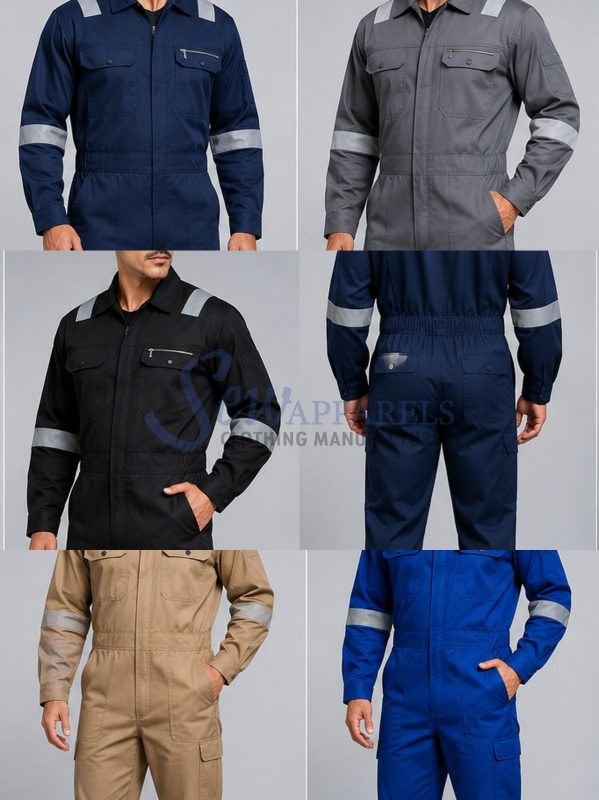
1. Define coverall leg opening access around a stated dressing sequence
Begin with the intended method of putting on and removing the garment. Will the wearer dress before putting on boots, or does the project require the garment to pass over footwear already worn? Those are different development conditions. Do not describe a sample as easy to wear without recording which sequence was tested.
For a coverall ankle opening over boots, identify the boot model, size and condition. The outsole, heel profile, upper, laces and any external fittings may affect passage through the opening. A footwear label or nominal shoe size alone does not describe the shape that the garment must pass over.
Coverall dressing sequence footwear notes should also identify where the activity takes place. A controlled fitting area can support observation without introducing workplace hazards. If the employer requires another dressing procedure, the development trial should reflect that requirement only after the responsible person has confirmed suitable arrangements.
Keep the required protective footwear unchanged. CCOHS safety footwear guidance explains that selection depends on the hazards and relevant jurisdiction, with fit and condition also important. This Canadian guidance supports treating footwear as a defined requirement; it does not establish a universal coverall opening measurement.
A work coverall boot entry trial should record the sequence rather than rely on memory. Note which closures were opened, whether the wearer was seated, whether assistance was used and whether the garment was pulled forcefully. A successful result under one sequence should not be extended to a different sequence without further evidence.
2. Compare the opening, fastening and footwear geometry
Assess coverall leg opening access in both its open and closed states. The open state determines entry clearance; the closed state affects the garment’s position during use. Increasing one measurement can solve an entry problem while creating unwanted volume at the ankle. Review those consequences together.
A coverall boot dimension brief should identify the relevant outsole width, heel shape, shaft and fittings, using an agreed method. Record the actual footwear samples used and the size coverage. Measurements help document the interface, but the three-dimensional passage of a boot through fabric still needs a suitable sample trial.
Coverall lower leg access may come from a fixed hem, gusset, zipper or another agreed fastening arrangement. Define the proposed construction, opening length, usable opening and reinforcement. A drawing should show the position of the closure relative to seams and the intended hem, so two suppliers do not interpret the same wording differently.
For coverall leg zipper usability, check access to the puller and the ability to open and close it in the intended posture. Observe whether fabric enters the slider path or a guard makes the puller difficult to reach. Record any glove condition required by the approved trial; do not assume a bare-hand result represents all users.
A coverall footwear access comparison should keep the garment size, footwear and dressing procedure consistent. If one option uses a different fabric or leg shape, identify that difference before attributing the result to the fastening alone. A coverall leg opening access comparison should explain what changed, what stayed constant and what remains untested.
3. Observe catch points and the finished hem interface
During a controlled sample review, coverall leg opening access includes the places where the footwear or fabric catches. Watch the heel, outsole edges, lace hardware, closure ends and seam allowances. Describe the location and circumstances of a catch rather than treating every hesitation as proof that the opening is too small.
Coverall lower opening catch points can arise from construction as well as dimensions. A protruding seam allowance, an awkward guard or an exposed fastening end may obstruct passage even when the nominal opening is adequate. Inspect the sample after the trial for pulled stitches, distorted fabric or damaged trim.
The coverall hem footwear interface also matters after entry. Check the hem position with the boot fastened as intended, then observe controlled standing, walking and bending relevant to the brief. Note dragging, riding up, bunching or interference with footwear operation. These observations support development decisions; they do not prove protection against a workplace hazard.
HSE machinery safety guidance warns about loose clothing becoming caught in moving parts within its Great Britain context. Any proposed ankle volume or fastening arrangement therefore needs the employer’s relevant risk review. Never test a garment’s catch behaviour against operating machinery; clothing design cannot replace guarding and safe systems of work.
Do not choose the widest opening as the automatic winner. The useful option is the one that meets the agreed entry method, closes appropriately and remains compatible with the intended use. Where competing requirements cannot be resolved in the sample, record the issue for the responsible development or workplace team.
4. Record closure operation and repeatable sample evidence
A coverall leg opening access record should identify the sample revision, garment size, footwear, participant code and garment condition. Use a coverall dressing observation sheet to capture entry, exit, closure operation and any assistance. Avoid collecting personal information that the development decision does not require.
Coverall ankle closure operation should be assessed after dressing, not only when the garment is laid on a table. Check whether the wearer can locate and operate the closure, whether it reaches the intended closed position and whether its components remain correctly aligned. If instructions are required, record what the participant was told.
For a coverall lower leg fastening review, distinguish failure to operate from difficulty understanding the sequence. A closure may work mechanically but be awkward to identify or reach. Record those observations separately so the proposed correction addresses the actual issue rather than adding unnecessary opening width.
| Observation field | Evidence to record | Decision supported |
|---|---|---|
| Entry and removal | Sequence, assistance and catch location | Whether the stated dressing method is feasible |
| Closure operation | Reach, puller access and complete fastening | Whether the fastening needs development |
| Finished hem | Position and behaviour during controlled movement | Whether length or volume needs review |
| Sample condition | Fabric distortion, stitch or trim damage | Whether construction requires correction |
| Uncovered variants | Sizes or footwear not assessed | Limits of the current approval |
This table is a suggested project record, not a certified test method or a supplier performance claim. A coverall boot entry clearance record should include the measurement method and any limitations. A numeric clearance without a sample identifier cannot reliably support a later production decision.
Where repeat observations are useful, agree their purpose and conditions in advance. Do not present a short usability trial as a lifetime durability assessment. Record a problem even if the wearer eventually completes the task; repeated force or assistance can reveal an unresolved development issue.
5. Cover size coverage, care condition and exceptions
Approve coverall leg opening access across a justified sample selection. A single middle-size garment with one boot does not establish compatibility for every combination in a bulk order. Identify relevant footwear shapes, garment sizes and length options, then state which combinations the evidence actually covers.
A coverall leg opening sample should match the proposed construction and trim revision. If a prototype uses a substitute zipper or different seam finish, identify the difference and plan the remaining review. Avoid releasing bulk production on the assumption that a later component will behave the same.
A coverall footwear compatibility trial should also state whether the garment was assessed before or after the agreed care evaluation. Changes to length, opening shape or closure alignment may affect the interface. The required care route and evaluation belong in the project brief; this article does not prescribe a universal wash cycle.
Keep exceptions visible. A particular boot fitting may remain difficult, or an intended fastening may not suit the approved dressing sequence. Record whether the response is a pattern change, another construction, additional evaluation or exclusion from the current scope. Do not quietly approve the exception because other samples performed acceptably.
6. Release the lower-leg brief with controlled revisions
The coverall leg opening access brief should connect the drawing, finished measurements, fastening specification, footwear samples and trial findings. Identify the accepted dressing method and the combinations approved. Include any limitations and the person responsible for authorising development changes.
For private label coveralls production, align the construction revision with the requested labels and user information. Confirm the proposed scope with the supplier rather than assuming any opening option, trim or size assortment is available. Manufacturing, minimum quantities and delivery terms remain project-specific matters.
At production review, compare the actual components and measurements with the approved reference. If the zipper, guard, hem finish or leg pattern changes, assess whether earlier evidence still applies. A visually similar trim substitution may alter operation, so record the decision rather than carrying approval forward automatically.
Use the coveralls bulk order height size range review to identify which garment lengths and footwear combinations the access trial covers.
Questions buyers should resolve
Does a longer zipper always improve access?
No. It may increase the usable opening, but guard construction, puller access and the finished leg shape also matter. Evaluate the complete sample using the specified footwear and sequence.
Can a boot size chart replace a trial?
No. A size designation does not describe every outsole, heel or external fitting. Use identified footwear samples and document the combinations assessed for coverall leg opening access.
What should be sent with a development enquiry?
Send the intended dressing method, footwear identification, garment size coverage, construction drawing and any observed problems. Clearly distinguish proposed changes from approved requirements.
Use the Coveralls Buying Guides for related construction and assortment decisions. Finalise coverall leg opening access through traceable sample evidence before approving the lower-leg specification for bulk production.