
Jumpsuit pocket load balance should be reviewed on the wearer with the intended carried items, not only on an empty garment. Because the bodice and trouser sections are connected, pocket weight can affect the waist position, side seam and upper garment together. A neat pocket opening on a hanger does not show how the complete style behaves during use.
This guide explains six checks for preparing a traceable loaded-pocket sample review. It connects the carried item, pocket position, support construction and movement trial to the buyer’s approval decision. There is no universal acceptable pocket weight or anchor arrangement for every jumpsuit fabric, fit and intended use.
Use the jumpsuit manufacturing page for the product enquiry. Include the jumpsuit pocket load balance brief with the fit reference, fabric, pocket construction and intended carried items so the development team can review function alongside appearance.
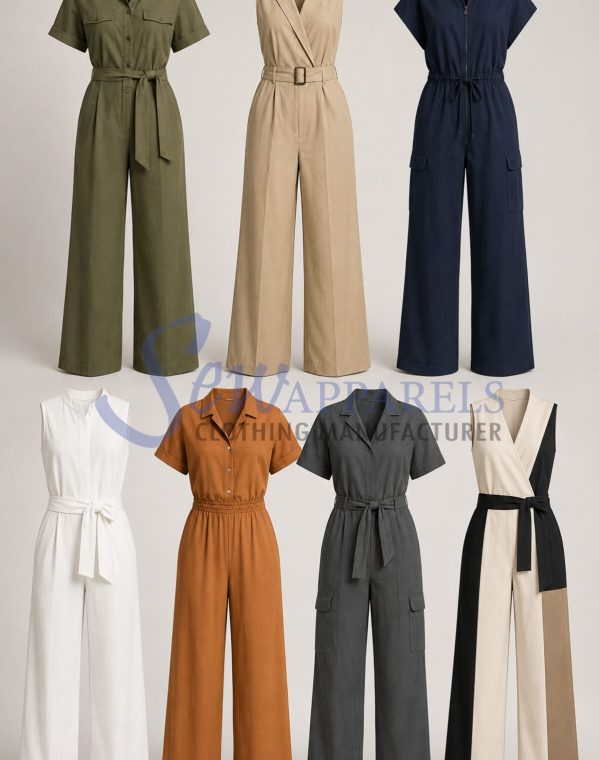
1. Define the jumpsuit pocket load balance trial conditions
Begin by identifying the use case. A fashion pocket intended for occasional light personal items has a different brief from a utility pocket designed around specified work items. State what the buyer expects the pocket to hold instead of treating every pocket as general-purpose storage.
Record jumpsuit carried item trial conditions in enough detail to repeat the review. Identify each item’s dimensions, measured mass, shape and position in the pocket. Note whether the trial uses one pocket or both and whether an accessory such as a belt is worn. Keep those inputs constant when comparing construction revisions.
A jumpsuit loaded pocket sample should match the proposed garment construction. Record the fabric reference, sample size, pattern revision, pocket material and attachment. A substitute pocket bag or temporary waistband finish may produce a different result, so identify those limitations rather than approving bulk function from an incomplete development sample.
Define what success means before the trial. Set buyer-agreed observations for pocket opening, waist position, wearer access and visible distortion. The jumpsuit pocket load balance review should assess those observations under identified conditions, not assign a broad safe carrying capacity from one informal exercise.
2. Establish an empty-garment fit baseline
Review the empty jumpsuit first on an identified wearer or appropriate fit reference. Check the intended waist location, bodice length, rise and leg position. If the empty garment already pulls or twists, resolve or document that condition before attributing every later change to the pocket contents.
The ISO 8559-1 body measurement overview describes a framework for anthropometric measurements used in clothing development. It supports defining a consistent fit reference. It does not provide a jumpsuit pocket-load limit or prove that an individual sample has been approved to a pocket performance standard.
Compare jumpsuit empty versus loaded silhouette using the same wearer, garment adjustment and camera views. Mark reference points where useful, such as the intended waist line, pocket mouth and side seam. Record front, side and back observations so a change hidden from one angle is not overlooked.
Control closures and styling details during the comparison. If the empty sample is worn loosely but the loaded sample has a tightly fastened belt, the trial has changed more than pocket contents. Keep those settings identified and distinguish any proposed belt support from the garment’s own construction.
Use the baseline in the jumpsuit pocket load balance record to separate fit correction from functional correction. Enlarging the complete garment to reduce one loaded-pocket pull may introduce unrelated excess width or change torso balance. Establish the source of the movement before choosing a pattern revision.
3. Observe sagging, displacement and access together
Run the jumpsuit pocket weight fit trial with the agreed items placed as specified. Inspect the garment immediately, then during the defined wearer actions. Record whether the opening remains accessible and whether contents settle in the expected position. Avoid rearranging an item repeatedly to obtain a better photograph without documenting that adjustment.
Check jumpsuit side pocket sagging at the mouth and lower pocket area. Note whether the pocket drops locally, pulls the side seam or changes the leg surface. The visual location of the effect matters: a lowered pocket bag and a displaced waist may require different construction investigations.
Record jumpsuit pocket waist displacement against the empty-garment reference. Observe whether the waist line moves down, tilts or shifts unevenly with one pocket loaded. Check whether the effect continues into the bodice, closure or neckline. A one-piece garment should be reviewed as a connected structure rather than two independent halves.
Jumpsuit side seam pocket distortion should be observed from both sides where relevant. Look for rotation, diagonal tension, gaping or changes around the pocket entrance. Identify whether the distortion follows the pocket contents, the wearer’s position or an existing fit issue, and keep the observations separate.
Include the user’s access experience. A pocket may hold an item without obvious sagging but require awkward reaching or allow the item to obstruct sitting. Jumpsuit pocket load balance includes the agreed functional use of the pocket, not only the appearance of a stationary loaded sample.
4. Compare pocket support and anchor construction
Inspect jumpsuit pocket bag support within the actual garment. Record which seams or components support the pocket, where its upper and lower areas are attached and how the bag hangs when empty. A technical sketch should identify these relationships without relying on a photograph of the garment exterior.
For jumpsuit pocket support construction, consider the complete fabric and seam assembly. A new reinforcement may reduce movement but create stiffness, bulk or discomfort. Review the garment after the proposed change rather than accepting an anchor simply because it appears stronger on a drawing.
A jumpsuit pocket anchor comparison should change an identified construction detail while keeping the relevant trial inputs consistent. Compare the original and revised samples with the same carried items and movement sequence. Record what improved and whether the revision introduced new pulling, access or surface appearance concerns.
Coats’ soft and secure seams bulletin describes the need to balance strength, appearance, stretch, bulk and softness in seam development. It supports assessing more than strength alone. Its representative thread examples are not a prescribed pocket attachment recipe or evidence that Sew Apparels uses a specific thread for this construction.
Retain the selected support arrangement in the jumpsuit pocket load balance brief. Specify its location and construction reference clearly enough to reproduce it. If a pocket bag material or seam changes later, review the effect before treating the new assembly as equivalent to the approved sample.
5. Check movement and the complete one-piece fit
Plan the jumpsuit pocket movement check around the intended use. Agree relevant actions such as walking, sitting, reaching and accessing the contents. Keep the sequence and observation conditions repeatable. Do not claim occupational or protective performance from ordinary fit movements where a separate performance specification is required.
Observe jumpsuit waist distortion with pockets throughout the movement sequence. A waist that looks level while standing may shift when the wearer sits or reaches into a pocket. Check whether the movement affects the waist join, bodice drape, front closure or rise, and record where the wearer notices restriction.
Complete the jumpsuit carried item sample review without changing the item halfway through the comparison. If a different item is relevant, create an additional identified condition. This prevents a successful trial with a small soft object from being used to describe behavior with a larger or differently shaped object.
Check both removal and replacement of the contents. Note whether the pocket opening remains convenient, whether the item catches and whether the garment returns to the expected position after removal. Record observations immediately and after any agreed recovery interval, with the actual interval identified.
If the intended size range includes different body proportions, review representative sizes and fit references as agreed with the buyer. A result from one sample wearer should not automatically establish jumpsuit pocket load balance for the entire size range. Record the scope of evidence and any remaining size-set decisions.
6. Record functional approval and control revisions
Use a jumpsuit pocket load observation sheet with separate fields for the empty baseline, carried item condition, movement result and construction revision. Include the sample identity and reviewer. Attach identified photographs or diagrams to the internal approval record where they help explain the decision.
Jumpsuit pocket functional approval should state the conditions accepted by the buyer. Distinguish appearance, access and garment displacement observations from any separate seam or durability testing. An acceptable fit trial does not establish unlimited carrying capacity or a lifetime guarantee for the pocket assembly.
For custom jumpsuit manufacturing, supply the intended pocket use early in the technical brief. That allows the development discussion to include support construction and fit rather than adding a new carrying requirement after the silhouette has been approved. Review proposed changes against the complete one-piece sample.
In private label jumpsuit production, startup brands can begin with a clear functional requirement and a focused comparison instead of adding many pocket variants at once. Discuss feasible sampling and production arrangements through the enquiry. Quantities, services and component commitments should be confirmed for the actual order.
Keep jumpsuit pocket load balance evidence with the approved pattern and component revisions. If the fabric, pocket dimensions, anchor or waist construction changes, decide whether the trial must be repeated before accepting that change. A revised sample should not inherit an earlier approval solely because the style name is unchanged.
Before release, confirm that the technical record describes the chosen construction and the buyer’s actual decision. Make unresolved observations visible instead of replacing them with a general pass label. The useful outcome is a traceable pocket arrangement that supports the intended garment and carried item conditions.
Use jumpsuit torso length fitting to establish the empty-garment baseline before attributing waist or bodice displacement to pocket contents.
Common pocket-load questions
Can stronger thread alone solve sagging?
It may address one aspect of an assembly, but sagging can involve pocket geometry, support, fabric behavior or the connected garment fit. Review the complete sample and compare the relevant construction change. Avoid selecting a stronger component without checking stiffness, appearance and the location of the remaining distortion.
Should every jumpsuit pocket be tested with the same item?
No universal item represents every use. Agree the relevant contents and identify their dimensions and mass in the trial. Use consistent items for an equivalent comparison, and document additional conditions separately where a buyer requires more than one carrying scenario.
How does this review connect with torso fit?
Pocket-related movement may affect the waist and bodice because the garment is connected. Use the jumpsuits buying guides to connect pocket observations with torso balance, entry construction and the broader development brief.
The final jumpsuit pocket load balance record should show the empty fit, identified contents, movement observations and selected support construction. That makes the approval meaningful for the intended use and gives the production team a clear reference for future changes.