
Kids pajama all over print continuity means keeping a two-piece set visually coherent without demanding exact matching at every seam. A repeat can look balanced on a flat fabric sample yet appear different on the top and trousers after cutting. Buyers need to control the artwork version, motif scale, direction and selected matching zones together. Those decisions should be visible in a paired sample and a clear approval record, rather than left to individual interpretations of a reference photograph.
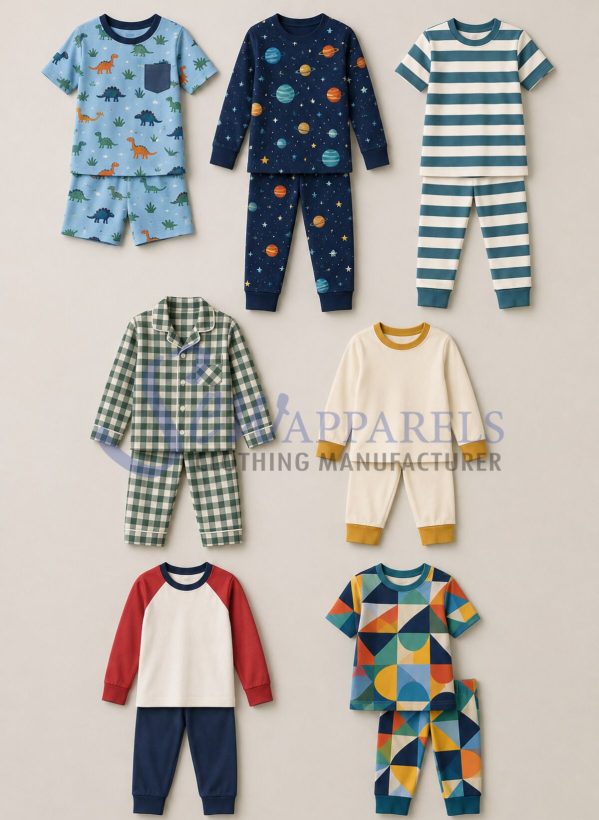
This guide sets out five practical checks for planning and reviewing printed pajama sets. It concentrates on artwork relationships across garment pieces; it does not replace fit, seam construction or market-specific product requirements. Use Sew Apparels’ custom kids pajama sets manufacturing page when preparing the wider product brief. Start with the intended appearance, identify the evidence needed to confirm it, and keep unnecessary matching demands out of the specification.
1. Kids Pajama All Over Print Continuity: Control the Master
A reliable kids pajama all over print continuity review starts with a single identified reference for the top and trousers. Record the artwork name, revision, repeat dimensions, colour references and intended fabric. State whether both pieces use the same repeat or approved variations of it. A file called final is not enough when several versions circulate between a buyer, print supplier and garment team. Each participant should be able to identify the reference being discussed.
Pajama set artwork version control also requires a change record. If a motif is resized, a colour is adjusted or a repeat is rearranged, explain which garment pieces are affected. Retain the previously approved reference so reviewers can compare the actual change. Avoid approving the top from one revision and the trousers from another simply because both samples are individually attractive. The set must be reviewed as a coordinated product.
Make kids pajama sets matching print artwork master an explicit field in the product brief. Identify who issues the controlled file and who confirms receipt. When a supplier proposes a technical adaptation, ask for a visible explanation and a revised reference before approval. Do not assume that every print process reproduces the same file in the same way. The supplier should explain any change that affects the intended relationship between motifs.
2. Review motif scale on the smallest and largest pieces
Pajama set all over motif scale should be reviewed on actual garment shapes. A large motif may appear complete on the body of a larger top while being cropped repeatedly on a smaller sleeve. That difference is not automatically a defect, but the buyer should decide whether it suits the design. Mark the areas where partial motifs are acceptable and those where their appearance needs closer review.
Kids pajama all over print continuity does not mean every size must show the same number of motifs. A fixed fabric repeat interacts with differently sized pattern pieces. If a design needs controlled placement or size-specific artwork, identify that requirement separately and ask the supplier how it will be achieved. Do not quietly treat a general all-over repeat as an engineered placement print; the development and consumption assumptions can differ.
Use kids pajama sets pajama motif size scaling as a review topic, rather than an instruction to resize artwork automatically. Confirm whether the repeat remains constant across sizes. For kids pajama sets small size motif placement, inspect cuffs, sleeves, narrow trouser sections and visible front areas. For kids pajama sets large size print appearance, check whether spacing and colour balance still feel consistent with the smaller set. Record the decision against the actual size reviewed.
An artwork continuity matrix
The matrix below keeps appearance decisions connected to specific pieces. Add the actual revision, sample identity and approval date to your working copy. Its purpose is to show what must be controlled; it does not prescribe a universal motif size, seam tolerance or matching rule.
| Review field | Piece or area | Decision to record |
|---|---|---|
| Kids pajama sets matching print artwork master | Complete set | Artwork revision, repeat reference and authorised issuer |
| Kids pajama sets pajama motif size scaling | Smallest and largest sizes | Fixed repeat or separately approved size treatment |
| Kids pajama sets top bottom repeat orientation | Top and trousers | Allowed direction and paired appearance reference |
| Kids pajama sets pajama matching zone specification | Named visible joins | Required relationship and acceptance reference |
| Kids pajama sets print version identification | Each reviewed sample | Sample identity linked to the controlled artwork |
| Kids pajama sets paired pajama print approval | Finished top and trousers | Reviewer, date and unresolved appearance points |
3. Specify the matching zones that matter
Kids pajama print repeat allocation should reflect the appearance the buyer actually needs. Identify whether the print direction is one-way, two-way or unrestricted within the approved design. Explain whether both garment pieces must present motifs in the same direction when worn. If contrasting cuffs or panels are used, state whether they deliberately interrupt the repeat. Those details give the cutting and sample teams a usable target.
For kids pajama all over print continuity, distinguish visual coordination from exact motif alignment. Children pajama top bottom print consistency can mean shared scale, direction and colour relationships without requiring a motif to continue physically from the top into the trousers. Exact matching at selected garment joins is a separate instruction. Name those joins and provide an accepted sample or annotated reference showing what satisfactory alignment looks like.
Kids pajama sets top bottom repeat orientation should remain consistent with the approved wearing direction. Ask the supplier to show the proposed layout when the brief restricts rotation. A direction requirement can influence material use, but any consumption consequence should come from the actual proposed layout. Avoid copying a fixed waste allowance from another print or promising that stricter matching has no effect on cost.
A kids pajama sets pajama matching zone specification should also state where matching is not required. This gives the team room to use the repeat efficiently while protecting the visible relationships that matter. If a buyer later adds new matching zones, update the artwork continuity matrix and ask whether sample development or quotation assumptions change. The approval record should make the expanded requirement clear to everyone involved.
4. Separate artwork continuity from sizing and care evidence
Kids pajama all over print continuity is an appearance decision, while garment sizing has its own approved measurements and construction requirements. Do not change a pattern merely to fit an attractive motif without reviewing the consequences with the responsible product team. Likewise, a well-proportioned garment can still show an unwanted print direction or mismatched artwork revision. Record these observations separately so the appropriate issue receives the appropriate correction.
Kids pajama sets set fabric print consistency should be reviewed under comparable viewing conditions. Identify the fabric and print route used for both pieces, and distinguish an approved strike-off from a finished garment sample. If the top and trousers use different constructions, ask how the intended colour and appearance relationship will be assessed. Do not assume that the same colour reference guarantees an identical visual result on every substrate.
For US children’s sleepwear, the CPSC sleepwear guidance explains that classification considers construction, intended use, marketing and fabric features, among other factors. The actual product needs an appropriate review; a coordinated print is not proof of compliance. Colour or print changes can also matter to the evidence supporting production units. Have the responsible team determine the requirements for the actual decorated set rather than treating a previously reviewed fabric as automatic approval of every print variation.
Kids pajama sets pajama repeat design control should include the agreed care assessment where it affects appearance approval. ISO 105-C06 covers colour fastness to domestic and commercial laundering under specified conditions. A reference to that standard does not establish a universal acceptance grade or predict an untested set’s lifespan. Ask a qualified laboratory or responsible reviewer to identify the applicable procedure and interpretation. Keep sample identity and artwork revision linked to the resulting evidence.
When reviewing kids pajama all over print continuity after the agreed care assessment, compare the paired set with its recorded starting condition. Note which observations concern colour appearance and which concern garment dimensions or construction. Do not interpret every changed motif relationship as a printing problem. The technical team should investigate the relevant material and garment evidence before recommending a correction.
5. Approve paired samples and preserve the version record
Kids pajama sets artwork continuity sample review should use the top and trousers together. Place each sample against the controlled artwork reference and record the size, material and revision represented. Review the set in its intended orientation, then inspect the specified matching zones. Kids pajama all over print continuity requires that paired evidence. A photograph of a single top cannot establish that the trousers share the approved repeat direction or print version.
Kids pajama sets paired pajama print approval should state what has been accepted and what still requires action. If a small-size sample is approved but the largest size remains unreviewed, keep that distinction visible. If only fabric appearance has been accepted, do not describe the full garment set as approved. A focused approval record helps the supplier act without guessing whether the buyer meant colour, motif placement, fit or the whole product.
Kids pajama sets print version identification belongs on the sample record and related reference documents. When an artwork update arrives, compare it with the accepted version and list affected pieces. Withdraw the old reference from active use through the team’s controlled process, while retaining the history needed to understand earlier approvals. The objective is to prevent mixed revisions from reaching the same set.
Buyer questions before production approval
Must every seam match exactly?
No. Decide which relationships are important to the design and identify those zones explicitly. Kids pajama all over print continuity should protect the intended appearance. Exact matching everywhere may add constraints without improving the buyer’s intended appearance. Ask the supplier to explain the proposed layout and sample result before extending the requirement to additional joins.
Should the artwork change with garment size?
That is a design decision requiring a clear technical brief. Review the smallest and largest pieces before choosing. For custom kids pajama set manufacturing, explain whether the fabric repeat stays fixed. For private label kids pajama set production, keep any approved size-specific variation linked to the set’s reference and quotation assumptions.
What should a startup brand send first?
Send the controlled repeat reference, intended fabric, size range and required matching zones. Add any known colour or direction requirements and identify the decisions that still need supplier input. This gives the development discussion a practical starting point without implying that print appearance alone completes the wider product review.
Kids Pajama All Over Print Continuity: Approval Brief
Kids pajama all over print continuity becomes easier to manage when artwork, size review and matching requirements are recorded together. Keep one controlled master, assess motif scale on representative pieces and approve the top and trousers as a pair. Use specific evidence for changes and avoid unnecessary matching demands that the design does not require.
The Kids Pajama Buying Guides connect this artwork decision with related product development topics. Carry the approved continuity matrix into the supplier brief so the selected appearance remains traceable through sampling and production review.
For custom kids pajama set manufacturing, submit the controlled repeat, paired sample references, destination and quantities with the quotation brief.
For private label kids pajama set production, identify unapproved artwork or matching assumptions before confirming the order version.
Use the stripe costing comparison for material-route and consumption questions. A coordinated appearance does not establish an equivalent cost basis.