
SEW APPARELS · BUYER RESOURCES
Kids T-Shirts Buying Guides
Kids t-shirts buying guides help childrenswear brands connect fabric, fit, necklines and artwork before they approve a production sample. Start with the development topic below, then use the six planning sections to organise a practical brief for your collection.
These resources support regular, relaxed, oversized and graphic kids tees. Bring your age bands, measurements and artwork requirements into the discussion so the finished garment reflects your own retail fit and brand direction.
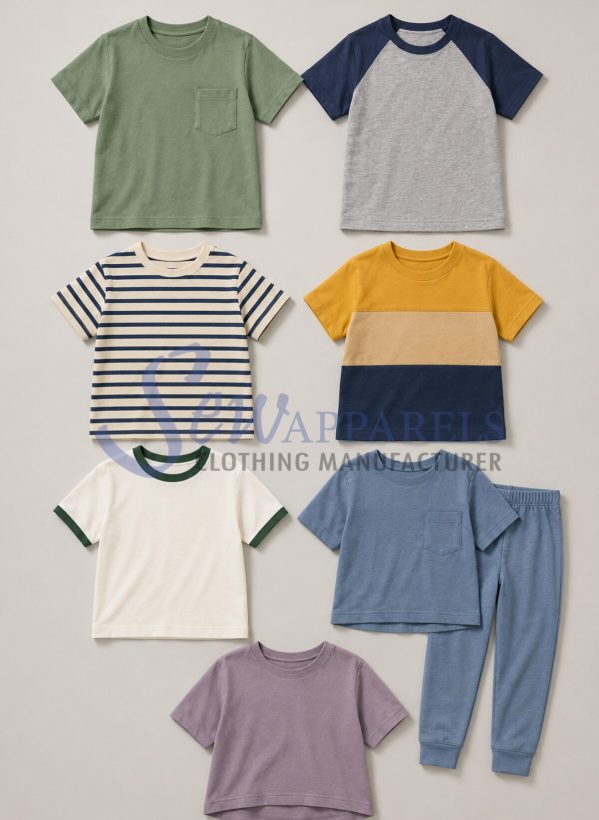
Existing Sew Apparels product-page illustration reused for kids t-shirts buying guides. It provides style context rather than proof of fibre composition, neckline recovery, print durability, approved fit or current material availability; confirm the actual garment sample, technical specification and quotation separately.
Start with neck rib proportion
Compare seven checks for finished rib width, stretch recovery, shoulder openings and after-care shape. The detailed guide includes an annotated construction plan, buyer decision table and approval questions for your sample room.
Read the neckline guidePrint hand feel choices: softness and wash durability
Compare print methods for a comfortable kids T-shirt hand feel while planning wash performance and artwork detail. Use the technical guide to record sample checks.
Read the print hand feel guidePrint colour separation costing: artwork and quote scope
Define artwork colours, print dimensions and quantity allocation before comparing decoration quotes. Use five checks and a cost-driver worksheet to record shared setups, approved simplifications and supplier-entered charges.
Read the colour separation costing guideTubular construction quotes: size coverage and route comparison
Compare tubular and side-seamed tee proposals against the same silhouette and size range. Use five checks and a quote worksheet to record fabric coverage, decoration assumptions, consumption, development charges and sample fit.
Read the tubular construction quote guideDecoration proof stages: strike-off and garment evidence
Define which observations a strike-off can support and which need a complete decorated tee. Use five checks and a proof-scope matrix to connect colour, placement, care questions and release decisions to the right evidence.
Read the decoration proof stages guideHanger neck distortion: retail handling and compatibility
Review the actual tee and retail hanger together. Use five checks and a compatibility chart to record size coverage, loading and removal, display observations and the approved handling route.
Read the hanger compatibility guidePrivate label data consistency: garment, pack and listing
Reconcile garment labels, packaging and retail listings against one approved tee variant record. Use five checks and a worksheet to assign evidence owners, resolve discrepancies and approve the complete proof set.
Read the data consistency guide1. Build the jersey and fabric brief
Choose a body fabric for the intended season, fit and decoration rather than relying only on a fabric name. Combed cotton jersey, cotton-elastane, interlock, blends and slub jersey can offer different surfaces and structures. Include the fibre composition, finished weight, colour standard and expected handfeel in your brief. Ask for a sample that represents the proposed production material, then compare opacity, drape and surface appearance under consistent conditions. Kids t-shirts buying guides work best when each material decision is connected to a specific style and approved sample reference.
Plan the review around how the fabric behaves after finishing and care. Record the agreed washing and drying process, measurement condition and acceptable changes in dimensions or appearance. Compare the rib and body as a pair when the neckline depends on their interaction. The University of Kentucky resource on sewing with knits provides useful background on knit stretch, recovery and construction. Use technical references to frame questions for your sample team, while the actual garment and agreed testing plan determine the final approval.
2. Coordinate necklines, shoulders and kids size grading
A kids T-shirt needs its own proportion review across the proposed age range. Define chest width, body length, shoulder position, sleeve dimensions, neck opening and front neck drop in a measurement table. Regular and oversized tees should have distinct fit references so extra ease is intentional. Review the smallest, middle and largest relevant development sizes, then expand the checks where the range changes block or construction. Kids t-shirts buying guides connect these fit decisions with the visible neckline instead of treating rib width as a separate trim purchase.
For the neckband, distinguish the finished visible width from the cut strip dimensions and seam allowances. Check the rib join, seam flexibility and back-neck tape together on a sewn sample. In the Folds explains practical neckline ratio development and why trials in the intended materials matter. Avoid transferring a ratio from another fabric without review. If a shoulder opening is part of the design, specify its position, overlap and inside finish, with the appropriate closure suitability and attachment assessment for the target wearer.
3. Plan graphics, print handfeel and private labels
A chest graphic should be reviewed on the garment sizes where it will actually appear. Define artwork dimensions, placement reference points and any scaling rules across age bands. Compare the proposed decoration on the chosen jersey because fabric colour, surface and weight can affect the result. Water-based printing, screen printing, transfers, puff effects, embroidery and appliqué each need a suitable sample review. Kids t-shirts buying guides encourage buyers to describe the desired print handfeel, visual coverage and inside-surface comfort rather than approving a technique by name alone.
Keep artwork files, colour references and placement instructions in one controlled revision. Review the sample before and after the agreed care procedure, recording the visible finish and feel without claiming performance that has not been tested. Private labels also need clear instructions: printed neck marks, woven labels, care labels, hangtags and size stickers should match your approved brand manual. For multipacks, identify which graphics and colours belong together, how sizes are marked and whether each piece requires separate labeling. This reduces ambiguity when sampling moves into packing preparation. Compare soft ink finish, coverage and the reverse surface in our kids T-shirt print handfeel guide before signing off the decoration.
4. Low MOQ kids T-shirt manufacturer planning
Brands searching for a low MOQ kids T-shirt manufacturer should define how the minimum applies before dividing an order into several graphics and colours. Sew Apparels lists a standard minimum of 500 pieces per design and colour on its main product page. Confirm the applicable quantity basis for your specific school or retail program, together with fabric sourcing, weight, colour, artwork and size ratios, before using that figure to calculate a collection budget. Record any project-specific conditions in the quotation rather than assuming the same arrangement covers every style.
A focused first range can make the development brief easier to control. Identify a core fit, a manageable colour selection and the graphics that must be sampled before approval. Discuss whether any proposed common materials or construction details can be coordinated across styles; do not assume that shared fabric automatically combines separate minimums. Kids t-shirts buying guides provide a planning framework, while the quotation confirms actual order conditions. List sample costs, packaging requirements, shipment arrangements and revision needs clearly so your comparison includes the complete product specification.
5. Support for startup kidswear brands
Startup brands can approach Sew Apparels with a measured reference garment, an initial tech pack or a clearly defined design brief. Explain your target age group, retail fit, launch quantity and artwork priorities so the team can review what is needed for sampling. A new label should prioritise a dependable base fit and approved fabric before expanding its assortment. Kids t-shirts buying guides help turn early ideas into specific decisions about measurements, necklines, decoration and packing. Confirm available development support, responsibilities and costs for your project rather than assuming every service is automatically included.
6. Turn sample comments into a production approval
Keep sample comments in one revision record with material codes, measurements, artwork versions and photographs of unresolved details. The main product page lists sampling at 10–15 days and production at 15–30 days at the applicable MOQ after pre-production approval; confirm the current schedule for your quantity, customised fabric, trims and packing. Use kids t-shirts buying guides to check that neckline, fit and decoration decisions are closed before release. Ask the team to confirm any open actions, delivery assumptions and inspection requirements, then retain the approved reference for repeat orders and later colour additions.
Turn your kids T-shirt decisions into a product brief
Bring your age range, fabric direction, neckline requirements, artwork and quantity plan together. Review the kids T-shirt manufacturing service and share a focused brief for a quotation and sampling discussion.
Explore kids T-shirt manufacturing