
School cardigan spare button quantity planning connects approved component references with actual repair demand, available stock and supplier terms. It is not a reason to add an arbitrary percentage to every garment order. A reserve can support a schoolwear programme only when buyers know which cardigan the button fits, where the stock will be held and how replacements will be controlled.
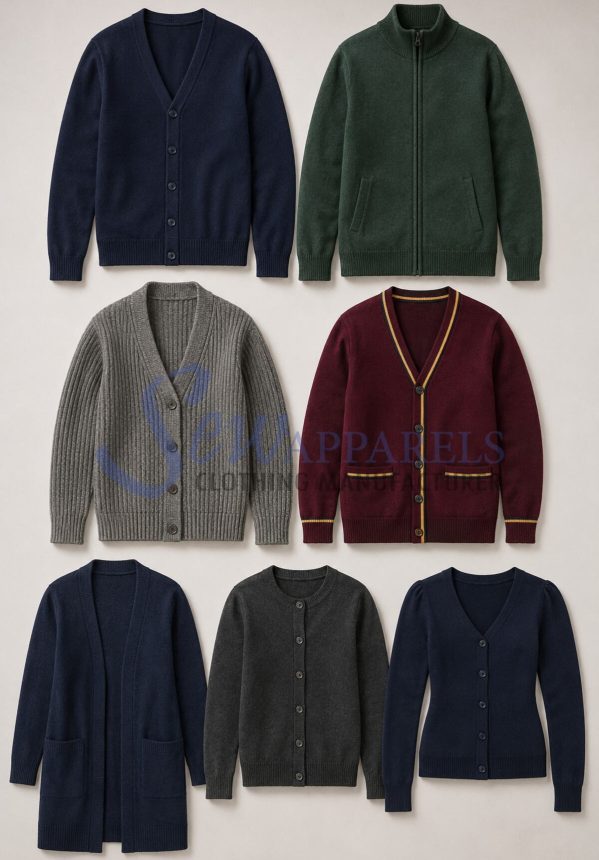
This guide explains five practical buying decisions and a worksheet for school cardigan spare button quantity planning. It addresses replacement-component purchasing rather than button-band construction. Existing production approval still governs the garment. Do not treat spare stock as evidence that an attachment or component issue has been resolved, and do not distribute loose components to young children without a responsible distribution review.
1. Identify every approved button variant
Begin with the sealed cardigan reference, bill of materials and component specification. Record button supplier, code, material description, dimensions, colour, finish, hole or shank arrangement and any school-specific appearance requirements. Link each reference to the styles and size ranges where it is approved. Two buttons that look similar may differ in thickness, attachment route or suitability for the existing buttonhole.
A school cardigan button reference inventory should distinguish production components from proposed alternatives. Keep a physical reference under controlled ownership and record the specification revision. If a replacement is selected by colour alone, the buyer may lose the connection with the approved garment. Ask the responsible supplier to confirm the relevant fit and attachment requirements rather than assuming a matching photograph is enough.
Use a school cardigans approved button variant register to separate branded, plain, contrast and style-specific buttons where those variants genuinely exist. Record which variants are shared, but do not create unnecessary stock lines for the sake of a large register. A shared reference should have documented approval for each linked style. Where evidence is missing, mark the mapping open instead of merging components because they have similar names.
School cardigans component to style mapping should include garment version and production period. A reserve for an older cardigan may remain useful for repairs even after a new range is introduced, but its purpose differs from the new programme’s reserve. Keep those inventories distinct. State whether a supplier code changed and whether the physical component changed, because an administrative renaming and a material substitution need different reviews.
2. Build the demand input from actual records
School cardigan spare button quantity planning needs an identified planning period and a description of the repair service being supported. Gather recorded button issues, stock issued for approved repairs, usable closing stock and any confirmed outstanding requests. Garment sales alone do not reveal replacement demand. Avoid presenting an assumed annual loss rate as evidence simply because a schoolwear programme has a known garment quantity.
A school cardigans historical button usage record should distinguish components issued from components actually fitted when that information is available. Record returns, damaged stock, transfers and unfulfilled requests separately. If the data cannot distinguish those events, explain the limitation. A register showing ten issued units does not necessarily prove ten garments needed repair, nor does a quiet period prove that future demand is zero.
For school cardigans schoolwear repair demand input, identify the source, period, covered styles and responsible owner. A central repair desk, retailer or school may hold different information. Reconcile records only when they refer to the same population and period, so the same request is not counted twice. Use aggregated operational quantities; personal student information is unnecessary for a component-order worksheet.
Where history is unavailable, school cardigan spare button quantity planning should remain explicit about the uncertainty. Use confirmed requests, a provisional buyer-controlled assumption or a limited review period agreed with the supplier. Label estimates as estimates and name who approved them. Do not invent a repair rate, a guaranteed reserve coverage period or savings from stocking components before actual demand and replenishment conditions are known.
3. Separate reserve stock from garment packing
A school cardigan spare trim quantity can refer to different purposes: components supplied for a controlled repair service, components used during production, or a packing arrangement expressly agreed for the garment order. List those purposes separately. Otherwise a quotation may count the same spare once as loose reserve stock and again as an included garment accessory without explaining what will actually be delivered.
School cardigans loose component distribution review should identify a responsible adult or repair operation, storage location and issue procedure. Do not recommend loose buttons be handed to young children. Confirm the intended distribution and packaging with the responsible parties, including age-related and market-specific considerations. A purchasing worksheet is not a safety assessment and should not imply that reserve quantity makes a distribution route appropriate.
For a school cardigan replacement button order, state whether the supplier is quoting loose components, labelled packs or an agreed service arrangement. Request unit definition and pack count. Keep packaging identity connected to the component reference and avoid a generic mixed bag when variants need separate control. Agree how shortages, incorrect references and damaged deliveries will be recorded before the reserve is accepted into stock.
Record school cardigans school cardigan spare stock by usable quantity rather than total quantity on the shelf. Quarantine unidentified, damaged or unapproved components until reviewed. Decide who can authorise release for repairs and how the issued reference is recorded. A reserve becomes less useful when its stock count is accurate but no one can confirm whether it matches the cardigan requiring attention.
4. Confirm supplier minimums and continuity
School cardigan spare button quantity planning must separate the desired reserve from the supplier’s feasible purchasing unit. Ask whether a minimum applies to the component reference, colour, branded design or pack. Confirm whether the quotation includes setup, packaging or other agreed charges. Do not infer spare-component terms from the garment minimum: the two buying routes may use different quantities and assumptions.
A school cardigan repair component MOQ enquiry should name the approved reference and ask for the current minimum and order increment. Request confirmation rather than asserting that a small order is always available. If the quoted minimum exceeds the proposed reserve, show the excess separately and decide whether to buy it, combine only approved requirements or discuss a different feasible arrangement. Do not conceal excess stock inside a higher demand estimate.
The school cardigans spare button supplier minimum belongs beside its date and conditions in the worksheet. Quote validity, reference availability and replenishment assumptions can affect the decision, but no lead time or continuity promise should be invented. Ask what happens if the component is discontinued and whether the supplier will notify the buyer of relevant changes. Any proposed alternate needs its own approval route.
School cardigans replacement button continuity involves more than keeping a supplier name. Preserve material and finish references, approved samples, relevant evidence and a change log. For U.S. children’s products, CPSC material-change guidance explains that changes affecting compliance can require testing and certification review. The responsible manufacturer or importer must determine applicable requirements; a visually similar replacement is not automatically covered by earlier evidence.
Request a school cardigans cardigan repair component quote that shows component quantity, order unit, agreed pack, charges, exclusions and approval assumptions. Keep the component offer separate from the garment offer while linking both to the same style references. A low unit figure may not describe the total purchasing commitment if minimum quantities, setup or excess ownership remain unresolved.
5. Reconcile quantities and approve the buying decision
A school cardigans button reserve order quantity should follow a transparent calculation. Start with confirmed replacement requirements for the planning period and any separately approved reserve assumption. Deduct verified usable stock that is genuinely available for those styles. Then apply the supplier’s confirmed purchasing constraints, showing the effect rather than rewriting the underlying requirement. Review each reference separately before combining the order.
For a school cardigan spare button quantity planning illustration, suppose a buyer confirms 12 outstanding replacement units, approves a provisional reserve of 8 units and verifies 5 usable units already held for that exact reference. The proposed requirement is 12 + 8 − 5 = 15 units. If the supplier separately quotes an order minimum of 20 units, the purchasing decision includes 5 units above the calculated requirement. These numbers are not a recommended reserve, failure rate or Sew Apparels minimum.
A school cardigans spare part order assumption should explain why the provisional reserve was approved, who owns the excess and when the stock decision will be reviewed. Keep calculated requirement, purchase quantity and excess quantity in different fields. If available stock exceeds the confirmed requirement, investigate the apparent surplus before buying more. Confirm that existing stock is approved and accessible rather than treating every positive balance as usable.
CPSC tracking-label guidance describes identifying information for U.S. children’s products and their packaging, to the extent practicable. It supports the importance of traceable production information; it does not provide a spare-button reserve formula or replace applicable safety requirements. Maintain the connection between component records and relevant garment production references for the market being served.
School cardigan spare button quantity planning should finish with approved references, a signed-off quantity decision and a named stock owner. Confirm the receipt and discrepancy process, issue authority and replenishment review. Do not release a substitute simply to meet an urgent request when its suitability remains unresolved. Keep the repair route connected to the responsible supplier and the garment’s controlled specification.
Worksheet for school cardigan spare button quantity planning
Use one row per approved component reference and a clear planning period. Keep supporting evidence beside the row or in a linked controlled record. This worksheet makes the buying decision reviewable without turning an estimated reserve into an unsupported technical claim.
- Style connection: cardigan version, approved button code, physical reference and responsible approver.
- Demand evidence: confirmed repair requests, historical usage period and identified information gaps.
- Stock input: verified usable balance, committed stock, quarantined components and storage owner.
- Planning assumption: proposed reserve, reason, approver and review date.
- Supplier terms: minimum, increment, pack definition, quotation date, charges and continuity conditions.
- Decision: calculated requirement, purchase quantity, excess ownership, reference approval and issue route.
Prepare a school cardigan spare button quantity planning enquiry
For custom school cardigan manufacturing, send the approved button register and quantity worksheet with the garment references. Use the school cardigans manufacturing page to prepare a product-specific discussion. Ask the supplier to confirm actual component feasibility, minimums and quotation conditions; the worksheet does not establish availability, repair-service coverage or a fixed commercial offer.
In private label school cardigan production, connect the spare-parts decision with the wider specification through the school cardigans buying guides. Preserve construction, care and component approvals while keeping replacement purchasing separately documented. Complete school cardigan spare button quantity planning before the order is released so quantity, ownership and approved reference describe the same controlled requirement.