
PE uniform print colour migration checks should begin with an investigation, not an instant diagnosis. A pale school badge that changes shade on a dark garment can create an approval problem, but appearance alone does not prove where the colour came from. Buyers need the substrate identity, decoration specification, processing record and retained comparisons before deciding whether to resample or change the production brief.
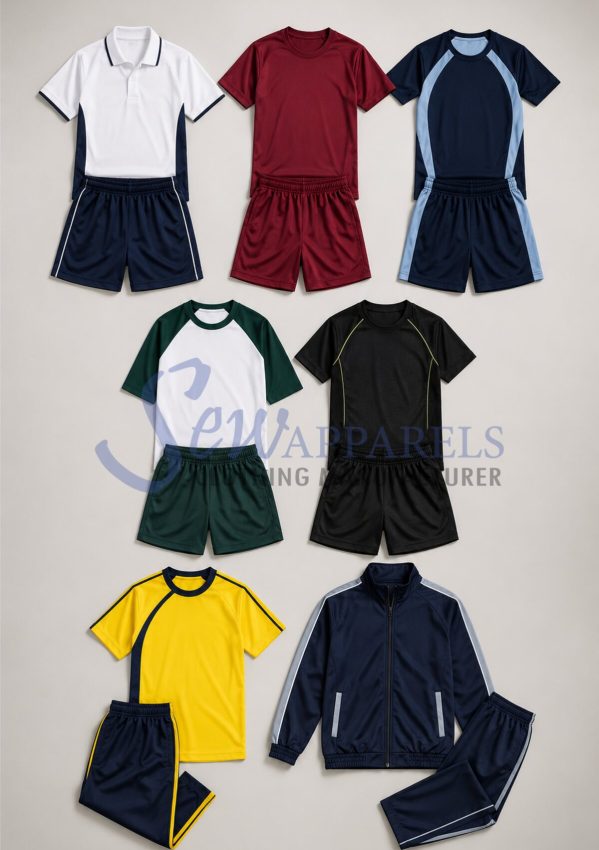
This guide sets out five critical evidence checks for a complete PE kit. PE uniform print colour migration checks concern the interaction between decoration and its supporting material; colour-blocking construction concerns panel arrangement and assembly. Keep the two decisions separate. Use PE uniform production-route quotation comparisons to document any revised commercial scope. No universal press setting, blocker layer or wash instruction can be approved from a photograph. The exact garment, decoration and intended care route must be reviewed together.
1. Identify the substrate and decoration combination
Record the fabric supplier, material code, fibre composition, colour reference, lot and finishing information available for the affected panel. A dark polyester description is not a complete material specification. Keep an undecorated swatch from the same lot, together with the decorated sample, so later discussions do not rely on a similar-looking replacement. Note whether the garment uses different materials at the badge, body, sleeve and contrast panels.
A PE kit polyester dye migration enquiry should distinguish a proposed explanation from a verified finding. Ask the fabric supplier and decorator what evidence would support that explanation for this substrate. Do not assume that all polyester behaves identically or that a report from another colour covers the affected lot. If composition or finish information is missing, list that gap before changing the decoration specification.
For PE uniforms badge substrate sample identity, connect the decoration to its own reference: transfer or print product, supplier, artwork revision, colour specification, component lot and any documented application instructions. A badge with the same visual design may use different materials on a repeat order. Record production-intent backing or barrier components where specified, without assuming that any layer guarantees resistance to colour change.
The PE uniforms polyester garment decoration compatibility decision belongs to a defined combination. A decorator’s experience with a light fabric does not automatically cover a dark fabric, and an acceptable logo trial does not automatically cover a larger print. State the artwork dimensions and placement. Retain enough reference material for agreed comparisons and identify which proposed changes would require a new approval.
2. Reconstruct the processing and storage history
PE uniform print colour migration checks need a timeline showing when the affected area was first observed and what happened before that observation. Record decoration date, the equipment used, the supplier’s specified application window and the actual recorded settings where available. Include pre-treatment, repeated pressing, correction work and later processing. Mark unknown values as unknown rather than filling them with an operator’s usual practice.
A PE kit decorated sample heat history should distinguish the machine display from the evidence available about actual processing. Equipment checks, maintenance records and the decorator’s observations may help explain whether the intended process was followed. Buyers should request that evidence rather than prescribe a temperature or pressure from general internet advice. Process changes must also preserve adhesion, appearance and the material’s other requirements.
Use a PE uniforms transfer press history record to link every application or reapplication to a sample ID, date, operator and reason. If one badge received additional work while another did not, keep those histories separate. A repressed sample cannot serve as an unchanged control. Record whether samples were stacked, packaged, transported or exposed to later heat, but do not treat a recorded event as proof of the cause.
PE uniforms stored print colour changes require dated observations. Keep the first accepted appearance record, the later affected sample and a description of storage conditions that can actually be established. Note packaging contact and whether other colours or surfaces were nearby. Avoid inventing exposure durations or retrospectively declaring an unobserved sample acceptable. A useful timeline separates observed facts, reported facts and working hypotheses.
3. Compare references without confusing failure types
Build a PE uniforms decorated undecorated comparison using traceable material and decoration references. Ask the decorator or laboratory which controls are suitable for the investigation. Depending on the question, the comparison may require affected and unaffected decorated samples, an undecorated substrate, a decoration reference and a retained production sample. Describe any differences in lot, process or storage so the comparison remains interpretable.
Record school sportswear badge colour contamination as an observation before selecting a mechanism. Is the change visible across the entire pale area, only at an edge, or where another surface touched it? Does it occur before care, after care or after an unrecorded event? Keep colour change, staining, adhesion loss, cracking and gloss change in separate fields. Several defects can coexist without sharing one cause.
A PE uniforms light print colour contamination review should use an agreed viewing arrangement and consistent sample positioning. Photographs can document location and sequence, but differences in lighting, camera processing or display can mislead a colour comparison. If instrumental or graded assessment is required, ask the responsible specialist to define it. Do not create a pass limit based on a phone image that the buyer and decorator interpret differently.
For PE uniforms dark substrate print interaction, compare only the variables the investigation is designed to address. Changing fabric, decoration, artwork coverage and pressing conditions simultaneously may produce a different result without identifying why. Label each trial clearly, preserve the original affected sample and record the intended change. Where practical, request a controlled comparison with the responsible supplier instead of repeatedly altering an unrecorded sample.
4. Agree an appropriate evaluation with the decorator
A PE shirt transfer print substrate test brief should explain the actual observed problem, intended use and known history. Ask the decorator or laboratory which evaluation can address that question, what specimen preparation is required and what the result can establish. PE uniform print colour migration checks should not use a convenient report as evidence for a mechanism outside the method’s scope.
ISO 105-C06:2010 concerns textile colour fastness under defined domestic and commercial laundering conditions. Its published scope can help distinguish a laundering question from a decoration-processing or storage question. A laundering result alone does not diagnose a suspected migration mechanism. Agree the relevant test conditions and interpretation with a suitable laboratory; do not claim that a report certifies the complete PE kit.
Request PE uniforms decorator process evidence alongside the sample result. The response should identify the evaluated substrate, decoration system, application conditions and any limitations. Where a supplier proposes a different component or application route, record that as a candidate requiring validation. Do not describe it as migration-proof simply because the supplier recommends it, or assume that one successful small trial establishes every artwork and colour combination.
A PE uniforms heat exposure investigation needs a specialist-defined scope rather than deliberate uncontrolled heating. Explain whether the concern arose during application, subsequent processing, care or storage. Ask which controlled comparison is appropriate and who will carry it out. Record its purpose separately from routine care validation. An accelerated evaluation should not be translated into a claimed service life without evidence supporting that interpretation.
5. Approve the exact combination and care evidence
PE uniform print colour migration checks should end with a documented decision: approve the evaluated combination, request a defined resample or keep approval open because evidence is missing. Name the fabric lot or controlled material reference, decoration identity, artwork and agreed process. Record the acceptance criteria before reviewing the next sample so a visually improved result does not quietly replace the original requirements.
A PE uniforms print colour resample request should identify the proposed change, the reason for it and the comparisons required. Ask the supplier to preserve the reference that generated the concern. If the decoration or substrate changes, confirm which adhesion, appearance, care and garment checks need repeating. Resolve ownership of the trial and the approval record before treating the revised sample as a production instruction.
For U.S.-bound clothing, the FTC care-labeling guidance explains that care instructions need a reasonable evidential basis, including the garment as a whole. This is a market-specific reference, not a universal label prescription. Review the decorated PE kit’s supported care route with the responsible supplier; a sound undecorated-fabric result may leave decoration performance unresolved.
PE uniforms exact decoration combination approval should connect the sealed sample, technical pack, process instructions and production order. State what changes require review: a new substrate reference, decoration component, artwork revision or relevant process change. PE uniform print colour migration checks remain useful for repeat orders only when the approved evidence can be traced to what is actually supplied.
Investigation card for PE uniform print colour migration checks
Use one investigation card per defined sample combination. Keep separate cards when substrate or decoration identity differs, then link them through the same enquiry reference. The card should let a buyer, decorator and laboratory understand what is known without guessing which sample, process or observation a message refers to.
- Identity: garment style, panel, substrate code and lot, decoration system, component reference and artwork revision.
- History: application record, subsequent processing, known storage events and unresolved information gaps.
- Observation: date, location, colour-change description, viewing arrangement and separate records for other defects.
- Comparison: affected sample, suitable controls, differences between samples and retained reference ownership.
- Evaluation: responsible specialist, agreed method, preparation, acceptance criteria and interpretation limits.
- Decision: approved combination, defined resample, missing evidence, responsible approver and revision date.
For example, a pale badge changing appearance on one dark body panel should trigger a traceable comparison, not an immediate replacement of every PE kit material. This is an investigation scenario, not evidence of a particular factory defect. PE uniform print colour migration checks help the team narrow the unresolved question before committing to a change that may affect costing, fit or production approval.
Prepare a focused manufacturing enquiry
For custom pe uniform manufacturing, send the material references, artwork, sample history and observed change with the investigation card. Use the PE uniforms manufacturing page to prepare a product-specific discussion. Current material feasibility, commercial minimums, quotation assumptions and development timing must be confirmed for the requested combination; this article does not promise a particular decoration solution.
In private label pe uniform production, connect this investigation with the wider product brief through the PE uniforms buying guides. Keep panel construction, fabric performance, care and artwork approvals consistent while preserving their separate evidence. Complete PE uniform print colour migration checks before releasing an unresolved combination into the production specification.