
School t shirt raised print sample review should establish what the decoration actually is and how the finished sample compares with the buyer’s intended effect. A raised surface may look convincing in a photograph while losing fine artwork detail or changing the surrounding garment. Approve the actual process, fabric and artwork together rather than accept a generic description of puff or dimensional printing.
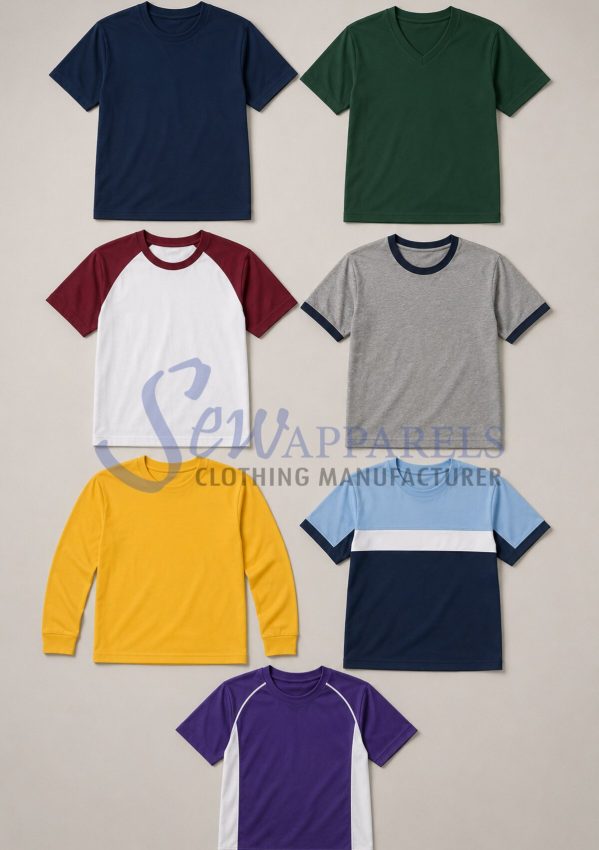
This guide uses five critical checks and an original raised-print proof card. The card connects process identity, a profile reference, artwork detail, garment state, care observations and an approval decision. It provides a framework for product development; it does not prescribe a print height, curing setting, chemistry or durability threshold.
Keep school t shirt raised print sample review distinct from emblem placement planning. Placement establishes where the motif belongs and how its position relates to garment sizes. This review establishes whether the proposed surface effect and reproduced artwork are acceptable on the actual tee. A correctly positioned motif can still require a different decoration sample.
1. Identify the actual raised-print process
Begin by asking the supplier to identify the proposed decoration route and its material references. Record the actual process description, artwork revision, fabric reference, garment colour and sample version. Raised appearance alone cannot establish which material or production route was used. Keep uncertain information open until the responsible supplier can confirm it.
A school tee raised print sample needs traceable development details. Connect the sample with its print-material reference and the supplier’s relevant process record. The buyer does not need to invent machine settings to create a useful brief. The supplier should confirm which controlled details must accompany an approved reference for reproduction.
For school tee raised print process identity, distinguish the proposed effect from the evidence available. If a quotation calls the process puff printing, confirm that this is the actual route represented by the sample. Do not assume another process producing a raised surface has the same preparation, artwork constraints or care response.
A school event shirt raised decoration proposal can explore alternatives, subject to supplier feasibility. Record which option was sampled and which options remain concepts. A digital mock-up or catalogue example may help communicate an aesthetic direction, but it is not approval of the actual fabric, print material or finished garment.
School t shirt raised print sample review should retain the confirmed process identity before comparisons begin. Otherwise, the team may compare two samples as though only artwork changed when the decoration route or material also changed. That uncertainty makes the reason for a different surface appearance harder to establish.
2. Define the intended profile and artwork detail
Use a retained reference to communicate the intended appearance. Identify which areas are expected to appear raised, how the effect relates to adjacent unprinted fabric and which artwork details must remain recognizable. Describe the decision in terms the supplier and buyer can assess on the same sample, rather than rely on a broad request for a premium finish.
A school tee raised ink profile record should identify the comparison reference and how the surface was observed. If the buyer requires a numeric measurement, agree a suitable method and target with the responsible technical team. Do not invent a universal puff height or assume a visual photograph supplies that measurement.
School tee puff print artwork detail should include the actual lettering, line work, open spaces and small features being considered. Compare the reproduced detail with the approved artwork. Record any merging, loss of definition or unclear text as an observation for review. A raised effect can be visually appealing without reproducing every part of the file as intended.
For school t shirt print texture approval, describe the surface observed on the actual sample. Keep texture preference separate from claims about skin contact, chemical safety or comfort performance. An appearance decision does not demonstrate those properties. Any relevant claim needs its own applicable evidence and review.
A school tee dimensional print effect should be evaluated as part of the complete design. Compare the raised and non-raised elements, the garment colour and the overall motif. If the supplier proposes simplifying artwork, obtain approval of the revised file before treating that sample as a match to the original.
School t shirt raised print sample review should conclude this check with a clear profile reference and artwork decision. Mark unresolved detail questions for a revised sample. Do not accept a surface effect through a verbal description while the controlling artwork remains uncertain.
3. Compare complete decorated samples across sizes
Review the actual tee with its intended fabric, garment colour and decoration. Record whether the sample represents the proposed production configuration or another development construction. A print swatch may support a material discussion, but it cannot establish the complete garment’s appearance, placement relationship or response to the finished sample process.
School tee puff print sample size should be chosen from the actual programme. Include the sizes needed to assess the intended motif and garment proportions. If the artwork changes by size band, record each version. Do not extend one size’s acceptance automatically to another version with different artwork dimensions or detail.
Compare the decorated sample relaxed in an agreed garment state. Record how it was laid out or presented and keep those conditions consistent between versions. Assess the surface without stretching one sample merely to make its outline look more similar to the reference. A fair comparison requires the relevant sample conditions to be recorded.
School tee decoration surface distortion should include both the motif and nearby fabric. Note changes in the outline, surrounding puckering or any other visible irregularity requiring technical review. Record what is observed before assigning a cause. The artwork, fabric, process and handling may require separate comparisons to investigate a difference.
A school t shirt print effect reference should identify the accepted garment size, fabric, artwork and process version. Keep it available for later sample comparisons. If the buyer accepts a size-specific interpretation, document that relationship rather than allow a later team to assume one identical result governs the whole range.
School t shirt raised print sample review should separate size coverage from the decision on appearance. Record which samples were assessed, what they demonstrated and what remains unevaluated. A successful review on a representative sample has a defined scope; it is not evidence for every possible fabric or garment configuration.
4. Review care response and visible changes
Plan the care comparison using the intended garment-care route and the programme’s agreed review conditions. Record the actual wash and dry procedure, sample reference and comparison state. Avoid supplying an unsupported temperature, cycle count or ironing instruction as a universal recommendation for raised printing.
School t shirt raised print care needs evidence for the complete decorated garment. Compare its surface, detail and surrounding fabric before and after the agreed procedure. Note any visible change and connect the result with the actual material and artwork references. A statement that a print is washable needs a defined basis rather than a favourable first impression.
Retain the original appearance reference and the evaluated sample as separate records. Identify the care stage represented by each. A team should not confuse an unwashed reference with a post-care sample or interpret a difference caused by the comparison conditions as a decoration failure without reviewing the evidence.
The FTC care-labeling guidance explains that care instructions for covered garments need reliable support for the garment as a whole. For an applicable US-market programme, review the fabric and decoration together when establishing instructions. This guidance does not supply a puff-print durability threshold or a suitable process setting.
School t shirt raised decoration evidence should state the limits of the evaluation. An unchanged appearance after the agreed sample procedure supports that particular observation. It does not establish lifetime performance, chemistry, skin-contact suitability or behaviour under every alternative care method. Keep such claims outside the approval unless suitable evidence covers them.
School t shirt raised print sample review should reopen the relevant questions if the print material, fabric, process or artwork changes. The earlier care result may no longer represent the new configuration. Decide which focused comparisons are needed rather than copy an earlier favourable result into a revised record.
5. Approve the effect with a retained reference
For school t shirt raised print sample review, make the approval specific to the sample and decision. Record the accepted process identity, profile reference, artwork revision, garment configuration and care observations. Name the responsible approver and the unresolved conditions, if any. An approval of artwork alone is different from acceptance of the complete decorated sample.
School tee textured print approval should distinguish accepted, revision required and not evaluated. Use these states for the relevant findings rather than one vague pass covering everything. A surface texture may be accepted while a small letter still needs revision. Preserve both findings so the supplier knows what the next sample must resolve.
A school tee raised motif specification should connect the retained sample with the supplier’s controlled production references. Agree how a later sample or production-intent piece will be compared. Do not add arbitrary tolerances or a guaranteed effect where the buyer and technical team have not established the criteria.
For a US children’s-product programme, the CPSC material-change testing guidance addresses changes that could affect compliance with applicable requirements. Ask the responsible compliance team to review relevant material or process changes and the evidence needed. Appearance approval of a raised print is not a substitute for that assessment or product certification.
School t shirt raised print sample review should keep sample approval and compliance decisions connected but distinct. The buyer’s accepted effect describes an appearance outcome on an identified configuration. It does not establish that every applicable market requirement has been met or permit an unsupported protective or safety claim.
School t shirt raised print sample review: the proof card
Use this original working card for each actual decoration version. It makes comparisons easier to trace without pretending to be a laboratory method or certification document. Populate it with the supplier’s confirmed information and the buyer’s observed findings.
| Review checkpoint | Information required | Actual observation / supplier input | Evidence / sample reference | Decision, limits and owner / date |
|---|---|---|---|---|
| Process: | identify the actual route, print-material reference, fabric and artwork revision. | — | — | — |
| Profile reference: | retain the accepted sample or agreed comparison and observation conditions. | — | — | — |
| Detail: | record text, line and open-space reproduction, including any approved artwork change. | — | — | — |
| Garment state: | identify size, presentation and whether the sample is before or after care. | — | — | — |
| Care observation: | connect visible findings with the actual procedure and its scope. | — | — | — |
| Approval: | state the decision, approver, date, retained reference and remaining questions. | — | — | — |
For school t shirt puff print review, retain failed and revised samples where they explain the final decision. A record of which detail changed is more useful than replacing the earlier file without explanation. Keep development versions distinct from the accepted reference.
Prepare a product-specific development brief
For custom school t shirt manufacturing, share the intended effect, actual artwork, garment range and evidence needed for a sample review. Ask for confirmed process feasibility and quotation inputs. Do not assume an offered decoration method, minimum, price or delivery schedule from a concept alone.
Private label school t shirt production can help a startup organise development around an identified decoration reference rather than several unrelated visual ideas. Begin with the actual product brief, compare feasible sample options and document the accepted version before extending the range.
Use the school T-shirt buying guides for related garment decisions. Complete school t shirt raised print sample review through confirmed process identity, defined artwork detail, complete size samples, recorded care observations and a retained approval reference.