
Swim shorts sand retention cleanout review asks a practical question: after beach exposure, can the buyer remove grit from the pocket bags, seams and folded edges using the intended care route? A short that drains water quickly may still hold particles in an inaccessible corner. Evaluate the complete construction before describing a pocket as easy to clean.
This guide provides a buyer-defined development comparison, not a certified sand-resistance test or a universal cleanout standard. It covers sample identity, exposure conditions, shake-out and rinse observations, dry residue inspection and an approval scorecard. Agree the trial details and care instructions for the actual garment, and avoid promising that one design will release every type of beach sand.
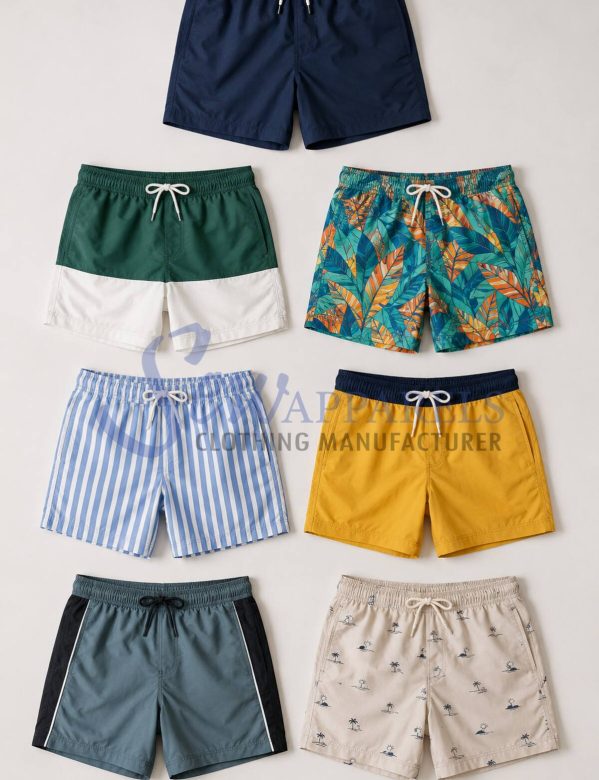
Why swim shorts sand retention cleanout needs its own review
Water drainage and beach short pocket sand retention are related purchasing concerns, but they are different observations. A mesh opening can allow water to leave while some particles remain inside folds or seams. Pocket access, corner construction and the direction in which the garment is emptied also affect what the reviewer can inspect.
Assess cleanout without losing the pocket’s original purpose. A wider opening may help inspection yet reduce security for an intended item. A revised hem may release grit more easily while changing appearance or durability. Record these tradeoffs instead of approving the cleanest-looking sample without considering the finished product brief.
1. Map the places that can retain grit
A swim shorts sand retention cleanout assessment starts with a construction map. Mark side and rear pockets, pocket corners, mesh-to-shell joins, seam allowances, folded hems, waistband channels and liner attachment points. Identify the areas the wearer can reach without dismantling the short or pulling against a seam.
Use production-intent samples with the specified pocket bags, closures, stitch construction and finishing. Record the style revision, size, colourway and material article. A simplified sample with an unfinished pocket or temporary hem can hide the very folds that need evaluation in the final garment.
Inspect the clean sample first. Record pre-existing loose thread, finishing residue or visible debris so it is not later misidentified as retained sand. Photograph the relevant zones with an identifying label and retain an untreated comparison sample where useful. Keep the baseline record beside the trial sheet.
Distinguish corners, seams and folded hems
Swim pocket corner sand may remain loose, while a seam can conceal particles between layers. A short folded hem sand trap creates another construction-specific location to inspect. Record where swim shorts trap grit in seams and exactly where residue is found; a single entry reading “sand in shorts” provides little guidance for revising the pattern or assembly.
Review beach short pocket accessibility: can the bag be turned out through its opening without forcing the fabric? If it cannot, record the access limitation. Do not cut open a pocket during a usability comparison and then describe the outcome as something a customer can achieve through ordinary care.
2. Define repeatable beach-sand trial conditions
For swim shorts sand retention cleanout, define beach sand test conditions, including the challenge material and its condition. Identify the sand source or prepared sample, particle description, amount, moisture condition and how it is introduced. Use the same defined setup for the constructions being compared. A dry, loose challenge and a wet, compacted challenge should not be treated as equivalent.
Choose the exposure to reflect the development question. The buyer may want to investigate pocket entry during beach activity or grit trapped along a folded edge. Describe the sample position, relevant movements and exposure sequence. Keep the trial contained and avoid collecting material from protected locations or introducing unknown contaminated debris.
This is a practical development protocol. Do not label it as a recognized laboratory standard unless the testing party actually uses an identified applicable method. Retain the written procedure and note any changes between trials so the result remains understandable after the samples have moved through the approval process.
Keep the comparison fair
Compare samples of the same relevant size and revision wherever possible. If construction or material differences are intentional, list them. Record who performs the cleanout, how the short is held and what tools or water source are allowed. Extra effort on one sample can make a design appear easier to clean than it is.
Use an agreed number of repeats suitable for the purchasing decision and record variation. A result from one unusually clean pocket should not hide a repeated corner problem. Where outcomes differ, investigate the construction and trial conditions rather than selecting only the most favourable observation.
3. Compare swim shorts sand retention cleanout after shake-out and rinsing
A swim pocket sand cleanout trial should distinguish dry shake-out from the agreed rinse step. The swim short shake out comparison should record sequence, garment position and effort. If a sample is shaken first and then rinsed, keep both observations rather than combining them into an unexplained statement that the pocket cleaned easily.
Define a gentle shake-out route that does not strain the waistband, seams or trims. Check whether the pocket can be emptied through its normal opening and whether corners remain accessible. Avoid aggressive snapping or beating against a hard surface merely to produce a cleaner result.
For beach short rinsing usability, use conditions consistent with the approved care route. Record water conditions and the handling applied to the pocket bag or hem. A construction that requires prolonged manipulation may create a usability concern even if the final visible residue is low. Include that effort in the scorecard.
Use drainage features as an example, not proof
Patagonia’s Baggies pocket details describe mesh drainage corners and a mesh rear pocket bag. This is a useful example of a manufacturer specifying where drainage features sit. It does not establish a sand-cleanout result for that product or for a different short using mesh.
In a custom design, inspect the actual mesh openings, surrounding seams and pocket geometry together. Do not infer that larger openings are always better; consider the items the pocket is intended to retain and the agreed security requirement. Test the proposed combination rather than approving mesh by its name alone.
4. Inspect dry residue without confusing it with retained water
Dry sand residue inspection in a swim shorts sand retention cleanout review needs a defined condition. Wet fabric and water droplets can make particles harder to locate or alter a mass reading. Record the drying or conditioning route and inspect the specified zones under consistent lighting before comparing residue observations.
Look at accessible pocket corners, folded hems, seam joins and the liner boundary. Use the agreed visual inspection approach and record the location of any remaining grit. If a layer cannot be viewed without damage, note the limitation rather than assuming an invisible area is clean.
For sand retained garment weight, establish a comparable clean baseline and a defined post-cleanout condition. Residual moisture, lint, salt or other material can affect the difference. A heavier garment is not automatically proof that the entire added mass is sand. State what the measurement can and cannot establish.
A useful measurement example
For illustration, a conditioned clean sample might be recorded at 150 grams and a post-trial sample at 153 grams. The three-gram difference alone does not identify the material responsible. The reviewer needs comparable conditioning and supporting residue observations before attributing the change. These invented values demonstrate interpretation; they are not Sew Apparels test results or acceptance limits.
If the team wants a sand-specific quantitative assessment, agree an appropriate collection and measurement route with the testing party. Keep its handling, recovery limitations and repeatability documented. Do not turn an uncertain garment-weight difference into a precise percentage-removal marketing claim.
5. Confirm swim shorts sand retention cleanout preserves care and pocket security
Swim garment grit removal should leave the garment functional. After the agreed handling, inspect the pocket bag, seams, hem and closures for visible change. Confirm that normal access still works and that the construction meets its separate item-retention requirement. Cleanout convenience does not excuse a damaged seam or unreliable closure.
Speedo’s swimwear care guide emphasizes fresh-water rinsing and following care instructions. Use manufacturer guidance as context, while validating the label for the actual shell, liner and trims. Instructions for another brand’s fabric should not automatically become instructions for every custom swim short.
Write swim care sand removal instructions that a wearer can reasonably follow through the normal pocket opening. Avoid requiring sharp tools, abrasive brushing or unapproved chemical treatments to remove grit. If ordinary approved care leaves a persistent trap, return the construction to development instead of asking the customer to compensate for it.
Keep related product decisions coordinated
The existing Swim Shorts Buying Guides connect pocket drainage with liner comfort, drying, pool-colour evidence and metal-trim review. Add cleanout observations to that shared brief while keeping each assessment separate. Faster pocket drainage does not prove grit removal, and low residue does not prove chlorine or corrosion resistance.
Review proposed changes as a complete sample. If a pocket corner is opened or a folded hem is revised, recheck the affected fit, appearance, stitching and intended contents. Record the tradeoff and revised drawing so that production does not combine the old specification with only part of the new approval.
6. Approve a scorecard and control revisions
Complete swim shorts sand retention cleanout with a beach use cleanout scorecard. Define each rating before the review: accessibility, handling effort, visible residue by zone, relevant mass interpretation and post-cleanout garment condition. Swim pocket cleaning approval should use buyer-defined acceptable outcomes for the intended use rather than borrowing a universal score from this article.
- Identify the exact sample, pocket and hem revision.
- Record the sand challenge and wet or dry condition.
- Keep shake-out and rinse observations separate.
- List the inspection condition and remaining residue locations.
- Record access effort, damage and pocket-security concerns.
- Assign approval, revision or further investigation with an owner.
Attach dated photographs and the swim shorts sand retention cleanout procedure to the scorecard. Preserve unsuccessful observations as well as favourable ones. A concise record should explain why the sample was approved and what remained outside the assessment, not simply display a green mark beside the word “clean.”
Send a complete manufacturing brief
For custom swim shorts manufacturing, provide the pocket map, hem construction, challenge description, care route and approved sample notes with the quotation brief. Private label swim shorts production benefits from having cleanout expectations defined before the pocket bag and assembly are purchased in bulk. Confirm commercial terms separately with the manufacturer.
Revisit the evidence when mesh, pocket shape, stitch construction, hem fold or closure changes. A visually similar substitute can change access and residue locations. Retain the approved revision and require the affected cleanout observations to be reviewed before transferring the previous decision to the new sample.
Final buyer decision
The final swim shorts sand retention cleanout decision should connect a repeatable challenge with practical access, residue inspection and an undamaged garment. State the trial conditions and claim limits clearly. This supports a useful beach-pocket approval without promising sand-free wear or treating one development comparison as proof for every beach and care situation.