
Track pants tall petite size extension costs include more than the fabric needed for a longer leg. A new length range can change pattern development, fit sampling, cutting plans, trims, labels and inventory allocation. Buyers should separate those costs before deciding whether to add tall, petite or several inseam options to a collection.
This guide explains how to build an incremental assortment budget and request a comparable quotation. It covers the customer brief, pattern scope, sample approval, quantity by variant and purchase release. It does not provide a universal surcharge or promise that shortening a regular pant creates a validated petite fit. Confirm the actual development and production terms for the proposed order.
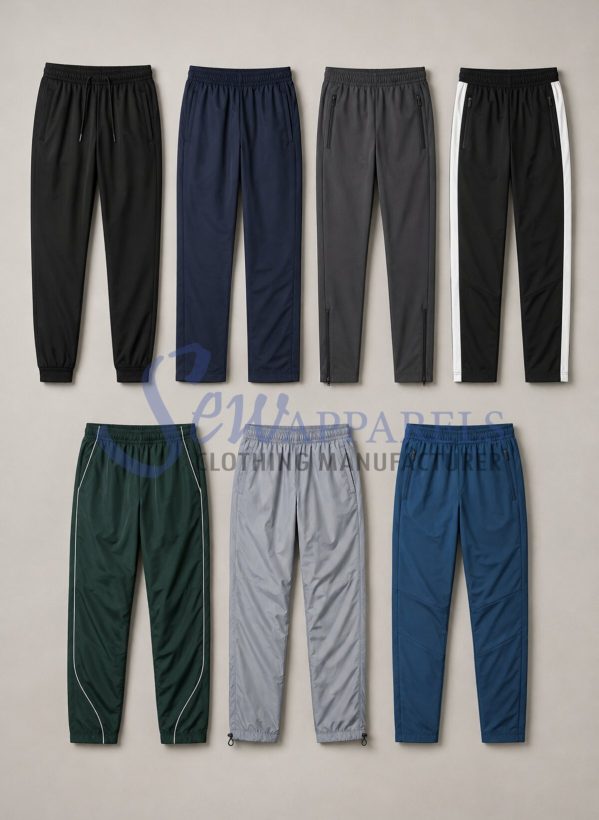
Why track pants tall petite size extension costs need a separate budget
A standard-size order and an extended-length order may share fabric and branding, yet their preparation can differ. Additional patterns and samples may be needed before a final cutting plan exists. At the same time, splitting a fixed order across more variants can leave small quantities in individual length, colour and size combinations.
The track pants additional inseam range cost should separate one-time development charges from recurring garment costs and inventory exposure. A lower unit price does not necessarily make an assortment less expensive if it requires more samples or leaves an unbalanced purchase plan. Compare complete order scenarios using the same assumptions rather than asking for one isolated tall-size surcharge.
1. Define the customer and the length-range promise
Start track pants tall petite size extension costs with the intended wearer. The body height customer brief should record waist and hip range, preferred finished length, footwear and activity. Height alone does not specify every proportion. Ask what problem the additional range should solve: ankle coverage, knee placement, rise comfort or a combination.
Distinguish body measurements from finished garment measurements. Nike’s men’s bottoms size guidance identifies body measurements and describes its tall option with changes to both inseam and rise. That is a brand-specific example of proportion changes; it is not a grading rule to copy automatically into a custom collection.
Write the proposed length names and measurement definitions into the brief. “Tall,” “petite,” “short” and “long” need an agreed meaning for this product. Identify whether each option is a separate proportioned fit or an inseam variant within an otherwise shared fit. That decision changes the development work the supplier should quote.
Set a controlled first assortment
Consider the evidence available for each proposed range. Customer requests, existing fit feedback and the buyer’s intended market can inform the decision without guaranteeing demand. Define which colours and waist sizes will be offered in each length rather than assuming every combination is necessary at launch.
Keep the intended offering consistent across the technical pack, size chart and purchase plan. A sales chart that implies a full petite range while the order contains only a shortened inseam creates a different customer expectation. Resolve the naming and fit promise before labels and product information are prepared.
2. Quote the pattern work instead of assuming simple hemming
For track pants tall petite size extension costs, specify which pattern areas require review. Inseam and outseam length are obvious, but knee position, rise, taper, calf shaping, pocket position and side-stripe landmarks may also be affected. Ask the pattern team to identify the necessary changes for the intended wearer and silhouette.
Simple hemming limitations need explicit review. Shortening below an existing ankle zip can interfere with stops, guard construction and the finished opening. Removing length at the hem of a tapered leg can change its circumference. A side stripe or shaped panel may also require its route to be reconsidered. A regular pant is not automatically a petite fit after a shorter hem.
Tall range pattern cost should reflect proportion changes: adding the entire length at the bottom may leave the knee or pocket in the wrong place. Agree the pattern approach through development and fit review. The quotation should identify whether it includes a new base pattern, length variants, grading, revised component drawings and production-ready files.
Separate scope from ownership and revisions
Request a clear list of deliverables, included revisions and any additional charges. Identify whether pattern preparation, grading and correction after a fit session are separate items or included in a development package. Confirm file availability and approval responsibilities through the commercial agreement rather than assuming all suppliers use the same policy.
Keep the pattern version identifiable in every sample request. When the regular range changes during development, confirm whether the new lengths need the same update. Otherwise a quotation may appear complete while the extended range still uses an earlier waist, pocket or stripe specification.
3. Budget for samples and fit validation
Track pants tall petite size extension costs should include a petite track pants sampling budget alongside any tall-range samples. Define the base-size prototypes, representative length samples and any graded-size checks needed before release. A photo of the regular fit does not establish how the tall or petite range sits during movement.
The additional length sample quote should state sample numbers, material assumptions, revision allowance and delivery terms. Identify whether courier costs, special trims and extra colourways are included. Keep development fabric differences visible when a sample uses a temporary material, because its drape or recovery may not represent the production shell.
For petite range fit validation and tall samples, use suitable wearers and the intended footwear. Check waist hold, rise, knee position, leg rotation, seated movement and ankle clearance. For zipped hems, review dressing access, guard contact and operation. Record measured changes and consolidate feedback into one revision log instead of issuing conflicting requests from several reviewers.
Approve the length range as a complete garment
The existing Track Pants Buying Guides connect ankle-zip construction and side-stripe alignment with sample approval. Length development should coordinate those details. A good inseam measurement cannot compensate for an ankle opening that fails over the intended shoe or a stripe that moves away from its approved landmarks.
Set finished measurement tolerances and the relevant after-care checks with the buyer and manufacturer. Retain the approved sample and pattern revision for each offered range. Do not describe an unreviewed length as approved simply because its nominal measurements were entered into a spreadsheet.
4. Recalculate consumption, cutting and component changes
Review track pants tall petite size extension costs against the actual cutting plan. Added leg length can affect consumption, while the size and length mix influences how pieces are arranged across the usable fabric width. Directional surfaces, stripe restrictions, matching and other nesting constraints may matter to the proposed construction.
Lectra’s Gerber AccuPlan overview describes spread and cut planning and order-specific material calculation. The purchasing lesson is to request consumption based on the actual order and constraints. It does not establish that a particular factory uses that software or that every additional length produces a fixed percentage surcharge.
Ask whether the quotation uses consumption by variant or a blended allowance for the order. Record the fabric price basis, usable width, stated wastage treatment and quantity ratio. Avoid comparing a tall-range quote based on one size mix with a regular quote based on another without explaining the difference.
Check trims, labels and artwork
Review ankle zip length, guard pieces, stripe length, drawcord specification and other components affected by the pattern. Some parts may remain shared, while others require a new article or quantity allocation. Ask the supplier to identify the change rather than adding a blanket trim allowance without a component list.
Record label artwork change cost for length labels, barcode data, packaging descriptions and size-chart artwork. Confirm which items require new artwork or printing and which can use shared information. Keep a length label distinct from a waist-size label so packing can be checked against the order matrix.
5. Count variants and control inventory exposure
A track pants tall petite size extension costs worksheet needs a length colour size variant count showing each combination. For an illustrative assortment with two colours, five waist sizes and three length options, the full combination count is thirty variants. The tall track pant size SKU plan does not require equal purchases; it shows how quickly a broad offering can divide an order.
If the same invented assortment contains 600 pieces, equal allocation would be twenty pieces per variant. This is an example for planning, not a factory minimum or a recommended sales ratio. Track pants length variant order allocation should reflect the buyer’s assortment and the supplier’s confirmed production and material conditions.
Ask which minimums apply at style, colour, material, trim or another level. Do not assume a garment minimum can be divided freely across every length. A shared shell fabric may simplify one part of the order while a length-specific zip, label or cutting arrangement creates another constraint.
Compare a focused launch with a full matrix
A focused launch might offer one additional length in selected colours and waist sizes. A broader launch might include every combination. Compare the development scope, production quantities, unit assumptions and unallocated stock risk for each scenario. Neither option is automatically better without the customer’s fit need and purchase plan.
Keep second length inventory exposure visible when reviewing track pants tall petite size extension costs. Slow-moving combinations can tie up purchasing funds even when their garment cost is close to the regular range. Do not promise that an expanded size range will sell through or produce a specific return rate without the buyer’s own evidence.
6. Approve the incremental budget and purchase release
Summarize track pants tall petite size extension costs in a worksheet with separate lines for pattern development, samples, artwork, recurring material and construction changes, packaging and the agreed order allocation. Record what is included, excluded and still provisional. The extended size purchase plan should show how the incremental budget differs from the approved regular-range scenario.
For an invented illustration, a buyer might allocate $300 to pattern work, $180 to additional samples and $60 to label preparation, giving $540 in one-time preparation. If spread over 600 pieces, that arithmetic equals $0.90 per piece before recurring differences and other costs. These values are not Sew Apparels prices or a quote; the example explains cost separation.
Keep the currency, quotation basis, payment terms and validity period clear in the supplier’s actual offer. If the buyer changes colours, size ratios, lengths or trim specifications, request the affected costs to be recalculated. A previous blended price should not silently carry forward to a different order matrix.
Prepare the manufacturing enquiry
For custom track pants manufacturing, send the wearer brief, regular and proposed length measurements, pattern-change scope, sample plan, colour-size-length quantities and component list together. Private label track pants production is easier to quote when the additional fit promise and order allocation are explicit. Confirm feasibility and commercial terms for the specific enquiry.
Before release, confirm that track pants tall petite size extension costs reflect the approved patterns and samples, the purchase matrix matches the labels, and all quoted assumptions are current. Preserve a separate length range approval record. This supports a controlled assortment extension without treating a longer leg, a shorter hem and a validated tall or petite fit as the same development task.