
Training t shirt sweat mark visibility is an appearance question: how clearly a damp area differs from the surrounding dry fabric under stated conditions. A tee may feel comfortable yet show a distinct patch, while another colourway may conceal the same wet area more effectively. Buyers should compare the actual finished garment rather than infer visibility from a fibre label or a dry swatch.
The aim is to approve colourway appearance with a traceable record. Wet colour darkening, patch boundaries, lighting, finish and care history can all affect what the reviewer sees. Visible sweat patches do not automatically prove poor moisture management, and a discreet patch does not establish rapid drying. These are different product questions requiring different evidence.
This guide explains six development checks for activewear brands. It separates controlled wetting observations from perspiration colourfastness testing and broad sweat-proof claims. The proposed review is a buyer comparison framework, not a licensed laboratory procedure or a statement that Sew Apparels has tested a particular shirt.
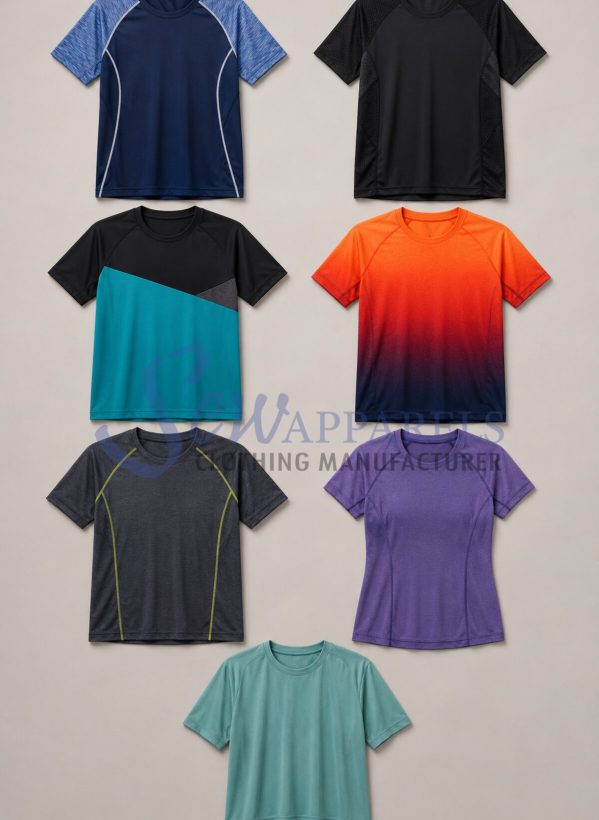
1. Define training t shirt sweat mark visibility for the intended wearer
Write the tee sweat mark consumer brief before choosing a colour. Identify the activity, usual layers, likely viewing conditions and areas of concern. A team training shirt viewed outdoors may need a different appearance review from a gym tee photographed under bright indoor lighting. State whether the buyer is concerned about the first visible patch, the edge of that patch or a mark remaining after drying.
Describe training tee visible sweat patches without treating every darker area as staining. A temporary change during wetting differs from residual discoloration after the fabric returns to its prepared state. Record both separately. A complaint that the back looks darker during a workout should not be entered as a permanent colourfastness failure without the relevant assessment.
Training t shirt sweat mark visibility should have an agreed comparison question. For example, a fictional brief might ask which of three proposed grey colourways shows the least obvious wet patch in the same development setup. That is a relative choice between named samples. It does not establish an invisible-sweat promise across all wearers and environments.
Keep the garment identity visible
List the style, size, colour code, fabric construction, composition, weight, finish and sample revision. Identify decoration and panels near the observed area. Use fabric ventilation design to map mesh and body knit; compare their wet patches separately. If the supplier changes a finish or dye route, keep the revised specimen separate from the original approval.
Ask the buyer what an acceptable appearance actually means. “Looks better” is too vague to control a reorder. Agree the reference shirt, observation conditions and decision owner. Where a numerical or laboratory requirement is needed, obtain an appropriate method and interpretation from the responsible specialist rather than inventing a universal visibility limit.
2. Compare wet and dry shade under consistent lighting
Begin with the prepared dry garments and record their appearance before wetting. Training fabric wet dry shade comparisons need the same background, orientation and viewing arrangement. Avoid judging one sample against a dark surface and another against a light surface. Texture, folds and fabric tension can change the apparent contrast even before moisture is introduced.
Use training t shirt sweat mark visibility to compare the patch with adjacent dry material in the same sample, then compare the named colourways. Wet colour darkening in a training shirt can look different across colours and finishes. A black option is not automatically approved because its dry shade is dark; inspect the actual wet area and its boundary.
Record training shirt wet appearance lighting so another reviewer can understand the result. Identify the light source used for the comparison and avoid mixing daylight, room lighting and phone flash within one sequence. If the product will be reviewed in several relevant settings, retain separate observations for each rather than merging them into one unexplained ranking.
Make photographs useful comparison records
Keep camera position, exposure arrangement and sample orientation consistent where practical. Include the sample identity and observation stage in the record. Automatic image processing can alter apparent colour, so photographs should support the controlled review rather than replace it. Do not edit a patch out of an approval image or brighten one colourway selectively.
Check the tee colourway wet appearance on the assembled garment as well as an appropriate material sample. Seams, ventilation panels, logos and changes in surface texture may make a boundary easier to notice. Describe these local differences. An attractive flat swatch does not settle how the finished front or back will look during use.
3. Control the wetting comparison and patch boundary
A training shirt colour wetting trial needs a controlled wet mark comparison identifying the liquid used, amount applied, application location, prepared sample condition and observation timing. Agree a repeatable development setup with the product team. This article does not prescribe a standard quantity or universal test duration. The comparison should answer the buyer’s question without being presented as a certified sweat simulation.
Training t shirt sweat mark visibility must distinguish a water wetting trial from actual perspiration exposure. Water can support a limited appearance comparison, but it does not reproduce every constituent, distribution or wearing condition of sweat. Label the liquid honestly in the record and restrict any conclusion to the setup used.
For the training shirt wet patch boundary, describe whether the edge is sharp, diffuse, irregular or influenced by a seam. Record the location and observed spread at agreed stages. A larger patch and a darker patch are different observations. Do not combine them into a made-up performance grade that conceals which feature influenced the colour choice.
Keep training tee sweat mark contrast separate from fabric absorption or drying claims. A visible boundary may change as liquid spreads, even while moisture remains present. The product team should identify which property needs further testing instead of assuming that reduced visual contrast demonstrates better transport or a dry garment.
A simple decision record
Use one sheet per colourway with a dry reference, prepared wet observation and later review stages. Record the operator, sample code, setup and deviations. A fictional comparison can conclude that Sample B showed a less distinct boundary than Sample A in that setup. It should not conclude that Sample B prevents sweat marks in general.
4. Record patch disappearance and changes after care
A training tee patch disappearance record should identify when visual contrast is no longer apparent under the agreed viewing conditions. That endpoint is an appearance observation. It is not necessarily the moment when all moisture has left the garment, and it should not be advertised as a drying-rate result without suitable evidence.
Training t shirt sweat mark visibility can be reviewed at agreed intervals while the garment remains in a documented environment. Preserve airflow, temperature information where available, hanging arrangement and handling details. Do not move only one specimen beside a fan or heater and compare its apparent recovery with a sample left elsewhere.
Assess the training tee finish wet mark effect using matched material identities. A change in finishing may alter the development observation, but the supplier’s treatment name alone does not establish the outcome. Compare the proposed finished material with the approved reference and document any other differences that could explain the result.
Repeat the tee wetting appearance after care where durability of the appearance decision matters. Use the approved care route, retain the number of cycles and identify detergent or other additions relevant to the preparation. Review the same colourway and garment revision. A fresh treated swatch and a washed untreated garment are not an equivalent pair.
If care leaves a persistent ring, shade shift or mark, open a separate investigation. Retain the dry-before, wet and recovered records so temporary darkening is not confused with residual change. Agree who decides whether the observation needs a colourfastness test, a finishing review or another sample before bulk approval.
5. Use colourfastness references within their actual scope
The AATCC TM15 public scope concerns resistance of coloured textiles to acid perspiration. Its summary describes evaluation of colour change and transfer after specified exposure and conditioning. That helps frame a laboratory discussion about colourfastness; it does not establish how conspicuous a temporary wet patch appears during exercise.
Training t shirt sweat mark visibility therefore needs its own stated appearance question. A favourable colourfastness report cannot be relabelled as proof that sweat marks are invisible. Ask the laboratory which measured property its report supports, and match the specimen identity to the material proposed for the garment.
ISO 105-A02:1993 describes a grey scale for assessing colour change in colourfastness tests. Its role is different from inventing a score for an informal wet-patch photograph. When a report uses a scale or method, retain its stated assessment context and obtain the full authorised procedure through the appropriate laboratory.
For training t shirt sweat mark visibility, keep the method edition, material code, preparation, result and limitations with the approval record. These references do not provide evidence of a Sew Apparels test result. Nor do they supply a universal buyer acceptance grade for this development comparison. The product team must approve any requirement and claim using relevant evidence.
6. Approve colourway appearance and limit sweat-proof wording
Complete training t shirt sweat mark visibility with training colourway appearance approval and its conditions. State which sample is approved, what was compared, which care stages were reviewed and what remains unresolved. Keep rejected or conditional colourways visible so a later reorder does not silently substitute an unreviewed shade.
Training tee sweat proof claim limits deserve a specific sign-off. A temporary wetting comparison does not justify “sweat proof,” “never shows marks” or a guarantee for every workout. Prefer a precise internal conclusion about the actual comparison. Any public performance wording should be supported by evidence matching the breadth of the promise.
For custom training t shirt manufacturing, include the colourway appearance record, material reference and care observations in the technical brief. Private label training t shirt production can then address the buyer’s appearance priorities during development. Confirm the proposed fabric and evidence needs with the team rather than assuming every colour receives the same outcome.
Training t shirt sweat mark visibility is most useful when it supports a controlled purchase decision rather than an unsupported marketing shortcut. Keep wet darkening, permanent colour change, visual recovery and moisture performance separate. Recheck a changed colour or finish against the same approved question before releasing the revised style.
Use the Training T-Shirts Buying Guides to connect this appearance review with seam placement, ventilation, accessory contact and layering. Each subject contributes different evidence to the final product brief. Together, those records help the buyer approve a repeatable garment with clear expectations.