
Training t shirt wicking versus drying evidence helps an activewear buyer decide which moisture claims a fabric report actually supports. Wicking describes liquid movement through or along a material; drying concerns removal of moisture under a defined setup. A shirt can transport liquid effectively without the same report establishing how quickly it dries. Treat those questions separately before approving product wording.
A supplier may send a moisture management report, a vertical wicking result or a drying comparison. Each can be useful, but its value depends on the method, specimen, preparation and measured endpoint. The words “performance polyester” do not replace those details. Neither does a photograph showing a wet area spreading across a swatch.
This guide explains six checks for reviewing reports and mapping them to a training tee brief. It does not reproduce licensed test procedures, set universal pass limits or claim that Sew Apparels has tested a specific material. Use the full applicable method through the responsible laboratory when measured evidence is needed.
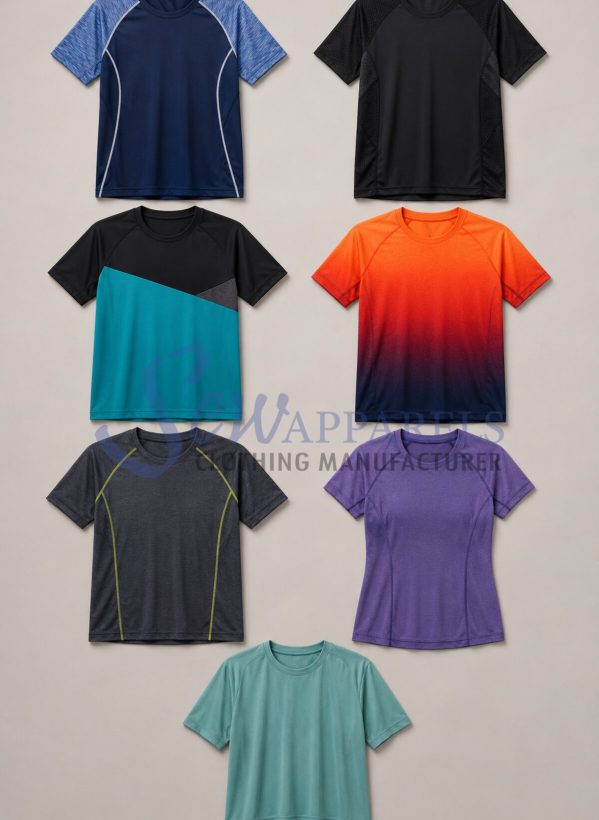
1. Define training t shirt wicking versus drying evidence before requesting tests
Start with the intended claim and the buyer’s development question. Do you need evidence that liquid travels along the fabric, spreads away from a contact point or leaves the specimen within a defined drying setup? These questions may require different methods. Asking only for a “moisture test” makes it difficult to judge whether the returned report answers the intended brief.
Training tee moisture transport versus evaporation should remain distinct in the specification. Transport changes where liquid is located. Evaporation concerns its transition into vapour and removal under the relevant conditions. A larger wet area can show liquid spreading while moisture is still present. Do not interpret spread alone as proof that the wearer or garment is dry.
Training t shirt wicking versus drying evidence should begin with a short claim-to-test map. Write the proposed phrase, the property it implies, the evidence requested and the material identity to which it will apply. Keep unresolved claims visible until the appropriate information arrives. This prevents an appealing supplier description from becoming approved packaging wording by default.
Separate wetting versus wicking versus evaporation
Wetting versus wicking matters when a drop disappears from view. The liquid may enter the structure, spread beyond the observed point or move to another face. A simple visual observation does not establish which mechanism dominates. Specify what the method measures rather than assigning all three effects to “moisture wicking.”
A training shirt quick dry claim scope also needs a defined comparison. State the reference fabric or shirt, care condition and relevant test arrangement. “Quicker than the named reference under the stated method” is a narrower proposition than “dries instantly in every workout.” The evidence must match the actual promise that will reach the buyer.
2. Identify what the wicking report measures
The AATCC TM197-2022 public scope addresses liquid transport along or through vertically positioned fabric specimens. It applies to woven, knitted and nonwoven materials. The method concerns wicking to specified distances; a buyer should obtain the full report and authorised procedure rather than recreate a laboratory test from the public summary.
For training t shirt wicking versus drying evidence, retain the measured property and its units exactly as reported. Identify the specimen direction, liquid, preparation and test conditions stated by the laboratory. A result for vertical transport should not be labelled as evaporation rate or automatically compared with a value from another moisture test.
A training tee wicking test comparison needs equivalent sample identities. Record the knit direction used in cutting the specimen and the intended garment orientation. Where several directions are reported, keep their results separate. Do not choose one favourable direction and present it as though it describes the whole garment without qualification.
Specimen direction control helps explain apparently inconsistent reports. A material tested in different orientations or under different preparation may produce results that are not directly comparable. Ask the laboratory whether the report reflects the actual body fabric, mesh insert or another component. Separate components should retain their own evidence records.
Read the full result rather than a marketing label
A training t shirt moisture management report should include enough information to identify the property assessed and the sample supplied. Request the report number, method edition, material code, test date, result and relevant qualifications. A supplier’s summary such as “excellent wicking” does not show which measurement supports that judgement or what reference was used.
3. Review drying evidence and its endpoint independently
The AATCC TM201 public scope concerns fabric drying rate with a prescribed water volume while the specimen contacts a heated plate set at 37°C. It covers several fabric types and fabric taken from end products. Those defined conditions are part of the evidence; the result does not automatically describe every assembled shirt in every climate.
Training t shirt wicking versus drying evidence must therefore preserve the drying method separately from the wicking method. A heated-plate arrangement and a hanging garment in room air are different systems. Their results should not be pooled into one invented performance score or expressed as interchangeable measurements.
Drying endpoint definition is essential when comparing reports. Ask the laboratory what its method identifies as the relevant endpoint and how the reported rate or time is calculated. The sweat-mark visibility review explains why an invisible patch is a separate observation. Visual recovery can occur while moisture remains, especially when the apparent contrast changes.
Airflow data limitations belong in the interpretation. A fabric result obtained under a stated arrangement does not establish drying performance under a jacket, hydration vest or tightly layered outfit. Keep the laboratory conditions with the claim record. If the product promise concerns a particular use configuration, determine what additional development evidence is appropriate.
Keep the liquid and preparation visible
Water exposure under a method is not a complete reproduction of all real perspiration conditions. State the liquid and preparation reported, and avoid silently converting a water-based result into a universal sweat-performance claim. Laboratory evidence can answer a defined material question without reproducing every wearer, exercise intensity or environment.
4. Compare reports only when their methods and samples align
For training t shirt wicking versus drying evidence, create a report comparison sheet with separate columns for property, method edition, material revision, preparation, units and result. This keeps moisture report method comparison readable. Mark incompatible entries as requiring interpretation rather than forcing them into a ranked list.
Same method result review is the starting point for a fair supplier comparison. Confirm that each report describes the same measurement and a sufficiently comparable specimen condition. If one supplier reports a fresh fabric and another reports a washed garment component, disclose that difference before deciding which material better meets the brief.
| Report entry | Question it can address | Conclusion to avoid |
|---|---|---|
| Vertical wicking result | Liquid transport under the stated vertical method | The garment dries quickly in all use conditions |
| Drying-rate result | Moisture removal in its defined arrangement | The fabric also passed a different wicking method |
| Wet-patch photograph | Visible appearance at a recorded stage | A measured drying endpoint or laboratory pass |
Consider a fictional review in which Fabric A has a vertical transport result and Fabric B has a heated-plate drying result. The reports do not establish a direct winner because they answer different questions. Request the relevant equivalent evidence for both materials or make a clearly limited decision using the information available.
Do not average a transport distance with a drying time or convert either into an unsupported comfort percentage. Their units and meanings differ. Keep any acceptance criteria connected to the selected method and buyer requirement. The laboratory should explain interpretation where a report summary lacks the context needed for approval.
Check material continuity before accepting a report
In training t shirt wicking versus drying evidence, match the supplier code, composition, construction, finish, colourway and lot information available. A report for a previous finishing route may not describe the new proposal. Record substitutions and decide whether they require further evidence. A material name reused on a quotation does not prove that the tested and supplied fabrics are equivalent.
5. Preserve conditioning and after-wash behaviour
Training t shirt wicking versus drying evidence needs a test conditioning record. Retain the laboratory’s preparation and conditioning details, including deviations noted in the report. Do not assume specimens held in different environments or handled differently are equivalent merely because they share a fibre composition.
After wash moisture behaviour should be reviewed where the proposed benefit is expected to persist through care. Define the approved care route and stages with the product team, then request evidence relevant to the claim. Compare the appropriate fresh and cared specimens without changing several material variables at the same time.
A finish can be part of the development proposal, but its commercial name is not proof of durable performance. Keep the treatment identity, prepared sample and report together. If the claim concerns repeated care, the approval needs evidence for that condition rather than relying only on the first unwashed result.
Review the assembled tee as a development product as well. Panel placement, decoration and layering can influence the practical configuration in which the fabric is used. An observation during wear may identify a problem requiring investigation; it does not replace the stated laboratory result or demonstrate a universal comfort benefit.
Close each changed sample with an action record: what changed, why, which evidence is retained and which test or comparison remains necessary. This prevents a revised ventilation panel or finish from inheriting an approval that applied only to the previous material. Name the person responsible for resolving open evidence before bulk release.
6. Map quick-dry wording to the evidence and approved revision
Complete training t shirt wicking versus drying evidence with claim test mapping that the technical and commercial teams can both read. Tie each proposed statement to its report, method, sample and limitations. Quick dry wording evidence should support the particular comparison or condition being described, rather than a broader promise added during marketing review.
For custom training t shirt manufacturing, submit the material references and moisture evidence requirements with the development brief. Private label training t shirt production can then consider the intended fabric, finish, care and panel arrangement together. Confirm testing needs with the team; this guide does not establish existing test results for a Sew Apparels shirt.
Training t shirt wicking versus drying evidence is useful because it prevents one attractive number from answering the wrong question. Preserve wetting, transport, evaporation and appearance as separate observations. Compare like methods, retain specimen direction and care history, and approve wording only for the material revision actually reviewed.
Use the Training T-Shirts Buying Guides to connect moisture evidence with ventilation, seam placement, wet appearance and layering decisions. The final brief should explain what the garment needs to do and which records support approval. That makes later sampling and reorders easier to evaluate consistently.