
Work shorts bulk order issue quantities should begin with the people who will actually receive garments, the approved issue policy and the time needed to return clean shorts to use. Multiplying a total employee count by an assumed allowance can hide missing sizes, double-count existing stock and include roles that do not use shorts. A useful buying plan explains every addition and deduction before a supplier prices production.
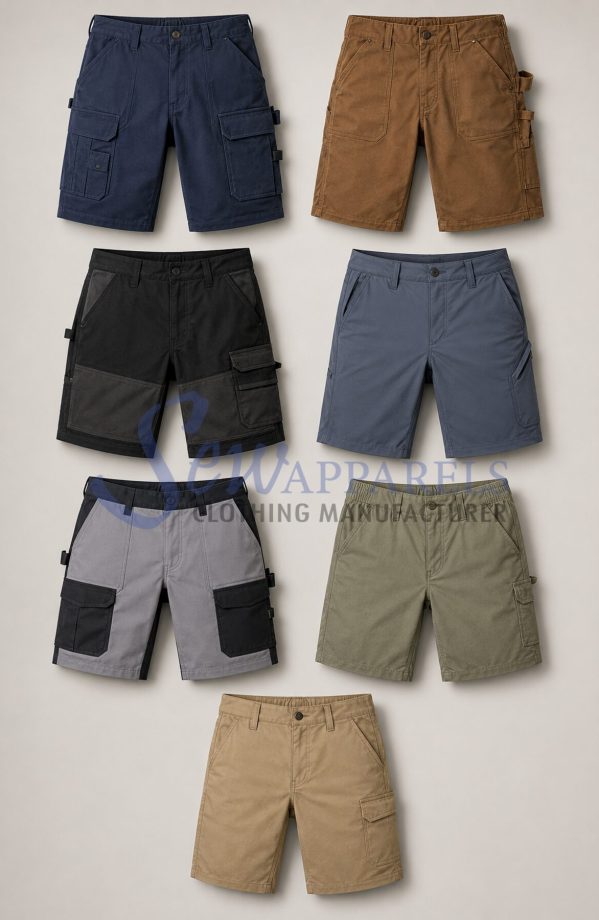
This guide provides a practical worksheet approach for ordinary uniform shorts. It does not decide whether shorts are suitable for a particular task, replace a workplace risk assessment or prescribe a universal garment allowance. Confirm the approved product and wearing arrangements first; then calculate the quantity required to operate that programme.
1. Establish work shorts bulk order issue quantities by wearer and role
Start with a dated workforce list. Separate current eligible employees, confirmed starters, temporary workers and future recruitment assumptions. Record the site, role, approved fit and size for each wearer. The work shorts buyer supplied workforce count should have an owner who can explain the cut-off date and changes after that date. A payroll total alone may include people who never receive this garment.
Build a work shorts role based shorts allocation around the approved issue policy. Some roles may wear shorts throughout the permitted season; others may alternate with trousers or use shorts only for specific approved duties. Record that distinction without treating garment quantity as evidence of protection. If shorts are unsuitable for a task, ordering extra pairs does not resolve the suitability problem.
For a staff work shorts size quantity plan, use confirmed fittings or an agreed size selection process. Keep different fit blocks and waist options separate, even where their labels look similar. A medium in one approved block should not silently become a medium in another. Unconfirmed wearers belong in a clearly marked provisional line that requires approval before the production breakdown is frozen.
2. Connect issue allowance to wearing and care arrangements
Planning work shorts bulk order issue quantities requires a clear distinction between the pairs assigned to a person and the stock held centrally. The assigned allowance must support the employer’s agreed wear and care arrangements. Ask how frequently shorts are worn, when used pairs are collected or washed, how long drying and return take, and whether clean stock is available before the next required shift.
A uniform shorts care rotation calculation should describe a real sequence rather than assume that washing always happens overnight. A pair may be in use, awaiting collection, being cleaned, drying or travelling back to the wearer. Review weekends, collection cut-offs and site transfers where relevant. Do not turn this planning exercise into an unsupported washing-temperature recommendation; the approved garment care instructions and operational requirements govern the care route.
Use a work shorts wear frequency buying scenario to compare a regular wearer with an occasional wearer. Their issue allowances may differ if the approved policy supports that difference. Document the work shorts care turnaround order assumption beside the allowance so a later change in the laundry service can be assessed. A longer turnaround can change availability even when workforce numbers remain unchanged.
Discuss work shorts laundry rotation issue stock with the person managing care and distribution. If a shared pool operates, confirm how clean garments are identified, sized and issued. If garments remain individually assigned, confirm how returns are matched to employees. Avoid counting the same clean backup both within every employee’s allowance and again as a central reserve.
3. Calculate gross need and deduct usable stock
A work shorts issue quantity worksheet can use one row for each site, approved style, fit and size. Record eligible wearers, approved pairs per wearer, gross assigned requirement, separate approved reserve, usable unallocated stock and the resulting purchase requirement. Keep supporting notes beside the inputs so the arithmetic can be reviewed without relying on someone’s memory.
For work shorts bulk order issue quantities, a basic planning expression is: approved assigned requirement plus approved central reserve, minus usable stock available for this issue. Apply it to each size and style combination. This is a transparent buying worksheet, not a complete forecasting model. Do not deduct damaged shorts, already committed garments or a different product merely because they appear in a stock total.
The CIPS inventory management guide emphasises accurate operational data and selecting an approach that fits the organisation’s supply arrangements. That supports checking what is genuinely available before ordering. It does not provide a standard number of shorts for every employee or an automatic reserve percentage.
The work shorts bulk issue quantity calculation also needs a stock location and verification date. A box listed at another site may be unavailable for the required issue date. Garments awaiting inspection should remain separately identified until their condition and specification are confirmed. Where a transfer is planned, record who approves it and when it will arrive rather than assume all company stock is immediately usable.
An illustrative quantity calculation
Suppose an organisation has 40 confirmed eligible wearers and approves two pairs per wearer. Assigned demand is 80 pairs. It separately approves eight central replacement pairs and verifies 12 matching, unallocated pairs in usable stock. The illustrative purchase requirement is 80 + 8 − 12 = 76 pairs. These numbers are a teaching example, not a Sew Apparels recommendation, customer result or universal allowance.
The total still needs a size breakdown. If the 12 available pairs are concentrated in one size, they cannot reduce every size proportionally. Apply the deductions only to matching rows. Reconcile the row totals back to 76 after checking that no row has a negative purchase quantity and no reserve has been counted twice.
4. Separate replacement reserves from speculative additions
Work shorts bulk order issue quantities become difficult to defend when every uncertainty is covered by an unexplained extra percentage. Identify why additional stock is proposed: confirmed new starters, documented replacement demand, distribution delays or a specific approved contingency. Assign each addition a quantity, size assumption, review date and decision owner.
Keep employee work shorts replacement allocation distinct from initial issue. A replacement policy may consider garment condition, authorised exchanges and the interval before replenishment arrives. It should not assume that every wearer requires another complete initial allowance on every order. Work shorts replacement reserve inputs should use relevant issue and replacement records where available; label estimates clearly when there is no reliable history.
For work shorts bulk order issue quantities, a work shorts initial uniform short purchase may need more provisional planning than a repeat programme. A new programme has less evidence about size exchanges and use patterns. Start with confirmed wearers, record the uncertainty and agree how the first issue will be reviewed. Buying a large speculative reserve can leave unsuitable size stock while the actual required sizes remain unavailable.
For repeat orders, use an issue log to distinguish damage replacements, size exchanges, starter allocations and transfers. These are different events. An exchanged pair returned in usable condition may re-enter available stock after inspection; a damaged pair does not. Linking the log to the worksheet helps explain changes without claiming that a past replacement rate guarantees future demand.
5. Turn the approved breakdown into a comparable quotation
Provide work shorts bulk order issue quantities as a dated size and style matrix with a clear specification reference. Include fabric, colour, fit, pockets, trims, branding, labelling and packing requirements where applicable. A work shorts staff shorts order breakdown should identify destinations and issue dates as well as the total. Ask the supplier to confirm assumptions and identify any unresolved manufacturing or scheduling questions.
For custom work shorts manufacturing, this matrix gives the product discussion a practical purchasing basis. It does not establish a minimum order, price or production slot by itself. Startup buyers can use the same process with a smaller confirmed workforce, making their initial requirement and replenishment assumptions visible for review.
When discussing private label work shorts production, separate garment quantity from packaging and branding decisions. Individual issue packs, site sorting or employee identifiers can affect preparation and checking. State whether the quotation must cover those operations, and keep personalised allocations subject to confirmed information. Do not compare a sorted issue pack quotation with a bulk-packed quotation as though their scope were identical.
The CIPS explanation of material requirements planning describes using inventory records to move from gross to net requirements and considering lead times in scheduling. The practical lesson here is to connect an approved quantity to availability and timing. This article’s simple issue worksheet does not implement a full manufacturing MRP system or promise a particular delivery date.
6. Review work shorts bulk order issue quantities before release
Complete a work shorts uniform shorts order review with the workforce owner, stock controller and buyer. Confirm the eligible wearer list, fit and sizes, assigned allowance, care assumptions, central reserve, usable stock deductions and purchase totals. Record unresolved questions as explicit decisions before release rather than let the supplier guess which version is correct.
After approving work shorts bulk order issue quantities, use a work shorts issue stock worksheet to maintain the connection between ordered, received and issued quantities. Check deliveries against the approved style and size matrix. Record shortages, exchanges and damaged receipts separately, then update available stock before a follow-up order. A purchase total can be correct while the delivered size distribution is wrong, so both levels need reconciliation.
Review related product decisions through the Work Shorts Buying Guides. Use the work shorts movement and coverage balance review before freezing wearer sizes and approved fit references. A quantity calculation cannot resolve inadequate coverage or restricted movement in an unsuitable size. Confirm construction and care suitability alongside allocation planning so a quantity decision does not conceal an unresolved product choice. Keep the approved sample or specification reference attached to the order breakdown.
Does every employee need the same allowance?
Only if the approved policy and operating arrangements support that choice. Differences in eligible duties, wear frequency and care access may justify different allocations. Document the reasoning and apply it consistently rather than invent an allowance from a purchasing target.
Should a reserve be calculated as a fixed percentage?
A percentage may be an approved planning assumption, but its basis still needs explanation. Check the size distribution, replacement history, replenishment timing and storage constraints. A reserve that cannot serve the required sizes offers limited practical support.
What should the buyer send for final review?
Send the approved specification, dated wearer and size matrix, care arrangement, allowance policy, verified stock deduction, separate reserve and required destinations. Work shorts bulk order issue quantities are ready for quotation when another person can reproduce the calculation and identify the assumptions that still need confirmation.