
Work t shirt enzyme finish evidence should connect a named finishing process with an identifiable sample and the buyer’s actual requirements. The phrase enzyme finished is not enough to explain how a work tee will look, feel or perform after the intended care route. A purchasing team needs a comparison that separates the treatment from other changes made to the fabric or garment.
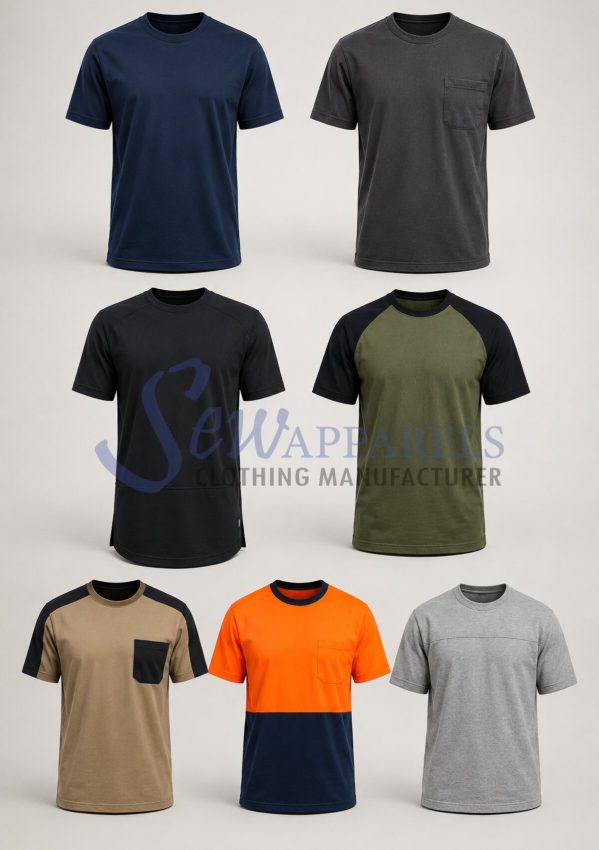
For product development, review the custom work T-shirts manufacturing page. Use the Work T-Shirts Buying Guides for related shoulder construction and branding decisions. This guide sets out six evidence checks for sample approval; it does not prescribe an enzyme recipe or claim that Sew Apparels has completed tests for a particular order.
Why work t shirt enzyme finish evidence starts with the intended result
A work tee fabric finish selection should begin with the product need. Decide whether the buyer wants a particular surface appearance, a different tactile feel or another clearly described result. Name the fabric composition, construction, colour and garment use. An attractive sample that does not represent the intended work-shirt specification provides a weak basis for bulk approval.
The supplier’s process description and the garment’s measured result are separate evidence. A process record can establish that a treatment was used; it cannot by itself prove every performance claim. Similarly, a pleasant sample does not identify the process responsible for that feel. Keep both records available and explain what each one establishes.
Work tee enzyme claim limits belong in the brief. Avoid converting a finishing description into unsupported claims about skin safety, environmental superiority, permanent softness or longer service life. Ask what evidence supports any additional claim for the actual garment. Approval can remain focused on the demonstrated result without adding marketing statements that the evidence does not cover.
1. Confirm the process identity and sample route
Start work t shirt enzyme finish evidence with work t shirt enzyme process identity. Ask the supplier to identify the treatment’s purpose and whether it was applied to fabric or finished garments. Record the processing reference and any subsequent finishing steps that matter to the sample comparison. A broad trade name should not replace the actual order reference.
CottonWorks’ garment finishing overview distinguishes enzymes used for different purposes and describes cellulase biopolishing of cotton surfaces. In its denim discussion, it also notes possible weight reduction and strength loss. These points support asking which treatment was used and reviewing the finished result; they do not establish a work T-shirt recipe or a guaranteed outcome.
A work t shirt finishing supplier brief should identify the fabric and sample stage, the requested appearance, the comparison reference and the approval owner. Ask which information will be retained to support repeat production. The buyer does not need to invent operating conditions or override the finishing specialist’s process controls to define a useful acceptance brief.
If the sample includes a softener or another treatment alongside the enzyme process, record that combination. The approval then relates to the complete finishing route shown, rather than to an isolated ingredient name. Any proposed replacement route needs a new review against the product requirement. Do not assume two supplier descriptions with similar wording represent identical results.
2. Build a fair treated and untreated comparison
Work t shirt enzyme finish evidence becomes stronger when the comparison has a clear baseline. A work tee treated untreated sample pair should use the same underlying fabric specification wherever practical. Identify unavoidable differences, such as a different source lot, rather than presenting the samples as perfectly matched when they are not.
For an enzyme finished work tee comparison, explain the sample preparation and what remains unchanged. Record fabric identity, garment size, colour and the other finishing steps used. If the untreated reference was also given a different drying or pressing route, acknowledge that difference. Otherwise, the observer may attribute every change to the enzyme treatment without a valid basis.
Use a work t shirt process sample comparison to answer the actual approval question. Swatches may help with surface observations, but finished garments are needed when fit, seam behaviour or decoration is part of the decision. Keep the sample type visible in the record. Evidence from one swatch should not quietly become a claim about every assembled garment feature.
Define the review sequence before the samples arrive. Decide who examines them, what comments are recorded and which unresolved observations require further evidence. A small startup project can use a simple paired sample record, provided it is controlled and honest about its scope. More pages of paperwork do not compensate for an unidentified reference.
3. Evaluate hand and surface appearance consistently
For work t shirt enzyme finish evidence, describe the tactile observations precisely enough to compare later samples. Work t shirt finish hand evaluation might distinguish softness, stiffness, surface smoothness and the way the fabric handles. Avoid a single comment such as premium feel when different reviewers may mean different things by it.
The public scope of AATCC EP5 for fabric hand evaluation describes guidelines for presenting fabrics under standardized evaluation conditions. It supports repeatable handling and comparison by evaluators. The public summary is not the full procedure and does not set a universal pass mark for a work tee.
Work tee surface finish evidence should also include identifiable visual observations. Use comparable views of the relevant areas and keep the samples labelled. Note which differences are desired and which need investigation. A photograph can support the record, but the review should acknowledge when a lighting or presentation difference limits the comparison.
A work t shirt finish appearance review should consider the assembled garment rather than just its most attractive area. Review body panels, neckline, seams and the intended visible branding locations. Document uneven results or unexpected differences. Agreement on a reference sample is more useful when it includes the areas that production inspectors will actually examine.
4. Review the result after the intended care route
Work t shirt enzyme finish evidence should explain whether the approved result has been reviewed after care. Agree the procedure appropriate to the product and record the conditions used. Keep the treated and comparison samples on a comparable route where the purpose is to evaluate their differences, rather than changing several variables at once.
Work shirt enzyme finish care planning needs the proposed garment care instruction, sample identity and recorded assessment points. Review the appearance and dimensions relevant to the brief before and after the chosen care process. Do not promise unchanged results through unlimited laundering from one initial observation. State the number and type of assessments actually completed.
The evidence should identify any laboratory report used, including its specimen, method and result. Check whether the tested material represents the proposed production fabric and finishing route. Ask a qualified laboratory which assessments suit an unresolved durability or dimensional question. A hand comparison alone should not be treated as a laboratory performance result.
When after-care observations differ from the initial approval, record the decision rather than hiding the change. The buyer may accept a defined result, ask for another sample or reconsider the finishing route. That decision should be tied to the intended use and actual evidence, with a clear owner for any follow-up sample requirement.
5. Confirm decoration and construction compatibility
Review work t shirt enzyme finish evidence alongside the intended branding method. Work tee finish decoration compatibility requires a sample representing the actual combination of fabric, finish, artwork and application route. Approval of an undecorated surface does not establish that every print, transfer or embroidered design will behave as required.
Record whether decoration occurs before or after the finishing stage and confirm the proposed sequence with the supplier. When that sequence changes, ask what evidence needs to be repeated. Keep the artwork identifier, finished dimensions and placement reference linked to the sample. If the finish change also requires a revised logo or decoration route, use the work T-shirt artwork change charges review to separate new proof and setup work from the finishing decision. This prevents a successful result with one design from being applied without review to another.
Inspect the garment features affected by the buyer’s use: the shoulder junction, neck edge, body shape and areas visible beneath workwear layers. The point is to confirm the finished product requirement, not to assume the finishing process caused every observed problem. Separate a construction issue from a finish-related question when arranging further investigation.
If a sample is rejected, write a focused comment describing the observed result and required reference. Avoid changing fabric, artwork, construction and finish simultaneously without documenting the choices. A controlled revision makes it easier to determine whether the next sample addresses the problem or simply introduces a different product.
6. Retain an approved standard for bulk production
Complete work t shirt enzyme finish evidence with a work tee retained finish standard. Label the approved garment and associate it with the fabric, finishing route, decoration and care review. Protect the reference against deterioration or confusion with development samples. State which reference production should use and how a proposed update will be approved.
A work tee finish approval record should distinguish accepted observations from outstanding questions. Record the decision date, reviewer, sample reference and any conditions. If approval applies only to one colour or size, make that limitation visible. A broad approved stamp should not silently extend the evidence to combinations that were never reviewed.
Work tee after finishing inspection should compare early production with the retained reference using the agreed checks. Record the production lot and any deviations requiring review. If a supplier changes the material or finishing route, request the relevant evidence before continuing under the original approval. The process name alone does not demonstrate equivalence.
For custom work t shirt manufacturing and private label work t shirt production, include these evidence requirements in the initial product brief. Startup brands can begin with one defined fabric and finish combination, then extend the range after approval. Discuss feasible order quantities and development requirements directly rather than assuming a universal low minimum or automatic test package.
Prepare an evidence brief before approving the finish
A practical brief for work t shirt enzyme finish evidence identifies the intended result, material, processing reference, comparison sample and review method. Add the care route, decoration combination, acceptance owner and retained standard. Keep claim wording within the scope of what the samples and reports demonstrate. These decisions make the next sample request more useful.
Work t shirt enzyme finish evidence is strongest when process identity, fair comparison and finished-garment approval remain connected. Review the demonstrated appearance and feel, investigate unresolved performance questions and retain a traceable production reference. That approach gives the buyer a clear basis for accepting the finish without relying on a treatment label alone.