
Breakaway hi vis vest evidence should connect a release-function claim with the exact vest model, its documented configuration and the conditions covered by the assessment. A removable fastening or a marketing description does not, by itself, establish how the complete vest behaves in its intended use. Buyers need a clear evidence question before accepting the claim.
This article is a procurement review guide, not a test procedure or an assurance of protection from machinery. It does not claim that a Sew Apparels vest is certified for a breakaway function. Use the Hi-Vis Vests product page for manufacturing enquiries, identifying the required configuration and documentation when discussing custom hi vis vest manufacturing.
1. Define breakaway hi vis vest evidence around the intended claim
Ask what breakaway means for the proposed article. Identify the release locations, fastening arrangement, model revision and limitations stated by the responsible manufacturer. Do not let a broad product adjective replace a description of the actual function being claimed.
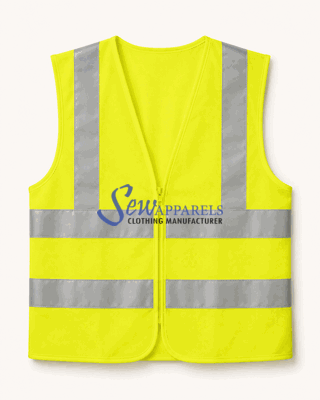
Breakaway vest claim documentation should distinguish the release feature from high-visibility performance. Evidence about fluorescent or retroreflective components does not automatically assess the release mechanism. Equally, a demonstrated release feature does not establish that the garment satisfies the applicable visibility requirements.
Start with breakaway vest employer requirements for the task and destination. The responsible workplace assessment should determine what equipment is appropriate and which evidence is required. A purchase specification copied from another site may not address the same work, equipment or applicable rules.
CCOHS guidance on high-visibility safety apparel, a Canadian occupational health and safety reference, advises checking jurisdiction requirements and assessing the worksite hazards before selection. It notes that additional features, including tear-away features, may be needed because of other hazards. This supports asking a task-specific question; it does not provide a universal release-force threshold or approve a particular vest.
For breakaway hi vis vest evidence, record the claim that needs substantiation and the responsible decision maker. Avoid phrases such as safe around machinery unless an appropriate, qualified assessment establishes the intended scope. A vest feature must not be treated as permission to approach an uncontrolled hazard.
2. Match the mechanism and assessed sample to the exact vest
Breakaway vest model identification should include the article code, construction revision, size range and relevant component references. If the evidence describes a different fastening, panel arrangement or material, obtain clarification before accepting it for the ordered model.
Hi vis vest release mechanism evidence needs a traceable description of the complete configuration. Identify which junctions are intended to release and how they are assembled. A component supplier’s information may be useful supporting material without establishing the behaviour of the finished vest.
A breakaway high visibility vest specification should preserve the relevant drawing, material and closure references alongside the documented claim. Record the proposed adjustment arrangement and supplied instructions. Do not change the construction during sampling while continuing to reference an earlier assessment as though nothing changed.
Within breakaway hi vis vest evidence, sample identity should connect a report or review with the actual construction evaluated. Ask about the sample’s model, revision and relevant preparation. A photograph that resembles the ordered vest does not replace an identifiable sample description.
For an illustrative comparison, model V-A has one documented closure arrangement while quotation V-B identifies another. These are fictional codes. The procurement issue is coverage: ask whether the evidence applies to V-B rather than assuming that a shared colour or product family establishes equivalence.
3. Review the test scope without inventing a universal method
Hi vis vest breakaway test scope should state the method used, the feature evaluated, sample identity, relevant conditions and reported outcome. Ask the competent assessor to explain the method’s applicability to the claim and intended product. An unexplained passed stamp offers little basis for that review.
A hi vis vest release function review should distinguish what was observed from what is being inferred. Evidence of one release location under one described condition should not be rewritten as proof of every location, direction, condition or size. Keep the conclusion within the documented scope.
Breakaway hi vis vest evidence should address relevant conditioning or service-state questions through the appropriate qualified process. Ask whether the supplied evidence covers the claimed use state and whether care, wear or other changes affect the assessment. This article does not prescribe a conditioning sequence, a test rig or an acceptance value.
Do not perform improvised demonstrations involving a wearer, moving equipment or deliberate snagging. Procurement staff should request appropriate documented assessment from competent parties. A sales demonstration is not a substitute for evidence supporting the stated claim and limits.
| Evidence question | Document connection | Gap to resolve |
|---|---|---|
| What function is claimed? | Model specification and stated release feature | Undefined marketing description |
| Which article was assessed? | Sample identity and construction revision | Different model or component arrangement |
| What did the assessment cover? | Method, conditions and reported scope | Unexplained extension of the result |
| What limits apply? | Relevant instructions and qualified conclusion | Missing or unclear limitations |
| Who accepts the claim? | Responsible review and approval record | Purchase order treated as technical approval |
These are suggested procurement questions, not a certification checklist. The applicable route and acceptance criteria belong to the responsible competent assessment and destination requirements. Do not convert a completed table into an unsupported declaration of compliance.
Where a report references a standard, verify its role, edition and relevant scope through the appropriate source. A familiar standard number does not necessarily address every release claim. Ask which part of the evidence supports each statement proposed for the product description.
4. Review accessories, modifications and supplied instructions
Breakaway vest accessory interaction should consider the proposed configuration rather than a bare sample alone. Ask whether radios, holders, identification attachments or other equipment affect the documented arrangement and what appropriate review is needed. The answer should come from the responsible manufacturer or qualified assessor.
HSE guidance on PPE selection and use, in its Great Britain context, emphasises fit and compatibility and instructing users about use and limitations. It also cautions that modifying PPE to fit is not a suitable solution. This general guidance supports controlled review of a proposed change; it does not approve a breakaway design or equipment combination.
A breakaway vest modification review should identify changed closures, materials, stitching, attachments or dimensions before production release. Decoration and private label development should also have a clear configuration record. Do not assume that an apparently small change is automatically inside the assessed scope.
Breakaway vest supplier instructions should connect to the exact model and describe the relevant intended use and limitations. Review their completeness, revision and accessibility. If a term is unclear, obtain clarification rather than rewriting it as a stronger promise.
For breakaway hi vis vest evidence, distinguish a procurement document from workplace training. A supplied leaflet can inform the responsible workplace process, but its existence does not establish that a wearer has received suitable instruction or that the product is appropriate for every task.
Breakaway vest function limitations should remain visible in the evidence summary and proposed claim wording. Do not hide them in a separate file while using a broad headline on the product. The accepted commercial description should reflect the substantiated function rather than the most reassuring interpretation.
5. Close evidence gaps before claim approval and ordering
A hi vis vest breakaway evidence gap register should identify the missing item, affected model, responsible party and evidence needed to close it. Useful entries are specific: sample revision unclear, accessory configuration not covered or release-function conclusion missing. Avoid a generic paperwork pending note.
Breakaway vest procurement questions should be sent with the exact specification and proposed claim. Ask for the relevant documents and clarification without implying that the supplier must simply provide a favourable answer. An unresolved limitation is useful information for the responsible selection decision.
Breakaway vest qualified assessment should establish whether the available evidence supports the stated function within its scope. Procurement can coordinate the documents, but should not replace technical assessment with visual comparison, a price decision or a marketing preference.
Breakaway hi vis vest evidence should preserve the accepted conclusion and its conditions. Breakaway vest claim approval needs a named responsible role, applicable model revision and the wording authorised by the review. Approval for one configuration should not silently extend to later variants.
For private label hi vis vest production, clarify the required product configuration, intended destination and claim-documentation responsibilities during development. This article does not establish Sew Apparels’ breakaway testing capability, certified model availability or conformity status. Confirm the actual scope before placing an order.
The purchase order should identify the accepted configuration and the required accompanying information. If a substitution is proposed, review its effect on the evidence before release. An equivalent-looking closure is not automatically an equivalent assessed release system.
Use the hi-vis vests vest closure selection review to identify the construction reference, while keeping any breakaway claim tied to its own qualified assessment and limitations.
Keep the approved scope connected to repeat production
Breakaway hi vis vest evidence remains useful only if the supplied goods stay connected to the accepted model and information. On receipt, compare the identification and relevant configuration with the order and evidence reference. Record discrepancies and obtain the responsible review before treating changed goods as covered.
For breakaway hi vis vest evidence, repeat orders should preserve the approved revision and communicate proposed changes early. Keep assessment information, supplier instructions and claim wording aligned. If workplace requirements change, revisit the selection through the appropriate competent process instead of relying on the earlier approval indefinitely.
Does a removable fastening prove a breakaway claim?
It identifies a construction feature. The claim needs relevant evidence for the complete model and stated scope, including limitations. Appearance alone does not establish the release behaviour.
Does visibility evidence also verify release behaviour?
Do not assume so. They concern different claims. Ask which evidence supports each proposed statement and keep the conclusions within their documented scope.
Can a buyer define a release limit from this article?
No. This guide does not supply a universal threshold or test method. Obtain the applicable requirements and competent assessment for the exact product and intended use.
Use the Hi-Vis Vests Buying Guides for related development decisions. Complete breakaway hi vis vest evidence through a reconciled model, assessment scope, instructions and responsibly approved claim before procurement release.