
Hi vis vest procurement use case brief development should begin with the people, tasks and environment the garment is intended for. A purchase request that only specifies a colour, logo and quantity leaves the supplier without the context needed to discuss an appropriate configuration. A useful brief transfers assessed requirements into a clear purchasing specification.
This guide describes procurement inputs, not a workplace risk assessment or a certification decision. It does not establish that a particular Sew Apparels vest is suitable for a task. Use the Hi-Vis Vests product page for manufacturing enquiries, sharing the intended application and documentation requirements when discussing custom hi vis vest manufacturing.
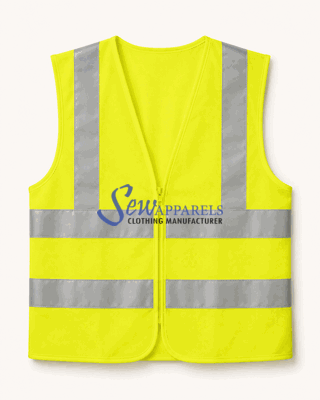
1. Start the hi vis vest procurement use case brief with the work environment
A high visibility vest work environment brief should identify the location, task, relevant lighting conditions and how people interact with vehicles or equipment. Describe the actual operation rather than using a broad label such as warehouse. Two warehouses can have different movement patterns, exposure and site controls.
Hi vis vest risk assessment inputs belong to the responsible workplace process. Procurement can collect relevant operational information, but it should not turn a purchasing checklist into an assessment it is not qualified to perform. Identify who provides the approved requirements and who resolves questions about suitability.
CCOHS guidance on high-visibility safety apparel, a Canadian occupational health and safety reference, advises confirming jurisdiction requirements and assessing worksite hazards before selection. Its discussion includes the work, environment, lighting, vehicle interactions and other controls. This supports collecting a specific use case; it does not determine the vest required for every destination or approve the model being purchased.
The hi vis vest procurement use case brief should distinguish operational facts from assumptions. Record unknown conditions as questions for the responsible team. Do not substitute an optimistic description such as low risk when no applicable assessment has established it.
Task exposure procurement fields can include where and when the vest is used, who is exposed and the relevant work duration or circumstances identified by the assessor. Preserve the context behind the requirement instead of passing only a preferred garment image to the supplier.
2. Identify the wearer groups and visitor requirements
Employer requirement intake should identify the operational owner, destination and approved procurement requirements. Where several departments use vests, record which requirements are shared and which differ. A single buying programme can contain more than one use case without treating all wearers as interchangeable.
Visitor vest procurement requirements should address the actual visitor process. Consider the intended route, supervision arrangement, garment issue and information handover through the responsible site procedure. A short visit should not be assumed to remove the need for an appropriate selection.
A visitor wearer group brief should describe the anticipated size range and clothing worn underneath, while keeping personal information limited to what the operational purpose requires. If visitors arrive in different outer layers, record that as a fit and selection question rather than specifying one size without review.
Physical wearer characteristics can affect fit and usability. Ask the responsible team how the proposed range will serve the people who need it. Do not treat a sample worn by one person as proof that the full wearer population has been covered.
For the hi vis vest procurement use case brief, connect the wearer group to its intended task and issue process. An employee working throughout a shift and an escorted visitor may need different operational arrangements. The competent selection process must establish the requirements rather than the article assigning them universally.
3. Transfer assessed visibility and compatibility needs
Assessed visibility needs should be stated by the responsible party with the applicable destination, standard or requirement reference where relevant. Keep the edition and scope clear. A request for certified hi-vis is incomplete if it does not explain the exact claim and evidence needed for the order.
A high visibility clothing compatibility brief should identify the clothing and equipment proposed alongside the vest. Include relevant outer layers, equipment carried and the intended configuration. Ask what review is necessary instead of assuming a vest can be worn with every combination.
HSE guidance on PPE selection and use, in its Great Britain context, addresses the user’s fit, size and compatibility and advises discussing the job with the supplier. It also calls for instruction on why equipment is needed, when to use it and its limitations. These principles help structure questions; they do not establish a universal vest specification.
Required equipment compatibility should remain connected to the actual proposed combination. If a harness, bag, tool arrangement or other item changes, route that change for the appropriate review. A sample assessment of one configuration should not silently extend to another.
The hi vis vest procurement use case brief should separate decoration preferences from assessed requirements. Submit proposed logos and identification attachments for the relevant review before treating the final decorated configuration as accepted. This guide does not invent a safe logo area or approve covering any visibility material.
Additional functions require their own appropriate evidence. A request for a breakaway feature, flame-related performance or another protective property should identify the claim and responsible assessment route. A high-visibility designation does not automatically establish every other function.
4. Build a use case matrix that a supplier can follow
A vest use case matrix should connect each wearer group and task with the approved requirements, relevant equipment combination, size needs and outstanding questions. Keep it concise enough to use while retaining the distinctions that affect selection or production.
| Brief element | Information to transfer | Responsible clarification |
|---|---|---|
| Task and site | Work location, use circumstances and assessment reference | Operational owner and competent assessor |
| Wearer group | Intended users, size range and underlying clothing | Issue team and selection owner |
| Visibility requirement | Applicable approved scope and evidence needs | Responsible assessor |
| Equipment combination | Proposed layers and other equipment | Qualified compatibility review |
| Manufacturing configuration | Model, materials, closures and proposed decoration | Supplier and responsible approval team |
| Handover | Instructions, issue procedure and unresolved questions | Operational owner |
These are suggested procurement fields, not a statutory form. Adapt them to the applicable rules, responsible assessment and actual order. A completed matrix should identify which information has been approved and which still requires an answer.
In the hi vis vest procurement use case brief, use reference numbers to connect the matrix with its supporting documents. Avoid attaching unrelated assessment files without indicating which requirement each supports. The supplier should be able to distinguish mandatory purchasing conditions from optional preferences.
For an illustrative example, use case U-A identifies an employee task and use case U-B identifies an escorted visitor route. These are fictional labels, not an assessment of any actual worksite. The useful distinction is that each has its own approved inputs, even if the eventual selected garment happens to be the same.
Review contradictions before quotation. If one document requests a particular closure and another defines a different configuration, identify which is authoritative. Do not let the supplier resolve a safety-related selection conflict through a price assumption.
5. Plan wearer feedback without treating a trial as certification
Worker trial plan inputs should identify what the responsible team intends to review, who participates and which model or configuration is involved. Fit, movement and practical use feedback can inform development, but it should not be described as laboratory verification of protective performance.
The hi vis vest procurement use case brief should keep trial feedback within its scope. Record the garment revision, relevant layers, participant coverage and observed issue. A general comment such as comfortable does not establish that the garment meets all applicable requirements.
Do not stage hazardous demonstrations or expose workers to uncontrolled vehicle or machinery risks to test visibility or another feature. The appropriate competent process should determine how any assessment is conducted. Procurement should request the necessary evidence and record the responsible conclusion.
Separate preferences from decisions requiring qualified review. A wearer may prefer a larger pocket or a different fastening, but the proposed change should be checked against the accepted configuration and requirements before production. Preserve the explanation for accepting or declining the change.
Responsible assessor signoff should identify the requirement or conclusion approved, relevant model revision and any conditions. A purchasing signature should not be presented as technical approval unless the organisation’s responsible process establishes that role and scope.
6. Release an approved purchasing specification and handover
An approved purchasing specification should identify the exact model, relevant materials and construction, size assortment, proposed decoration and required documentation. Connect it to the accepted use cases. If some requirements remain unresolved, record them and obtain the appropriate resolution before treating the specification as final.
For private label hi vis vest production, clarify the intended destination, configuration and document responsibilities during development. This article does not establish Sew Apparels’ certification status, assessed model availability or ability to satisfy every employer requirement. Confirm the actual manufacturing and evidence scope before ordering.
Site instruction requirements should be transferred to the operational owner alongside the relevant manufacturer information. Receipt of garments is not the same as completion of workplace instruction. Define how the issue team receives the documents and how questions are escalated.
The hi vis vest procurement use case brief should preserve change control through sampling and repeat orders. If the model, work environment, equipment combination or intended users change, ask the responsible team whether the requirements need review. Do not extend an earlier approval silently to a changed situation.
On receipt, compare the supplied identification and configuration with the accepted order and document references. Record discrepancies with the responsible party. A correct quantity does not, by itself, establish that the garments match the approved scope.
If the brief includes a release feature, use the breakaway hi vis vest evidence review to identify the separate claim, model and qualified assessment needed.
Questions buyers should close
Can colour and quantity be the whole brief?
They are useful purchasing details, but they do not explain the task, user needs or approved requirements. Connect them to the use case and responsible selection process.
Does a worker trial approve every safety claim?
No. Define its scope and preserve feedback separately from the appropriate technical evidence and qualified approval.
Can visitors automatically use the same specification as employees?
Review their actual route, task, clothing and site procedure. The hi vis vest procurement use case brief should preserve the relevant distinctions rather than assume equivalence.
Use the Hi-Vis Vests Buying Guides for related development topics. Complete the hi vis vest procurement use case brief with traceable assessed inputs, an exact purchasing configuration and a clear operational handover.