
Chef coat contrast trim cleaning needs a whole-garment decision: the white shell, dark piping, sewing thread and closures must remain suitable under the same approved care route. A clean-looking fabric swatch cannot establish whether an assembled jacket will develop a coloured halo beside its trim. For uniform buyers, the useful question is which evidence supports the intended cleaning conditions and the appearance that must be retained.
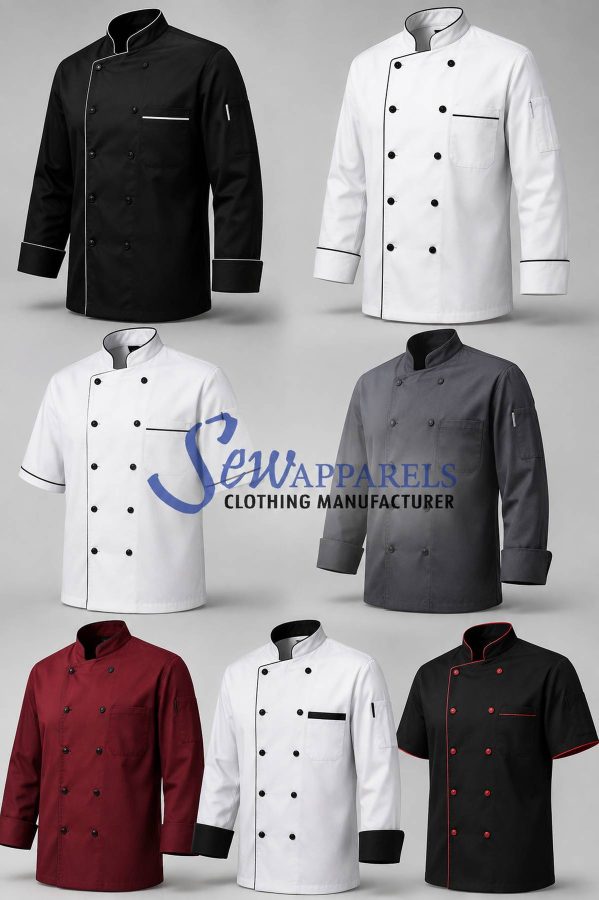
This guide helps purchasing teams, hospitality brands and startup uniform programmes prepare an approval brief. It separates staining from fading, connects reports to the actual component lots and explains why a finished sample matters. It does not prescribe an unverified washing recipe or claim that every contrast component tolerates the same treatment. Begin with the garment’s documented instructions and confirm unresolved care questions before placing a repeat order.
1. Define chef coat contrast trim cleaning around the intended care route
Write down how the finished coat will be cleaned. Identify whether staff use domestic machines, a commercial laundry or a particular industrial process. Record the proposed temperature, detergent system, bleach restrictions, drying and finishing conditions with the responsible provider. A broad instruction such as “wash as normal” leaves too many differences between sample approval and daily use.
Keep stain-removal expectations separate from material compatibility. A treatment that removes kitchen soil may still be unsuitable for a coloured component. Conversely, a mild route that preserves colour may not satisfy the buyer’s operational cleaning needs. The chef coat contrast trim cleaning approval process must resolve both requirements instead of assuming that an attractive sample answers either question.
GINETEX’s care-labelling principles explain that care information considers sensitive aspects of an article, including colour, finish and accessories. Apply that principle to the assembled coat when discussing the proposed instructions. Do not select a stronger treatment solely because the white shell can tolerate it; confirm the piping, thread and other components as well.
Make the care brief specific enough to review
List the garment revision, intended cleaning route, restricted treatments, appearance criteria and the person authorised to approve the result. If laundry conditions are still undecided, label the approval provisional. Avoid converting an uncertain sample result into a permanent claim about all future cleaning methods.
2. Connect chef coat contrast trim cleaning to component identity
For chef coat contrast trim cleaning, a useful bill of materials identifies the shell fabric and each contrast component. Include supplier codes, colour references, fibre descriptions where verified, finish information and lot identifiers. Chef piping material identity matters because two visually similar trims may have different constructions or colour behaviour. Thread and facing materials can also affect the appearance at the boundary.
Ask for chef coat piping dye lot evidence that relates to the material actually used in the sample. A report for another colour, supplier or finish is background information, not automatic approval. Keep the reference swatch, supplier declaration and report linked to the same revision so a purchaser can follow the evidence without guessing which dark material was assessed.
Chef coat piping shell compatibility includes more than dye transfer. Inspect puckering, differential shrinkage, twisting and seam appearance after the agreed care exposure. Even without visible staining, a distorted edge may fail the buyer’s presentation standard. Evaluate these observations separately and document the acceptance decision for each.
Control substitutions before repeat production
Specify which changes require review: a new dye lot, trim supplier, fibre blend, finishing process or attachment construction. A replacement that matches the shade photograph may still need compatibility evidence. Written change control prevents a successful first sample from being treated as approval for an unidentified substitute.
3. Read chef coat contrast trim cleaning reports within their scope
Chef coat contrast component colourfastness evidence should identify the test method, specimen, conditions and reported outcome. Check whether the report assessed the dark trim, the shell, a combined specimen or another material. Ask the laboratory or supplier to explain any missing identification before comparing results or using a pass statement in purchasing records.
ISO 105-C06:2010 addresses colour fastness under specified domestic and commercial laundering conditions for normal household articles. Its published scope distinguishes those conditions from potentially more severe industrial or hospital procedures. A report under that method therefore needs a scope check against the intended uniform laundry route; it is not a blanket guarantee for every detergent, bleach system or service process.
Use the chef coat trim wash reference stated in the report rather than inventing a cycle equivalence. Record how the test conditions relate to the proposed care instructions, and flag differences for technical review. If two reports use different conditions or specimens, keep those differences visible instead of ranking their results as though the evidence were identical.
Separate laboratory evidence from an operational trial
A finished-garment trial can answer practical questions about the chosen construction and cleaning provider. Describe it as a trial with recorded conditions. Do not label an informal wash as a standard test or imply laboratory certification unless the appropriate documented work actually supports that statement.
4. Evaluate chef coat contrast trim cleaning on the assembled sample
For a chef jacket contrast trim wash trial, retain an uncleaned reference sample and identify the trial garment. Inspect its condition before exposure. Record any existing mark near the piping so a later observation is not incorrectly attributed to the cleaning process. Use the approved construction, including the intended thread, closures and seam arrangement.
Examine the areas where chef coat dark piping meets white fabric: collar edges, fronts, cuffs, pocket openings and any decorative lines. Chef jacket white panel staining may be localised at a seam rather than uniform across the coat. Photograph defined inspection locations under consistent lighting and include close views that show the boundary clearly.
Record the complete sequence, including drying and finishing, rather than inspecting only a damp garment. Note cycle details supplied by the provider, the sample’s care history and any deviations from the brief. Keep the evidence tied to that sequence; an acceptable result after one defined exposure does not establish unlimited service life.
Inspect function and presentation together
Check that seams remain stable, closures work and the trim lies as intended. For chef coat complete garment cleaning, the outcome is an assembled uniform decision. Colour observations, shape retention and fastening function should each have a recorded result rather than being compressed into a vague “looks good” note.
5. Distinguish chef coat contrast trim cleaning failures before corrective action
Chef coat staining versus fading describes two different observations. Fading concerns a change in the component’s own appearance; staining concerns unwanted colour on another area. White chef coat trim bleeding is a practical description of a concern, but visual inspection alone may not establish the mechanism or the responsible material.
Document chef coat trim staining observation by location, colour, extent and sample history. Check whether the mark existed before cleaning and whether it follows the piping, occurs across the shell or appears elsewhere. Consider cleaning residues, soil and handling as possible investigation paths without declaring a cause from a photograph.
Request a controlled review when the evidence is unclear. The supplier, laboratory and laundry provider may need to compare retained components, the affected garment and the recorded conditions. Change one identified variable at a time where a suitable investigation permits it. Multiple undocumented changes can produce a better-looking sample without explaining what actually improved.
Keep corrective claims proportionate
Record the proposed correction, the revised component or process and the evidence needed for reapproval. Avoid promising “no bleeding ever” on the basis of a limited trial. A useful corrective record states what was changed, what was assessed and which cleaning conditions the decision covers.
6. Close chef coat contrast trim cleaning approval before ordering
Chef coat contrast trim approval should bring the care brief, material identities, report review and assembled-sample observations together. Name the approved revision and care route, note unresolved limitations and keep signed or otherwise traceable acceptance records. Define who must authorise a change before the next delivery.
For custom chef coat manufacturing discussions, provide the supplier with the contrast layout, component references and cleaning expectations early. That makes technical review more useful than simply asking for a black-and-white jacket. For private label chef coat production, retain the same evidence in the brand’s specification pack so the purchase order and care communication refer to one agreed version.
Startup brands can use this structure without making unsupported performance claims. Start with the actual intended care route and a clearly identified sample. Ask which evidence is available and which questions still need assessment; do not assume a minimum order quantity, testing service or guarantee that has not been confirmed for the enquiry.
Example: a partial report versus a complete approval file
Imagine one file containing only a report for a dark trim swatch, while another connects that report to the supplied lot and includes a finished-coat trial under the intended route. The second file answers more construction and traceability questions. This is a hypothetical comparison, not a Sew Apparels test result or a rule that every laboratory report needs the same supplementary programme.
Compare the black chef coat colour transfer testing review when assessing dry or wet contact; keep rubbing results separate from the contrast garment cleaning assessment.
Practical questions for buyers
Can a white shell’s care instructions cover its dark piping?
Only an appropriate whole-article review can support that conclusion. Chef jacket mixed colour care must consider the sensitive components and their attachment. Do not copy instructions from an untrimmed shell without checking the contrast construction and intended treatment.
Is a trim report enough to approve the finished jacket?
It may provide relevant material evidence, but its scope must be understood. An assembled trial can address boundary appearance and construction behaviour that a separate swatch does not show. Decide the required evidence with the responsible technical parties rather than treating either document as universally sufficient.
What should be retained for a repeat order?
For chef coat contrast trim cleaning, keep the approved sample reference, component and lot details, care brief, reports, observations and change-control instructions. Chef coat contrast trim care becomes easier to manage when the next purchasing team can see exactly which version and conditions were accepted.
Turn the cleaning decision into a clear development brief
Bring your contrast layout, intended laundry conditions and evidence questions to the chef coat manufacturing page when preparing an enquiry. Confirm project-specific materials, quantities and assessment needs directly. Clear information helps identify the next technical decision without implying that a particular performance result has already been achieved.
The Chef Coats Buying Guides connect related construction and approval topics. Keep this article’s cleaning evidence tied to its own approved sample and care conditions. A traceable file gives buyers a stronger basis for approval than a broad colourfastness promise with no supporting scope.