
A hi vis jacket certification document review should establish whether the evidence belongs to the exact jacket being purchased. A certificate with a familiar standard number is not enough when the model, colour, size range or customised construction differs from the assessed product. Buyers need a traceable connection between the garment, declaration, assessment documents and order specification.
This guide describes a procurement review, not a certification decision or legal opinion. It does not claim that a Sew Apparels jacket is certified. Use the Hi-Vis Jackets product page for manufacturing enquiries, identifying the destination and evidence requirements when discussing custom hi vis jacket manufacturing.
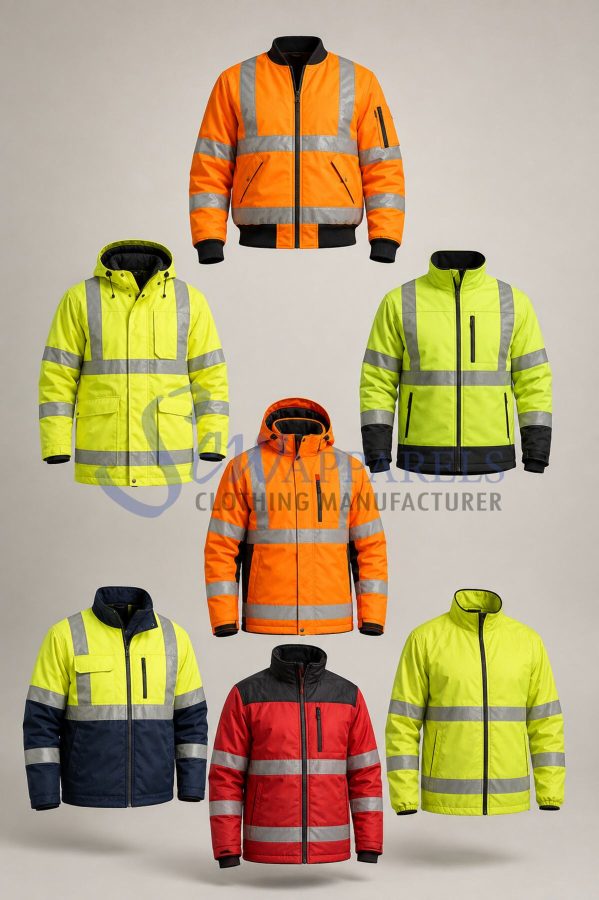
1. Define the hi vis jacket certification document review by destination and intended use
Begin with the market where the jacket will be supplied and the work for which it is intended. A requirement appropriate to one jurisdiction should not be treated as a global approval. The responsible buyer should obtain competent advice on the applicable product rules, workplace requirements and conformity route before accepting the evidence package.
A destination standard requirement brief should identify the intended claim, relevant standard and edition, required performance designation and procurement conditions. Separate a contract requirement from a legal requirement. If the brief only says certified hi-vis, ask what that means for this order rather than allowing each supplier to interpret it differently.
HSE guidance on PPE product safety and supply explains the Great Britain context, including conformity marking, declarations and instructions for most new PPE. Northern Ireland has separate guidance. This reference illustrates why destination matters; it does not establish that the same document set is sufficient everywhere.
For a hi vis jacket certification document review, record the responsible roles in the supply chain. The factory, brand, manufacturer named in the declaration, importer and distributor may be different entities. A commercial trading name on a quotation does not, by itself, explain which organisation takes responsibility for the assessed product.
2. Match the exact jacket model across the evidence package
A hi vis jacket certification document review needs the model code, construction revision and garment identity before reviewing broad performance claims. Hi vis jacket certificate model matching should compare the quoted article with the document description, associated drawings or model list and any referenced annexes.
For a model code document match, preserve the full identifier rather than comparing only the family name. A suffix may distinguish an insulated version, another fastening or a changed tape layout. If the supplier says two codes identify the same model, request a documented explanation from the responsible party.
Hi vis jacket variant documentation should make colour, construction and size coverage understandable. Colour variant evidence should connect the proposed colour combination with the assessed scope. Do not assume that evidence for one fluorescent material or colour arrangement automatically covers another.
Check the size range documentation scope against the actual order. Some supporting information may identify specific tested sizes or a defined range. Where the relationship is unclear, ask the responsible manufacturer or assessor to explain it. Do not extrapolate the buyer’s own approval to unlisted variants.
A test report sample identity should include the submitted garment or material description and the date or reference that connects it to development records. Compare that identity with the finished model. A component report can be relevant supporting evidence without being a complete assessment of the assembled jacket.
3. Distinguish declarations, assessment certificates and test reports
A useful hi vis jacket certification document review treats each document according to its purpose. A declaration is not the same thing as a laboratory report, and a voluntary commercial certificate should not automatically be treated as evidence satisfying a mandatory conformity procedure.
For a high visibility jacket declaration review, identify the responsible organisation, product description, referenced requirements, date and authorised signatory as relevant to the applicable route. Request the complete document rather than relying on a cropped image. Check that references and annexes needed to identify the product are available.
Reflective jacket test report scope should state what was evaluated, under which method and on which sample. Material performance, garment design, conditioning and other assessments may appear in different records. A favourable result for reflective tape does not establish that the complete jacket and its proposed configuration meet every applicable requirement.
Your Europe guidance on conformity assessment explains that the required EU route depends on the product rules and that a notified body’s competence must match its notified area. It points to NANDO and warns about misleading voluntary certificates. Use the relevant official information and competent assessment when checking an issuer; a logo alone is not verification.
Keep certificate issuer verification questions specific: which legal framework and procedure apply, is the body designated for the relevant scope, and how can the document’s status and model coverage be confirmed? Contact details and verification routes should come from an authoritative source. Do not treat a supplier-provided contact address as independent confirmation without checking it.
4. Review customisation and reconcile the garment label
The hi vis jacket certification document review must account for the jacket as supplied, including requested decoration or construction changes. A branded sample can differ from the model described in an earlier assessment. Record the proposed logo size, placement, application method and any material or tape changes.
A customised style evidence review should ask the responsible manufacturer or assessor whether the change is covered and what further work is required. Do not invent a universal safe logo area or assume that a small modification cannot affect the assessment. Approval needs the appropriate evidence and responsibility.
For jacket label document reconciliation, compare the sample’s model identity, size and claimed designation with the accepted documents and instructions. Check whether the information is consistent across the garment, packaging and order. A conformity mark does not remove the need to investigate an identity mismatch.
Photographs can help record the received sample, but they should not replace the underlying documents. Keep the actual revision of the artwork and garment specification available. If the label is changed during private label development, confirm that the named responsibilities and approved information remain correct.
| Review item | Evidence connection | Question requiring resolution |
|---|---|---|
| Model identity | Quote, sample and document model code | Are these the same assessed configuration? |
| Variants | Colour and size list with relevant annexes | Does the evidence cover the ordered range? |
| Assessment route | Declaration, certificates and supporting reports | Are the documents appropriate to the destination? |
| Customisation | Artwork and construction revision | Has the proposed change been properly reviewed? |
| Label and instructions | Finished sample and accepted document set | Do the identity and claims agree? |
This is a suggested procurement record, not a substitute for conformity assessment. Assign unresolved issues to the relevant responsible party rather than approving the model merely because most cells in the table are complete.
5. Control document revisions and unresolved gaps
A hi vis jacket certification document review should use the current, applicable evidence set and preserve its revision history. Declaration revision control should connect an updated document with the model revision and the reason for the update. Do not mix pages from different versions into an apparently complete file.
A documentation gap register should identify the missing or conflicting item, the affected model or variant, the responsible party and the evidence needed to close it. Use clear statuses such as awaiting issuer confirmation or variant scope unresolved. An undocumented verbal assurance should not be entered as a verified result.
For an illustrative example, a quotation might identify model HV-A while a supplied document names HV-B. The codes are fictional and no actual supplier is being assessed. The gap is model identity: obtain the appropriate evidence or a substantiated explanation before accepting the proposed article. The existence of a certificate is not the answer to that question.
Keep the document status review separate from suitability for the task. An evidence package may be consistent while the selected garment is still unsuitable for the intended working conditions. The employer or responsible competent person must address selection and use through the appropriate process.
Where a document has an expiry, validity condition or status reference, check it through the applicable authoritative route. A recent printing date does not necessarily mean a new assessment. Equally, do not declare a document invalid solely because the first issue date is old; obtain the current status and scope information.
6. Link approved evidence to the purchase order and received goods
The hi vis jacket certification document review is ready for procurement release only when the accepted identity, variants, specification and evidence requirements agree. Approved model procurement evidence should identify the exact order configuration and the person responsible for accepting the review outcome.
For private label hi vis jacket production, clarify the brand and manufacturing responsibilities before treating another organisation’s document as covering the branded product. Confirm the accepted scope with the responsible parties. This article does not establish Sew Apparels’ certification status, assessed models, testing services or destination approval.
Attach the accepted model code, construction revision, colour and size range to the purchase order. Identify required accompanying instructions and documentation for the destination. If a substitution is proposed, review its effect before release rather than relying on similarity in appearance.
On receipt, compare the goods and their identification with the accepted order and evidence set. Investigate a changed label, model suffix or construction detail. Preserve a traceable record of the discrepancy and the resolution so repeat orders do not inherit an unexplained exception.
Use the hi-vis jackets reflective tape layout planning review to identify the proposed layout revision, while leaving conformity coverage to the appropriate documented assessment.
Questions buyers should resolve
Does a tape report certify the whole jacket?
It provides evidence for the tested material and scope. The assembled model, variants and applicable conformity procedure need their own appropriate evidence. A component result should not be described as a complete garment approval.
Can one certificate cover every customised version?
Only the documented assessment scope and appropriate responsible review can establish coverage. A hi vis jacket certification document review should not assume that changed colours, logos or construction are automatically included.
What is the first check on a supplied certificate?
Establish its purpose and connect the model identity to the proposed jacket. Then review the issuer, scope, relevant status and supporting documents through the appropriate route.
Use the Hi-Vis Jackets Buying Guides for related development decisions. Complete the hi vis jacket certification document review through a reconciled evidence package before accepting the exact jacket configuration for the order.