
A custom printed scrub cap order brief should connect approved artwork, cap construction, colorways and quantities before a buyer requests a sample or bulk quotation. A logo file alone leaves too many decisions open: where the design sits, how a repeat behaves across panels, which fabric is intended and what the institution permits.
Use six checks to build a printed-cap order sheet with clear ownership and approval references. This guide concerns ordinary headwear procurement. A print, logo or scrub-cap style does not establish surgical suitability or infection protection. Confirm the institution’s headwear and branding requirements through its responsible team before releasing artwork for manufacture.
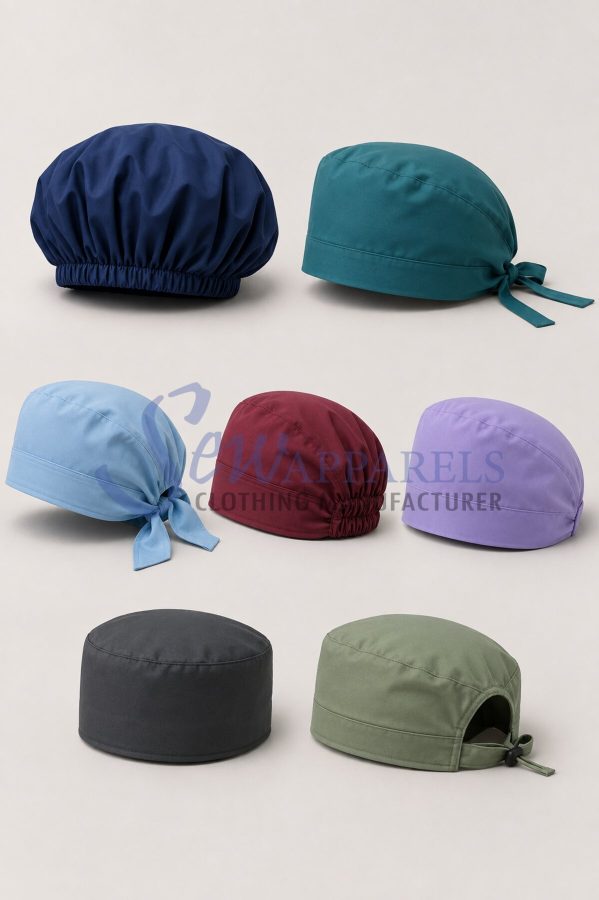
1. Define the scope of your custom printed scrub cap order brief
Identify the intended cap style, wearer requirement and approved use setting. Keep construction and artwork decisions separate in the record while checking their interaction on an assembled sample. The hair-volume accommodation review supports a separate approved garment specification; a print inquiry should not silently alter the fit block to make a motif easier to place.
Record the scrub cap institution branding policy reference and the person who can authorize its use. Confirm permitted marks, wording, colors and any relevant placement restrictions. Do not treat a department’s informal request as permission to reproduce an institution-owned logo. Supply the approval reference with the artwork rather than asking the factory to infer ownership.
The custom printed scrub cap order brief should state which details are fixed and which remain supplier proposals. A buyer may have approved a cap block but still need a printing-route recommendation. Name that open decision and request confirmation of capability on the specified fabric; do not assume a supplier offers every printing method discussed online.
Separate the garment supply requirement from any clinical or institutional acceptance process. Ordinary custom headwear manufacture does not certify a scrub cap for a surgical setting. Include the institution’s approved care and use requirements in the inquiry, and ask its responsible reviewers to resolve any conflict before sampling or production instruction.
2. Supply controlled artwork and color references
A scrub cap owned artwork file should carry a unique design reference, revision and authorization owner. Include the intended dimensions, readable text and any required orientation. State which file is the master and which is only a visual preview. A screenshot or messaging-app image should not become production artwork without deliberate review.
For a scrub cap print artwork quotation, ask what file preparation and technical checks the proposed route requires. Identify responsibility for revisions, proofing and approval. Confirm any quoted artwork or development charge in writing; do not assume a standard fee or a fixed number of included revisions for every supplier.
Scrub cap print color approval should connect the artwork colors to agreed physical references and the intended fabric background. Screen display is useful for communication but does not prove a printed shade match. Record the comparison conditions and approved sample reference, including any accepted variation, rather than promising identical appearance under all lighting.
In a custom printed scrub cap order brief, name each colorway explicitly. If the same design uses different background fabrics or color substitutions, give each version its own reference. A production instruction that says assorted colors can create mismatched proofs, quantities and packing identifiers unless the assortment has been specified and approved.
The scrub cap approved artwork archive should retain the released file, sample decision and change history together. Preserve obsolete versions as records, but identify them clearly so they cannot be mistaken for the current instruction. Releasing a corrected file without updating the order sheet leaves a preventable conflict.
3. Decide between placed and repeat-print treatment
Scrub cap placed versus repeat print is a procurement distinction that affects the instruction. A placed design needs a defined position, finished size and orientation relative to construction points. A repeat needs the artwork repeat, direction and an agreed approach to what can appear at panel joins and cut edges.
The CottonWorks printing techniques comparison describes digital, rotary-screen and cool-transfer approaches for cotton textiles. It is useful background for asking how a design reaches the fabric. Its historical examples are not current supplier quotations or proof of Sew Apparels’ equipment, colorway limits or minimum order quantities.
Ask about scrub cap print method availability on the actual fabric and construction. Confirm whether the proposed treatment occurs on fabric, cut panels or an assembled cap, and how that affects placement. Different routes can have different preparation and approval needs; retain the supplier’s confirmed proposal instead of choosing a method solely from a generic description.
The custom printed scrub cap order brief should show the print zone on a cap drawing. Define the relevant seam or edge reference and viewing direction. If a motif approaches a tie, fold or join, inspect the assembled result. A centered image on an isolated flat panel may not look centered when the cap is worn or closed.
For a directional repeat, establish which orientation matters and whether a specific motif must appear at a chosen location. If exact motif placement is not required, record the approved variation. Do not demand seamless pattern matching by implication; ask the supplier to quote any specifically required matching treatment and confirm it through a representative sample.
4. Approve fabric, decoration and care together
A scrub cap fabric print approval sample should use the intended fabric reference, background shade and decoration proposal. A fabric swatch can support color or print review, but the assembled cap answers additional placement and construction questions. Link both approvals to the same artwork revision and explain any differences from production intent.
Record a scrub cap print care sample using the institution’s agreed evaluation route. Compare the approved initial sample with its condition after the defined evaluation. Observe print appearance, readability, relevant distortion and interaction with garment construction. Do not declare universal wash resistance or invent a standard cycle count from a fresh sample.
The CDC’s institutional laundry guidance provides context for healthcare textile handling and processing. It does not validate a particular scrub-cap print method or certify an ordinary cap for a clinical task. The institution’s responsible team should define the applicable care route and review its requirements.
For the custom printed scrub cap order brief, record each sample outcome as approved, revise or awaiting named evidence. Identify who approved artwork appearance, who reviewed construction and who accepted the care observations. Avoid a single undated sample-approved message that leaves these responsibilities unclear.
If a print revision changes dimensions, repeat direction or background fabric, decide which sample checks need repeating. A prior approval does not automatically cover the changed combination. Keep the revision reason and linked sample reference visible so a later buyer can understand what was actually evaluated.
5. Allocate quantities by style and colorway
A custom scrub cap colorway order split should use buyer-entered quantities for each approved combination. Do not invent a demand ratio, supplier minimum or colorway limit. If a supplier proposes quantity conditions, record them against the specific quotation and seek approval before treating them as an order instruction.
Build a scrub cap style color quantity matrix with one row per cap style, artwork version and colorway combination. Include the approved size or adjustment reference where relevant. Use distinct order-line codes for combinations that look similar but have different fabrics, motifs or receiving destinations.
The printed scrub cap bulk order worksheet should reconcile its row quantities to the buyer’s intended total. Record sample quantities separately unless the buyer has explicitly included them in the bulk count. Identify packaging and receiving requirements without silently changing the garment assortment to suit a convenient carton ratio.
A custom printed scrub cap order brief should contain the following fields. Keep unknowns visible as questions rather than filling them with supplier assumptions.
- Cap reference: approved style, construction revision, fabric and relevant fit or adjustment reference.
- Artwork: design ID, released file version, ownership approval and intended treatment.
- Colorway: fabric background, artwork colors and physical approval reference.
- Placement: print zone, dimensions, direction and any expressly required repeat or matching rule.
- Quantity: buyer-approved amount for the complete style and print combination.
- Sample: assembled and care-review references, decisions and unresolved evidence.
- Commercial scope: quotation version, included development, stated exclusions and delivery boundary.
- Release: sign-off owner, date, current instruction and repeat-order archive reference.
Reconcile the custom printed scrub cap order brief with the quotation before release. A provider may quote only one colorway or a different treatment from the requested matrix. Mark that difference and obtain an aligned revision; an attractive total does not establish that every ordered combination has been included.
Before signing the custom printed scrub cap order brief, compare the matrix with the sample archive line by line. Confirm each artwork and colorway reference, identify combinations awaiting approval and preserve the buyer’s quantity total. An approved sample for one row should not silently release a different row with another fabric or design.
6. Close quotation exclusions and preserve repeat-order identity
Scrub cap print quote exclusions should identify the supplier’s actual boundaries for artwork preparation, sample development, decoration, packing and transport where relevant. An unanswered inclusion is not a zero cost. Obtain clarification before comparing offers, and distinguish a supplier proposal from a buyer-approved instruction.
Scrub cap logo repeat order records should connect the reorder to the released artwork, cap specification and physical sample. Confirm whether materials, decoration route or artwork preparation will change. A repeated order name alone does not prove that the previous combination remains available or that a fresh sample is unnecessary.
Use scrub cap print order signoff to release the reconciled specification, matrix and quotation together. Identify outstanding questions and their owners. Keep personal patient data outside the artwork and order records; approved institution branding and aggregate procurement quantities are sufficient for the commercial discussion.
For custom scrub cap manufacturing, send the cap artwork, colorways, intended quantities and sample requirements for a focused quotation brief. Ask for written confirmation of the proposed print route and any limitations. Do not present a generic printing reference as evidence of supplier capability.
For private label scrub cap production, supply authorized brand artwork and the institution-approved use and care requirements. Keep branding, garment specification and any separate clinical acceptance process clearly defined. The scrub cap product inquiry page supports the supply discussion, while the scrub caps buying guides connect related development decisions.
A complete custom printed scrub cap order brief gives both parties one traceable instruction: which cap, which artwork, which colors, how many and what was approved. Maintain that record through sample revision and repeat inquiries. It supports a clearer commercial conversation without invented pricing, capability claims or unsupported clinical promises.