
Reusable patient gown laundering durability needs evidence from identified garments exposed to a defined care process. A supplier’s general statement that a gown is reusable does not establish how its fabric, seams, closures and labels will perform in your institution’s laundry conditions. Start with a documented baseline and review changes at agreed trial stages.
This guide explains six checks for an ordinary patient-apparel trial. It does not set a universal number of reuse cycles, approve a clinical cleaning process or establish infection-prevention performance. The useful result is a traceable record of what happened to the evaluated samples, under which conditions, and who accepted the observed condition.
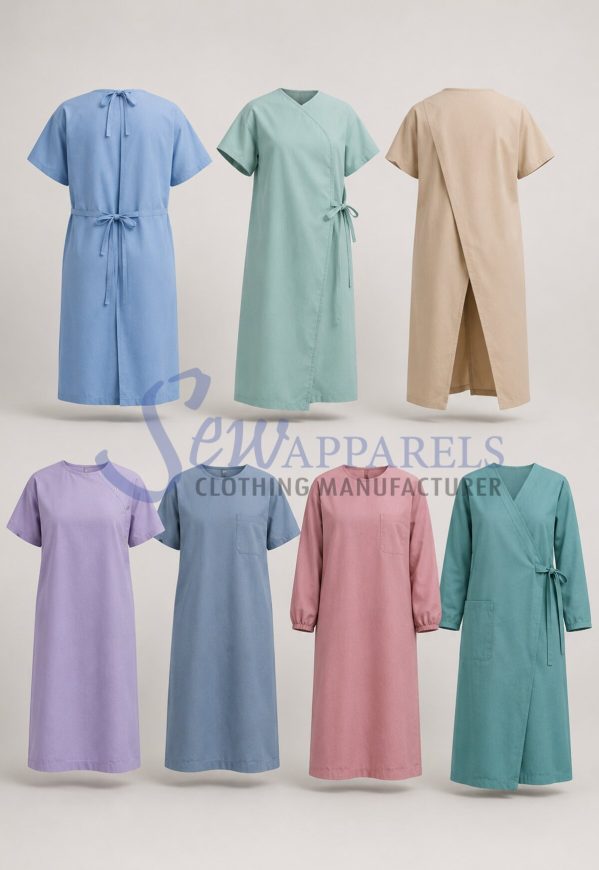
1. Define the scope of reusable patient gown laundering durability
Write the intended garment use before selecting tests. Patient clothing and protective medical gowns have different purposes. Keep patient gown ordinary apparel scope explicit in the trial brief so an appearance or construction review cannot be mistaken for proof of a liquid barrier, sterility or suitability for a clinical procedure.
The FDA’s medical gowns information discusses protective gowns, intended use and relevant performance requirements. It provides an important scope distinction; it does not certify an ordinary patient gown or supply a standard service-life number for it. If a buyer requires protective performance, that requirement needs a separate applicable specification and evidence review.
Record the institution-approved care route, including the processing facility, product identification, washing, drying and finishing conditions relevant to the trial. Obtain these details from the responsible laundry team. Do not prescribe temperatures, chemicals or processing combinations from a general garment article. The institution’s authorised team remains responsible for selecting and validating its handling process.
For reusable patient gown laundering durability, identify whether the proposed trial represents a laboratory method, a controlled laundry evaluation or actual operational processing. These routes answer different questions. Describe deviations and limitations instead of presenting a simplified demonstration as a complete simulation of every institution or service condition.
The CDC’s institutional laundry guidance addresses healthcare textile handling and processing. It explains why the care route and post-processing handling require coordinated oversight. This guidance is context for the trial boundary, not a textile durability test or a basis for inventing an accepted reuse count.
2. Identify components and acceptance criteria
Prepare patient gown care acceptance criteria before processing the samples. Name the characteristics to inspect, the review method and the person who can accept them. Include fabric condition, relevant measurements, seam integrity, closure operation and label readability where these affect the approved garment. Buyer criteria should be agreed in writing rather than created after seeing the results.
Reusable patient gown strength retention requires an appropriate test method when a quantified strength claim is needed. A visual inspection cannot establish a retained-strength percentage. If the trial includes testing, record the method, sample conditioning and report reference. If it includes observations only, describe visible condition without translating it into an unsupported performance number.
Plan a patient gown seam condition review for relevant construction points such as tie attachments, neckline edges, sleeve joins and hems. Identify those points on a garment drawing and use the same inspection sequence at each stage. Document thread breaks, opening, distortion or fraying as observed; do not infer a single cause from the appearance alone.
Patient gown closure function after washing should be assessed with the gown assembled and arranged in its approved closing condition. Check tie reach, overlap and the operation of any approved fastening. Review the selected sizes and underlayer conditions where they affect the closure. A fastening that works in isolation may behave differently on a distorted or shortened garment.
Patient gown label wash readability needs the actual label material, artwork and attachment used in the trial garment. Check that the relevant information remains accessible and readable. This review does not certify a tracking system or establish that an electronic identifier is compatible with a particular institution’s equipment.
3. Create a baseline with traceable samples
A patient gown laundry baseline record should connect each sample to its style, size, material references, construction revision and label version. Record its initial condition before the first trial stage. Preserve relevant measurements and photographs with the viewing direction and inspection conditions identified, so later observations have a meaningful comparison point.
Use a patient gown wash trial sample identity that follows the garment throughout the evaluation. An anonymous sample cannot support a reliable comparison between stages. Identify any control or retained sample separately and explain its role. Do not substitute a newly prepared gown for a damaged trial sample while keeping the original sample number.
Reusable patient gown laundering durability depends on comparing like conditions. State whether measurement occurs after agreed conditioning, whether the closure is secured and how the gown is laid out. A damp, folded or freshly tensioned sample can create observations that differ from an appropriately prepared comparison sample. Keep the chosen preparation consistent and document deviations.
The patient gown repeated laundry sample review should use production-intent components when the decision concerns production approval. If fabric, thread, label or closure references differ from the intended bulk garment, list those differences before the trial starts. The resulting observations belong to the tested construction, not automatically to every later material substitution.
4. Inspect at agreed stages and preserve observations
Agree the stages of patient gown staged care inspection with the responsible teams. Define the planned processing sequence and review points without declaring a universal number of cycles. Keep each stage’s processing record alongside its inspection entry, including any interruption or variation that may affect interpretation.
Patient gown after wash inspection should cover the same named components and measurement points used at baseline. Record observed changes and distinguish them from an acceptance decision. For example, note that a seam has opened at a specific location before recording whether that observation meets the buyer’s agreed criterion.
For reusable patient gown laundering durability, use the following trial-log structure. Complete one entry per identified sample and review stage, with supporting records referenced rather than reconstructed from memory.
- Sample: unique ID, garment revision, size and relevant material references.
- Stage: agreed review point, processing record and any deviation from the defined route.
- Preparation: conditioning and viewing or measurement arrangement used for the inspection.
- Fabric: appearance, relevant dimensional observations and separate test-report references where required.
- Construction: seam, edge and attachment observations at the named inspection points.
- Operation: closure sequence, tie reach or other specified garment-function observations.
- Identification: label condition, readability and access, with no personal patient information.
- Decision: accepted, revise or awaiting evidence, with reviewer and follow-up responsibility.
The patient gown laundry failure log should preserve the first observed stage, location, sample identity and relevant processing history. Photographs can document the appearance but do not by themselves prove chemical, mechanical or manufacturing causation. Record competing explanations as questions for investigation rather than publishing a confident diagnosis.
If reusable patient gown laundering durability observations conflict across samples, retain the disagreement. Check sample identity, construction differences, preparation and processing records before combining results. An average can conceal a damaged component or unsupported outlier; let the agreed evaluation method determine how the result is interpreted.
Before summarising reusable patient gown laundering durability, reconcile the log against the planned sample list. Explain missing entries, removed samples and unfinished stages. A complete record includes limitations and unresolved observations; it should not present the surviving samples as though they were the entire original trial population.
5. Separate observed performance from service-life claims
Patient gown laundry life claim evidence must match the claim being considered. An inspection after selected trial stages establishes the condition observed at those stages. It does not prove indefinite reuse, a guaranteed replacement interval or equivalent performance in a different facility. State the actual scope and limitations beside any summary.
Patient gown reusable life evidence should include the tested construction, defined process, acceptance criteria and decision history. Where a proposed claim extends beyond these records, identify the additional evidence needed. Do not fill a gap with a supplier’s unrelated test report or a general statement about the fabric family.
Reusable patient gown laundering durability should also remain separate from initial opacity selection. A buyer may monitor changes in coverage during a defined trial, but a single observation does not establish every wearer condition or fabric option. Keep the original fabric approval reference and identify any material change that requires its own review.
When revising a component, record what changed and why a repeat evaluation is needed. A stronger attachment, different label or alternative fabric can affect other garment characteristics. Do not silently transfer the previous trial decision to a new construction merely because the revised sample appears similar.
6. Approve the defined trial and prepare the next enquiry
A patient gown laundry trial decision should state which samples and conditions it covers. Record whether the outcome supports the defined approval question, requires a revision or remains incomplete. Name the reviewer responsible for each unresolved observation and the evidence needed to close it. Preserve rejected and interrupted stages in the record.
Complete reusable patient gown laundering durability review with a version-controlled trial summary. Include the garment specification, component references, process record, baseline, staged observations and limitations. This gives sourcing and quality teams a shared basis for discussing the evaluated construction without inventing a universal service-life promise.
For custom patient gown manufacturing, share the institution’s approved laundering conditions and the garment specification when requesting a trial brief. Identify the components that need observation or testing and ask the supplier to confirm any proposed sample differences. Keep sampling, testing and acceptance responsibilities clear before an enquiry becomes a production instruction.
For private label patient gown production, include the label artwork and attachment references with the care-evaluation plan. Garment identifiers are sufficient for sample traceability; personal patient data does not belong in the commercial or inspection record. Any separate protective requirement must be reviewed through its appropriate evidence route.
Use the patient gown product enquiry page for garment development discussions and the patient gowns buying guides for related specification decisions. Send the current garment and trial references together so the next sample addresses the actual approval question.
The final reusable patient gown laundering durability record should describe evaluated condition with enough detail for another reviewer to follow it. Identified samples, agreed criteria, staged observations and a clear decision are more useful than an unsupported reuse number. Keep the evidence tied to the tested garment and care route whenever the procurement team considers a subsequent order.