GUIDE 01
Pleat Retention Planning: School Skirts
Control fabric composition, pleat direction, pressing response and care validation through one measurable school-skirts approval method.
Read the pleat retention planning guide
SCHOOL SKIRTS PRODUCT DEVELOPMENT
Use these School Skirts Buying Guides to convert a school skirt concept into measurable fabric, pleat, fit, pressing, care and quality requirements. Each guide addresses one development decision while keeping sampling, approval and production evidence connected. Start with the pleat-retention article below, then use the product page when your brand has a controlled specification ready for focused manufacturing review.
Review the School Skirts product page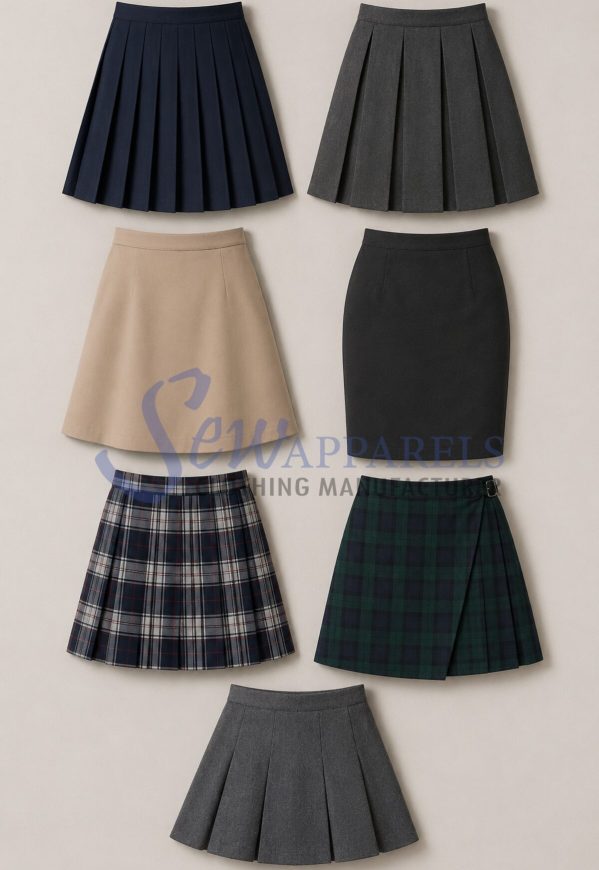
School skirt style examples from the existing product page illustrate pleated and A-line silhouettes. The image does not establish pleat-retention test results, fabric availability, fit approval or certification.
GUIDE 01
Control fabric composition, pleat direction, pressing response and care validation through one measurable school-skirts approval method.
Read the pleat retention planning guideGUIDE 02
Control internal elastic, side fastening, waist extension, fit range and care validation through one measurable school-skirts adjustment method.
Read the waist adjustment options guideGUIDE 03
Compare school-skirt length options using a size-by-length costing matrix. Use five critical checks to record school requirements, demand, actual consumption quotations, supplier minimums, identifiers and a confirmed stocked or alteration route without assumed costs or services.
Read the length variant costing guideGUIDE 04
Map a proposed reversible school skirt in both wearing states. Use five critical checks to connect actual materials, accessible product information, whole-garment care evidence and destination-specific labeling review without extending a narrow care-label exception to every label or market.
Read the reversible information planning guideGUIDE 05
Investigate a washed skirt hem with an unwashed control and a traceable observation sheet. Use five critical checks to connect actual construction, wash–dry records, edge appearance and corrective resamples while separating hem curl from pleat loss and avoiding promises of permanent flatness.
Read the hem curling evidence guideGUIDE 06
Review a proposed lining with the complete school skirt. Use five critical checks and an outer/lining movement map to connect actual materials, attachment points, relative layer travel, care response and controlled resamples without assuming one fabric or construction suits every garment.
Read the lining movement review guideA useful school skirt brief starts with the wearer, uniform policy, climate, school activities, sitting time, laundering route and intended service life. Define the silhouette, fabric family, size range, waistband, closure, pockets, length and approved underlayer before refining decorative details. Convert words such as crisp, comfortable or easy-care into measurements, construction rules and acceptance checks. Record the fit-model profile, approved base size and representative graded sizes. This keeps pleat, waist, hip, hem and closure decisions connected as one garment.
It also gives sampling, costing and quality teams one controlled target for every revision and repeat order. School Skirts Buying Guides help the buyer separate compulsory school rules from optional design preferences. Identify who can approve length, waist arrangement and visible fastenings, and send suppliers the same controlled revision so each quotation describes comparable work.
Define whether the style uses knife, box, inverted or mixed pleats, then map every fold line, placement line and direction arrow. State visible width, underlay, count, spacing, top control, release point and any topstitching. Coordinate the arrangement with centre front, centre back, side seams, checks, stripes, pockets and closure. Review the map on the unfolded pattern and the finished garment. During fitting, inspect standing, walking and sitting views for symmetry, controlled opening and hem balance.
A numbered fold diagram prevents operators from interpreting a fashion sketch differently and gives grading teams stable references across the size range. In School Skirts Buying Guides, the pleat diagram should have a revision code that matches the cutting pattern. If a fold crosses a pocket or a closure, document the changed intake before checking total sweep and finished garment balance.
Specify fibre blend and tolerance together with yarn, weave, finished weight, width, stretch, surface, shade, shrinkage and finishing route. Pleat retention cannot be predicted from fibre percentages alone because density, yarn structure and finishing change heat and moisture response. Approve production-intent fabric rather than a generic swatch. Pleat and press candidate materials under recorded settings, then evaluate definition, shine, handle, colour and dimensional stability before and after care. Keep an approved fabric reference with supplier documentation and test evidence.
Coordinate shell, waistband support, pocketing, interlining, thread and labels so component behaviour does not distort the sealed skirt. Use School Skirts Buying Guides to compare candidate fabrics under the same selected care route. Keep a material reference for each sample and record changed variables; a more defined fresh press does not by itself demonstrate better retention after washing.
School skirt fit should be checked through waist position, hip ease, seat coverage, skirt length, pleat opening and hem behaviour. Use controlled standing, walking, stair, sitting and bending movements with the intended underlayer. Confirm that the waistband remains level, the closure lies flat and pleats open enough for mobility without losing the approved silhouette. Pattern balance must reconcile pleat intake, finished waist, hip and total sweep. Grade selected small, middle and large sizes on suitable fit models rather than copying one intake rule across the range.
Photograph consistent views and log revisions so acceptable fit becomes a repeatable specification. School Skirts Buying Guides distinguish body dimensions, finished garment dimensions and intended ease. Record waist position and the agreed length point before comparing samples, because different measurement landmarks can create an apparent fit discrepancy without a genuine pattern change.
Coordinate waistband depth, extension, zip, button or hook, pockets and belt loops with the pleat map. State exact placement from stable seams and show which folds change around a pocket or closure. Test fastening and pocket access while standing and sitting. Loaded pockets should not pull pleats sideways or rotate the skirt. Approve reinforcement, seam allowance, topstitch and attachment layers in production-intent materials. Check the reverse side for bulk, raw edges and trapped folds.
A clear operation sequence should prevent later waistband, closure or hem work from shifting approved pleat positions and should give inspectors measurable points for bulk comparison. School Skirts Buying Guides connect trim choices with the sealed construction. Confirm that an adjustable waist remains usable through the agreed range and that fastening access does not trap a pleat, lining or label in normal operation.
Develop an approved pressing range for temperature, steam, pressure, dwell time, vacuum or cooling and protective equipment. Inspect fold definition together with shine, glazing, scorching, shade, handle and interlining behaviour. Test strips help establish safe settings, but complete garments confirm interactions at seams, waistband, pockets and hem. Record the equipment and production sequence, then verify that operators can reproduce the result. A weak process may relax during handling, while excessive heat can damage the material.
Condition pressed samples before judging them and repeat assessment after the intended cleansing route. Retain face and reverse photographs with the sealed standard. For process review, School Skirts Buying Guides link a pressing observation to the fabric lot, machine, setting and sample revision. A supplier needs that record to investigate a defect; a general instruction to press harder may introduce damage without resolving the cause.
Confirm the selected wash procedure, detergent, drying method, cycle count and conditioning before sealing the skirt. Rate pleat or crease appearance under an agreed viewing method, then check shrinkage, twist, seam smoothness, shade, waistband stability, closure and hem level. Record results after each agreed cycle rather than using a general instruction such as wash tested. The bulk plan should list pleat count, direction, spacing, press appearance, measurement tolerances, visual zones and defect limits.
Retain approved pre-production and washed samples with test reports. Traceable evidence helps production teams correct material, pattern, pressing or handling causes before bulk continues. School Skirts Buying Guides should retain the agreed wash and dry method alongside each appearance record. Compare results at the stated review stage and keep causes open until material, construction and process evidence supports a corrective action.
A low MOQ school skirts manufacturer can help a startup brand validate fabric, pleat map, pressing, fit, branding and packaging before committing to a larger programme. Small MOQ development still requires a controlled technical pack, approved material, size set, care route, quality plan and sealed sample. For startup development, the first brief should limit variables and use measurable approval stages. Begin with one base silhouette, one fabric and one pleat system, then record controlled changes between variants.
Confirm the current commercial minimum, material availability and development schedule. Treat the first order as a disciplined validation stage that creates reliable evidence for repeat production and future colour or size extensions. Before an enquiry, School Skirts Buying Guides lead to a clear product brief with size-by-length allocation, colour, quantity, destination and required delivery date. Mark forecasts separately from confirmed orders, and ask for a current quotation against the exact selected specification.
For commercial planning alongside School Skirts Buying Guides, the public product page currently lists 500 pieces with matching export-quality stock fabric or 2,000 pieces with custom fabric, per colour and style. It lists sampling at 10–15 days and bulk production at 15–30 days at MOQ after pre-production approval, with timing dependent on quantity. These are published planning terms, not unconditional stock or delivery commitments. Confirm the selected fabric, colour availability, size-by-length allocation, sample charges and production schedule in the current quotation before placing an order.
Use ISO 6330:2021 for controlled domestic washing and drying procedures in textile testing, and ISO 7769:2009 for evaluating retention of pressed-in creases after cleansing. These references support consistent care and appearance evidence. They do not replace product-specific fit trials, pressing validation, sealed samples, grading checks or buyer acceptance limits. ISO 7769 assesses pressed-in crease appearance after cleansing; it does not specify how to insert the crease. Neither reference certifies this company or supplies a universal acceptance grade. Agree the procedure and review limits for the actual fabric and garment before approval.
ISO domestic washing and drying procedures ISO crease appearance assessmentUse the guide above to prepare fabric standard, pleat map, fit measurements, waistband and closure construction, pressing range, care evidence, grading rules, branding details and quantity route. Send the confirmed brief for focused costing and sample development. Keep each approval measurable so production can be inspected against the same sealed standard.
Review custom School Skirts manufacturing