
School skirt lining movement review helps buyers investigate an inner layer that catches, twists or restricts the outer skirt. A lining is part of a complete garment system: its material, dimensions, attachments and response to care must work with the proposed shell. Looking at the lining fabric alone cannot establish how the finished skirt will behave.
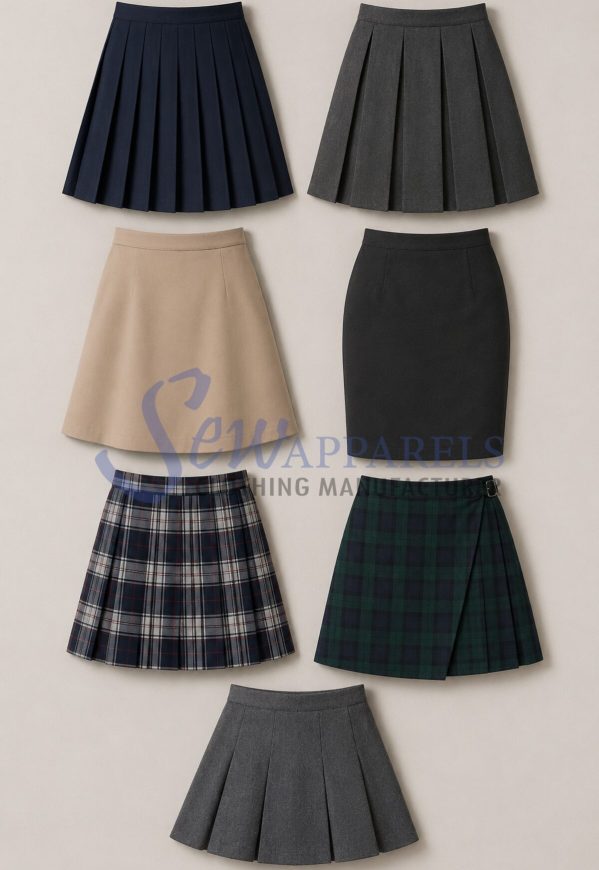
This guide uses five critical checks and an outer/lining movement map to connect observations with a controlled revision. The aim is a traceable development decision, not a promise that one lining material will suit every school skirt. Confirm the actual construction and intended use before approving any change.
Keep school skirt lining movement review separate from pleat retention and school skirt hem curling after washing. Those issues may occur on the same sample, but they involve different observations. Record the inner layer and outer garment together so that a lining correction does not inadvertently alter the approved fit or appearance.
1. Identify the actual outer and lining materials
Begin with the sample reference, development version, size, colour and construction drawing. Identify the outer fabric and lining by their actual supplier references and declared compositions. Record which components are present, including waistband support, pockets, fasteners and any joining tapes. If a material was substituted during sampling, mark the substitution clearly.
School skirt lining material compatibility is a garment-specific question. Two fabrics that look suitable separately may behave differently when assembled. Ask what evidence supports the proposed pairing and retain representative swatches alongside the complete sample. Do not infer movement performance from a fibre name, fabric price or a description such as premium lining.
During school skirt lining movement review, record the direction of each fabric in the pattern, its approved dimensions and any supplier information relevant to construction or care. These details create a reference for later comparison. A changed lining lot or construction version should be identifiable rather than silently treated as the same development sample.
For school skirt lining movement review, define the intended configuration before testing it. A fully lined skirt, a partial lining and a separate underlayer are different proposals. Confirm which one the buyer is considering and whether the supplier can develop it. None of these options should be described as an existing service without confirmation.
2. Observe the complete skirt during approved movement
Agree the intended activities with the buyer and school. A practical observation sequence might include standing, sitting, walking and returning to the starting position where these reflect intended use. Record the fit model, relevant garment measurements and any agreed underlayer. Keep consent, suitability and school requirements within the buyer’s own review process.
A school skirt lined movement trial should use the complete sample in a consistent way. Note the starting position of the lining and shell, the activity performed and the position afterwards. Do not simply write that the skirt feels wrong. Describe where contact occurs, whether the inner layer moves with the shell and whether adjustment is needed.
School skirt lining catching can appear as a local snag, an inner layer riding upward or material gathering at a particular attachment. These observations do not establish a cause by themselves. Mark the location and retain photographs or annotated drawings in the development record, without presenting an isolated observation as proof of a material defect.
Use school skirt inner outer movement notes to distinguish restricted movement from an appearance concern. An inner layer may be visible below the shell without causing restriction; another sample may look normal when standing but interfere during sitting. Evaluate the stated problem rather than combining all observations into one pass or fail judgment.
A school skirt lining restriction sample should be retained with its original records. If different sizes are involved, identify each separately. One accepted size does not automatically establish that the same relationship is suitable throughout the size range, especially where the graded pattern or attachment arrangement changes.
3. Map attachments and relative layer movement
Create a school skirt lining attachment map showing where the lining joins the shell and where it remains free. Include waistband seams, side seams, fastener areas, pocket connections and any specified securing points. Mark which locations are confirmed on the physical sample and which are only proposed in the drawing.
School skirt lining attachment review should compare the drawing with the actual sewing. A planned free area may have been caught into a seam, while a specified connection may be absent. Record such differences before changing pattern dimensions. Otherwise the team may revise the pattern to compensate for an assembly departure that needs a different correction.
Check school skirt lining seam position against the shell in the agreed starting condition and after movement. Identify any rotation, local pulling or attachment that appears to limit relative travel. Do not assume that shifting every lining seam is the solution; describe the specific relationship that the resample must investigate.
School skirt inner layer length review should record actual finished lengths and the buyer’s intended relationship between the layers. Include the observation condition and measurement points. There is no universal lining length or allowance provided by this guide. The approved values belong in the product-specific specification and must be checked on the complete garment.
Where school skirt lining twist observation is recorded, compare orientation marks, seams and attachments before and after the activity. A repeatable change at one location is more useful than an unlabelled photograph of a disturbed garment. Keep possible explanations as hypotheses until the revised sample provides evidence.
4. Review both layers after the agreed care route
Retain an unwashed comparison sample where practical and record the complete care sequence for the reviewed skirt. Washing and drying both matter. The public scope of ISO 6330 domestic washing and drying procedures describes procedures for textile testing and notes that changing procedure parameters can affect results. It does not supply a lining-movement acceptance limit for this product.
Record the actual procedure, equipment information available to the reviewer, drying route, cycle count and condition at observation. If a laboratory conducts the work, retain its report and identify the procedure used. Avoid comparing a washed sample with a differently dried sample as though the care conditions were equivalent.
A school skirt lining care mismatch should be investigated through the complete garment evidence. Record changes in each layer and the relationship between them, including gathering, exposed lining, local pulling or movement interference. Do not assign the problem automatically to shrinkage or declare that a particular fibre combination always fails.
School skirt care layer interaction also includes how seams, attachments and other components behave after care. Recheck the same movement observations used before laundering. A fabric-only result can provide useful information, but it does not show every interaction created by sewing the two layers together.
For US care labeling, the FTC care-labeling guidance explains that instructions need a reasonable basis and that evidence must support care of the garment as a whole. Review actual component interactions and the intended market before confirming instructions. This guidance is not a certification or an automatic approval of the proposed skirt.
5. Approve a controlled complete resample
Use school skirt lining movement review to turn each observation into a revision question. Identify the proposed change, the reason for it, the components affected and the evidence that would support acceptance. Changing the material, dimensions and attachment arrangement at once may obscure which change addressed the problem. Where feasible, use controlled development comparisons.
School skirt lining sample correction should be documented in the revised specification. Identify new material references, adjusted pattern dimensions or changed joining details explicitly. Preserve unchanged approved features as the reference, while checking that the correction has not introduced an unwanted change elsewhere in the garment.
A school skirt layered garment sample must represent the full revised construction. Repeat the agreed movement sequence and care review on that sample. A loose lining swatch, a partial seam trial or a verbal assurance can support investigation, but cannot replace the complete evidence required by the buyer’s approval process.
School skirt lining approval should name the sample version, reviewed sizes, accepted configuration, care records and any remaining conditions. Distinguish a development approval from a bulk-production inspection decision. If a requested condition has not been evaluated, record it as open rather than silently treating it as passed.
School skirt lining movement review: use a movement map
For school skirt lining movement review, use one record linking materials and construction to each observed interference. The following fields form a practical working sheet. They are a suggested review structure, not a standardized test method or a substitute for the buyer’s technical specification.
| Field | Information to record | Actual record / observation | Hypothesis / explanation to test | Evidence / resample reference | Reviewer decision / open condition |
|---|---|---|---|---|---|
| Identity: | sample version, size, colour, outer material and lining reference. | ||||
| Attachment: | location, planned connection, actual connection and any departure. | ||||
| Movement: | starting state, approved activity, relative layer travel and observed interference. | ||||
| Care response: | actual washing and drying route, sample condition and layer changes. | ||||
| Revision: | hypothesis, proposed correction, resample reference and repeat observation. | ||||
| Decision: | acceptance criteria agreed by the buyer, evidence reviewed and open conditions. |
Keep observation and explanation in separate columns. For example, inner material gathering near a side attachment is an observation; excessive restraint at that connection is a hypothesis. This separation lets the supplier investigate without converting an early assumption into a permanent construction rule.
Questions buyers should close before approval
Can a lining be approved from its material description?
No description alone establishes the finished relationship. Match the actual material reference with the complete construction, agreed movement and care evidence. The same lining may need a different arrangement in another skirt pattern, so retain product-specific approval records rather than relying on a generic fabric claim.
Should the lining be changed before the attachments are checked?
Check the recorded construction first. If the sample differs from its drawing, identify that departure. A material substitution may still be appropriate, but it should answer a documented question. School skirt lining movement review works best when a revision is connected to a repeatable observation and a controlled resample.
Does one satisfactory sample close every size and care condition?
It closes only the agreed scope represented by the reviewed evidence. Record the sizes, configuration and care route assessed. If other conditions matter to the order, agree how they will be reviewed before acceptance. Do not describe an unreviewed variant as equivalent merely because it shares the same product name.
Prepare a focused supplier brief
For custom school skirt manufacturing, provide the material identities, complete sample reference, attachment map, intended activities and observed interference. The school skirt manufacturing page is the commercial enquiry destination; this article helps organize the evidence needed for that discussion.
For private label school skirt production, include the revised specification, intended market, care evidence and approval conditions in the quotation or development brief. Use the school skirts buying guides to connect the lining decision with the wider garment plan. Complete school skirt lining movement review with a traceable buyer decision supported by the finished resample.