
School skirt length variant costing requires a clear separation between waist size, finished length and the quantity assigned to each combination. Adding a longer option is an assortment decision as well as a garment-development decision. The price difference cannot be established from the length name alone.
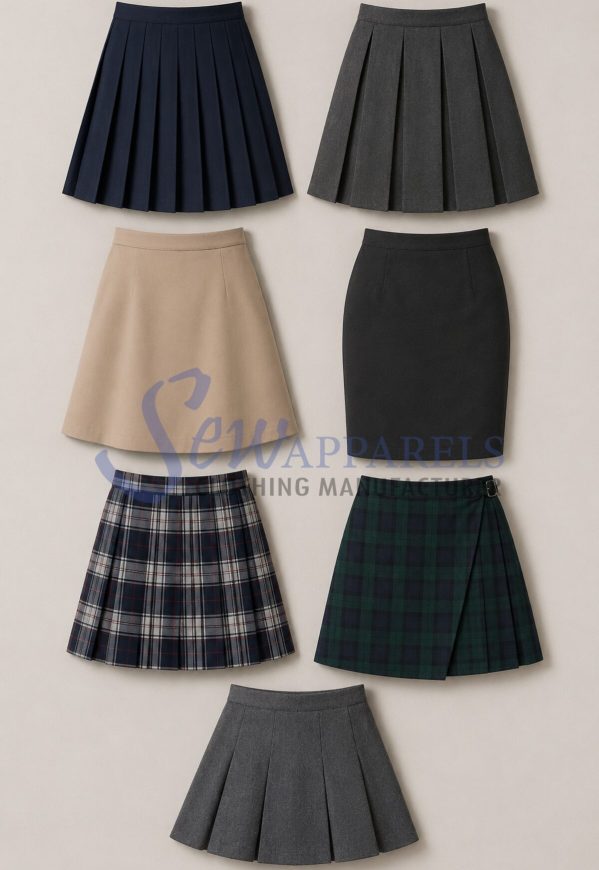
This guide explains five critical checks for buyers comparing school-skirt length options. Its practical tool is a size-by-length costing matrix that connects buyer-supplied requirements, demand inputs, actual consumption quotations, supplier minimums, identifiers and the proposed fulfillment route. No universal school-length rule, extra-cost percentage or alteration service is assumed.
Start school skirt length variant costing with the garment the school actually requires. Keep its fabric, construction, waist specification and approval status identifiable. Then ask what changes when the requested length changes, and how those changes affect quantities, sample work and commercial scope.
1. Define finished lengths separately from waist sizes
A waist size does not automatically identify the finished skirt length. Give each proposed length a clear measurement, measurement method and tolerance. State whether the length is measured from the top of the waistband, a seam or another agreed landmark. Two suppliers cannot quote equivalent options if they use different starting points.
Prepare a school uniform skirt size length matrix showing the intended waist sizes across the approved lengths. Mark combinations that are required, optional or excluded. Do not imply that every size must be offered in every length merely because the spreadsheet can generate those combinations.
A school skirt multiple length quotation should identify the underlying pattern and construction. Changing length may affect pleat layout, hem allowance, pocket relationships or garment balance. Ask the development team which details remain constant and which require a revised pattern or sample. Use the school skirts pleat retention planning guide when a proposed length changes the pleat layout or care-review brief.
For school skirt length variant costing, distinguish an intentionally designed longer version from an unfinished garment intended for later hemming. These are different product and fulfillment proposals. Each needs its own dimensions, finishing scope, approval evidence and quote conditions.
Keep the terminology measurable
Terms such as standard and long can be useful labels after the measurements are agreed. They are not substitutes for specifications. A school skirt standard long option cost comparison should name both finished lengths and the same waist size, material and construction basis before identifying any price difference.
Record whether the length changes by waist size, remains constant across several sizes or follows another approved grading rule. Obtain the buyer’s approval of the rule and the supplier’s confirmation of feasibility. Never infer the grade from an unrelated skirt range.
2. Record the school-supplied requirement
Request the current school supplied length requirement from the buyer or authorized school contact. Keep the document, date and approval owner with the specification. A school may describe an appearance expectation, permitted options or a particular measurement, and these need different forms of clarification.
Ask how the requirement is assessed on the intended wearer and what wearing conditions apply. Confirm the approved waist position and relevant uniform layers. Do not convert a general appearance description into a universal numerical rule without the school’s agreement.
School skirt length variant costing should also identify whether different schools share the same approved product. Similar colour names or style descriptions do not establish that they use identical lengths. Separate requirements where the garment or acceptance basis differs.
Keep the sample review controlled. Identify the waist size, proposed finished length, material and wearer profile represented by each sample. Approve the relevant measurements and appearance together, then define the required size-set review before production release.
Make changes traceable
If the school changes its requirement after quotation, retain the earlier version and issue a clearly dated revision. Identify affected matrix cells, samples and stock commitments. A revised requirement may alter consumption or demand, but its commercial effect must come from an updated supplier response.
3. Request actual consumption and cost scope
Ask for long skirt actual consumption against the approved fabric width, pattern and cutting assumptions. Fabric use depends on the complete layout, not only the extra finished length. Pleats, print matching, shrinkage allowance and size allocation can affect the result, so keep those inputs visible.
A multiple length cost request should separate garment prices from development charges and other exclusions. Identify whether the offer includes revised patterns, samples, grading, labels, packing and any agreed finishing work. Do not compare a fully developed option with a price that excludes its preparation.
For school skirt length variant costing, request comparable quotations using the same material reference and quantity scenario. Where a supplier proposes a different fabric or construction, treat it as a documented alternative. Do not attribute the whole difference to length when other variables have changed.
Record the supplier’s actual price basis without inventing a standard uplift. A longer option may use a different cutting layout or production method; only a confirmed quotation explains how the supplier has priced that proposal. Keep currency, shipment basis and quote validity consistent during comparison.
Use a controlled custom school skirt manufacturing brief to send the specification and matrix together. Ask the supplier to flag unquoted combinations or assumptions rather than filling gaps with an averaged price.
Check what the sample proves
A sample can support measurement, appearance and construction approval. It does not establish the consumption or bulk price for every size-by-length combination. Connect sample evidence with the supplier’s stated production assumptions and request clarification where a quotation covers more variants than were reviewed.
4. Map variants to demand, quantities and identifiers
Build a waist by length order matrix from confirmed requests and clearly labelled buyer demand assumptions. Record quantities at combination level before adding them into a total. A large total can conceal an uneconomic allocation or an unavailable size-length combination.
Review skirt length order demand separately from general enrollment or total skirt sales. Historical purchases are useful only when the product, population and selling period are comparable. Note returns, exchanges and stockouts, and avoid counting an exchange as an additional final purchaser.
Request the length variant supplier minimum for the actual programme. Clarify whether a condition applies to a length, size, colour, style or overall order. Do not assume that a total minimum permits any distribution among the matrix cells.
The school skirt length SKU assortment needs clear size length SKU mapping in ordering, storage and receiving records. A stock-keeping unit identifies the buyer’s inventory item; it should not be confused with an automatically generated label for an unspecified garment.
Where the supply chain uses GS1 identification, review the GS1 GTIN Management Standard with the responsible brand owner. It addresses trade-item identification and relevant product or packaging changes. It does not determine your demand or replace a documented size-by-length assortment decision.
School skirt length variant costing should show the stock created by supplier multiples or minimums. Keep any excess above the buyer’s requirement visible and assign an approval owner. Do not silently distribute extra garments across the slowest combinations merely to reconcile a total.
5. Compare stocked lengths with an approved alteration route
A stocked length buying scenario offers defined finished products ready for the agreed fulfillment process. Its comparison should include quantities, usable existing stock, variant availability and the buyer’s demand evidence. More stocked options create more combinations to manage, without guaranteeing better sales.
A school skirt alteration option requires separate confirmation. Ask who would perform the work, which garments can be altered, what finished lengths are feasible and how the result is inspected. Do not imply that Sew Apparels or another party provides an alteration service unless that service is explicitly agreed.
Check whether an altered hem changes pleats, appearance, measurement balance or care requirements. Agree the method on a representative sample and document the acceptance standard. Alteration should not be treated as a harmless arithmetic subtraction from the original length.
For school skirt length variant costing, compare the full confirmed scope of the stocked and alteration proposals. Include supplier-entered garment and finishing charges, handling responsibilities, inspection scope and timing conditions. Do not promise a saving or a faster route without actual offers.
Keep labeling responsibilities in the comparison
For goods intended for the United States, the FTC textile labeling guidance explains required disclosures for covered products. It notes that substantially completed garments can require labeling even where hemming remains unfinished. Review the applicable destination requirements and responsibility for the proposed route rather than assuming unfinished hems remove labeling duties.
The size-by-length costing matrix
Create one record for each proposed waist-size and finished-length combination. Keep unavailable or unapproved combinations explicitly marked. The matrix below describes the information to collect, without supplying invented prices or predicted purchases.
| Required field | Combination A | Combination B |
|---|---|---|
| Waist-size / finished-length combination | Combination A — measurements to be entered | Combination B — measurements to be entered |
| Product identity: school, style revision, waist size, finished length, measurement method and approved material. | ||
| Demand input: confirmed requests, comparable sales evidence, usable stock and any provisional allocation assumption. | ||
| Supplier scope: actual consumption basis, quoted garment quantity, variant minimum, multiples and exclusions. | ||
| Commercial response: garment price, separate development or finishing charges, quote validity and shipment basis. | ||
| Inventory identity: SKU mapping, agreed trade-item identification where relevant, labels and packing instructions. | ||
| Fulfillment choice: stocked finished length or a confirmed alteration proposal, approval evidence and responsible owner. |
Maintain skirt assortment quote assumptions beside the matrix. If a price covers a combined quantity, record how the offer relates to the individual variants. If rounding creates additional garments, show both the original requirement and adjusted commitment. The reader should be able to explain every change without reconstructing it from email fragments.
A length variant fulfillment choice belongs in the final release record. Identify the selected route, approved samples, accepted size-length allocation and outstanding conditions. School skirt length variant costing is complete as a comparison only when the supplier responses and buyer decision refer to the same controlled specification.
Questions before adding length options
Does a longer skirt have a fixed extra cost?
Request actual consumption and comparable supplier quotations. There is no assumed percentage uplift for every fabric, pattern and order allocation.
Must every waist size have every length?
Use the buyer’s requirements and demand evidence to define the combinations. Ask the supplier to confirm the feasibility and commercial conditions of the proposed matrix.
What should accompany the first enquiry?
For private label school skirt production, send the school requirement, length measurements, waist sizes, material specification and quantity scenarios. Use the school skirts buying guides to connect assortment planning with garment development. Finalize school skirt length variant costing with quoted scope, sample evidence and a recorded buyer approval.