
Gym shorts mechanical stretch versus elastane is a material selection question, not a contest with one universal winner. Buyers need to compare the actual fabric’s extension, recovery, direction, hand and behaviour after care against the intended garment. A fabric can feel flexible in a swatch and still leave unwanted growth in the seat or restrict movement through a poorly positioned panel.
For stretch mechanism material selection, the useful distinction is between the source of stretch and the finished result. Mechanical stretch generally describes flexibility arising from the yarn and fabric structure or processing rather than relying on an elastomeric fibre. Elastane is an elastic fibre used in blends. Neither label, by itself, proves a particular movement range, lasting recovery, moisture behaviour or garment fit. Ask for candidate-specific evidence and verify the assembly.
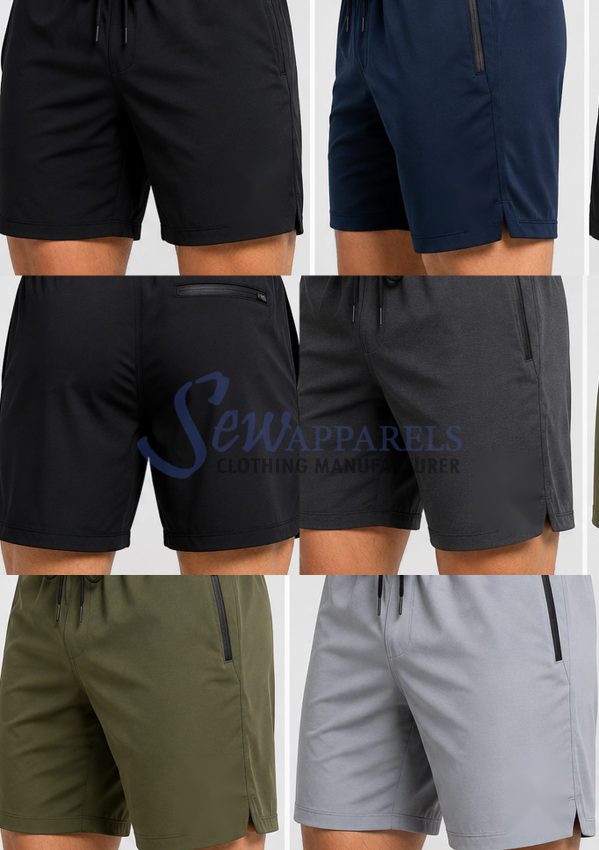
Why gym shorts mechanical stretch versus elastane needs a performance brief
A gym shorts buyer may need ease during a squat, a stable silhouette after sitting or comfortable movement without a close compression fit. Those requirements are not identical. The brief should identify the adult garment, intended activities, fit, care route and areas where movement matters. Define how much recovery is needed before choosing a fibre story or a supplier’s descriptive term.
For gym shorts, a mechanical stretch gym fabric can be appropriate for one silhouette while an elastane blend may suit another. An elastane gym short material comparison must consider pattern ease, garment length, waistband construction and seam behaviour. More extension is not automatically better: a fabric that opens easily under load can still retain excessive growth after release, or its seams may prevent the garment using that extension.
1. Identify the stretch mechanism and verify composition
Start gym shorts mechanical stretch versus elastane with the actual candidate references. Ask the supplier to identify the fibre composition, yarn arrangement, woven or knit construction and stretch mechanism. Record the fabric code and finish version. A sales description such as performance stretch is not a composition report and does not reveal whether an elastic fibre is present.
The CottonWorks NATURAL STRETCH technology explanation provides an example of engineered mechanical flexibility in woven cotton without elastomeric yarns. This illustrates that stretch need not always come from elastane. It describes a particular technology, not a guarantee for every fabric sold as mechanical stretch. Its published benefits should not be transferred to a proposed gym shorts material without matching evidence.
For elastic fibre versus structure stretch, retain the supplier’s composition documentation and seek appropriate verification where needed. Gym short composition verification should identify the relevant fabric rather than an unrelated catalogue sample. An elastane percentage does not quantify fabric recovery on its own; construction and processing still matter. Do not describe a material as elastane-free until the composition basis supports that wording.
2. Map directional stretch to the garment
In gym shorts mechanical stretch versus elastane, direction can be as important as mechanism. Record woven gym short directional stretch and how it aligns with the cut panels. A material with extension across its width does not necessarily offer an equivalent result along its length. Avoid relying on ambiguous two-way or four-way descriptions without identifying the tested directions.
Map that orientation onto the seat, thigh and other relevant panels. A rotated panel may change the movement result even when the fabric code stays the same. Check whether pockets, lining, facing or seam placement restrict a stretch direction. Keep panel orientation and grain information in the technical brief so a production change does not silently alter the approved behaviour.
For an initial comparison, keep the silhouette and panel arrangement consistent where possible. If the mechanically flexible fabric requires different ease from an elastane blend, document the pattern change. The garment result can justify a complete material and pattern combination, but it cannot prove that the stretch mechanism alone caused the outcome.
3. Compare extension, growth and recovery separately
A meaningful gym shorts mechanical stretch versus elastane comparison records what happens under the chosen test conditions and what remains after release. Extension describes the increase while loaded; residual growth describes the remaining change after the specified recovery period. Recovery should be reported with the method and timing, rather than described simply as good stretch.
ASTM D3107-26 stretch, growth and recovery methods address defined woven fabrics and specified tension or extension conditions. A laboratory should confirm whether the candidate fits the method’s scope. The method does not measure breaking elongation and should not be assumed appropriate for every knit or low-stretch construction. Its public guidance also advises against commercial shipment acceptance because between-laboratory precision is poor.
The gym short material recovery brief should specify the applicable method, direction, conditions and buyer criteria. Do not compare two percentage results from different methods as if they were equivalent. Gym fabric permanent growth concerns need a measured recovery interval: an observation immediately after release can differ from one made later. Avoid calling all temporary extension permanent growth.
4. Examine after-care elasticity and appearance
Extend gym shorts mechanical stretch versus elastane beyond the new swatch by reviewing the agreed care route. Record washing and drying conditions, preparation and the comparison stage. Gym short after care elasticity should be assessed on identified samples using a consistent method. Keep before-care and after-care results distinguishable so a change in the test arrangement is not mistaken for a material change.
Inspect shape, surface appearance and seams alongside the fabric result. A care trial may affect garment dimensions or component behaviour even when the selected fabric’s extension remains similar. Compare the waistband, liner and pocket bag where they influence movement. Do not assume that a mechanically flexible fabric needs no care review or that every elastane blend behaves poorly after washing.
Ask the supplier and laboratory to explain the proposed care conditions and any known material limitations. Use those facts in the final care and development brief rather than adding unsupported instructions. A limited care comparison does not establish lifetime elasticity, a guaranteed number of workouts or performance under every consumer laundering practice.
5. Separate fabric hand from movement evidence
Gym shorts mechanical stretch versus elastane also requires a gym fabric hand versus stretch review. Softness, drape, body and surface feel affect product preference, but a soft swatch does not establish useful recovery. Record subjective observations separately from measured material results. This allows the buyer to accept a hand preference without misrepresenting it as laboratory performance.
Conduct the gym short movement material trial on the proposed garment and intended adult size range. Use an agreed sequence appropriate to the product, such as ordinary movement and the relevant fit positions. Record restriction, coverage, seam tension and any shape change after the sequence. Feedback should describe the actual fit and activity rather than claim a universal range of motion.
Keep fabric selection connected to pattern development. A restrictive crotch or pocket attachment may not be solved by increasing elastane content. Review liner versus unlined construction when the inner assembly limits movement. Conversely, a stable non-elastane construction may still require more pattern ease. Review the observed location of the problem before changing the material. This protects the brief from unnecessary substitutions that introduce other tradeoffs.
6. Build a comparison matrix and approve the wording
Close gym shorts mechanical stretch versus elastane with a stretch fabric comparison matrix covering candidate code, composition basis, construction, stretch direction, method, extension, growth, recovery, after-care observations and garment feedback. Add hand preference and commercial considerations as separate fields. Mark missing evidence explicitly rather than scoring an unknown property as a pass.
Use the gym short material tradeoff record to explain the decision. One candidate may suit the preferred silhouette with revised ease, while another may meet the movement brief with a different hand. The approved choice should identify the complete fabric, pattern and component combination. A matrix is useful because it shows which requirement each candidate meets without hiding compromises behind a performance label.
Mechanical stretch claim wording should reflect verified facts. If the evidence establishes composition and directional extension only, do not add superior recovery or greater durability. Similarly, elastane content does not justify a compression, moisture-management or environmental claim. Any supplier technology name or licensed claim needs its own verified basis; this comparison does not establish Sew Apparels access to a branded technology.
How to read the material report without losing its scope
A gym shorts mechanical stretch versus elastane review benefits from a clear gym short stretch report scope. Check that the report identifies the candidate, specimen direction, method edition, conditioning and measurement stage. Confirm whether it concerns new fabric, cared fabric or an assembled garment. A report on one version should not automatically approve a later finish or composition change.
Suppose an illustrative Candidate A has the preferred hand but more residual growth under the agreed conditions, while Candidate B has better measured recovery but feels less suitable for the target silhouette. That is a decision requiring priorities and possibly another development sample. These are hypothetical observations, not Sew Apparels test data or a claim that one fibre mechanism inherently performs better.
When reports from different laboratories disagree, request a technically justified comparison rather than averaging unrelated numbers. Differences in specimen, procedure or measurement timing can change interpretation. Keep the evidence scope visible and ask a qualified laboratory to resolve method questions. A result should support the stated development decision, not become a certificate for claims that were never examined.
Frequently asked sourcing questions
Does mechanical stretch mean the shorts contain no elastane?
The phrase describes a mechanism, but a supplier may use it loosely. Verify the actual composition and construction before making an elastane-free statement. A product can combine structural flexibility with elastic fibres, so the descriptive label alone is insufficient.
Is a higher elastane percentage always better?
The percentage does not replace extension and recovery evidence, the garment fit or the care review. Compare the finished candidate against the brief instead of selecting solely from the fibre percentage. The desired hand and silhouette also influence the decision.
Can a quick hand stretch replace testing?
It can help a buyer understand a swatch, but it does not provide a controlled performance result. Use it for initial screening and record it as an observation. The approval needs an appropriate evidence basis and the actual garment trial.
Transfer the selection into the manufacturing brief
For custom gym shorts manufacturing, provide the selected fabric code, verified composition, panel direction and complete approval record. For private label gym shorts production, retain those details across reorders and size development. Ask about current sampling options, material availability and commercial terms rather than assuming that a specific technology or test is included.
Use the custom gym shorts manufacturing page for the product enquiry. The Gym Shorts Buying Guides connect this decision with liner, pocket, care and contact considerations. Keep gym shorts mechanical stretch versus elastane tied to the selected material’s evidence and the approved garment, not a general claim about either mechanism.