
Jogger scrub pants sample revision costing starts with a clear record of what the first sample was supposed to demonstrate. A low opening development quote is difficult to assess when pattern changes, replacement fabric, repeat samples and courier movements are left undefined. Buyers need an agreed starting specification, a change classification and written approval of additional charges before revised work begins.
This guide explains five critical checks for separating the initial prototype from later revisions. It includes a practical change log for comparing supplier proposals without assuming a standard fee, a free correction policy or a refund arrangement. The scope is ordinary apparel development; a scrub-jogger sample does not, by itself, establish protective performance or clinical suitability.
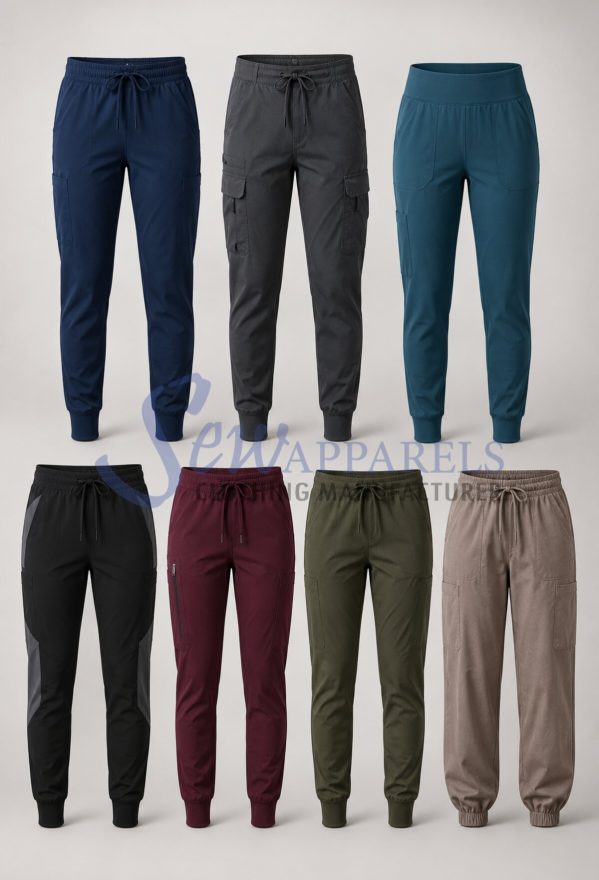
1. Define the starting sample before comparing charges
The first control in jogger scrub pants sample revision costing is a versioned brief. Record the style reference, base size, measurement chart, fabric identification, cuff construction, pocket arrangement, waistband, decoration and labels supplied to the developer. Attach dated drawings and identify which details remain open. A quotation based on a sketch is not necessarily equivalent to one based on an approved pattern and complete technical specification.
Your scrub jogger sample quotation scope should state whether pattern development, material procurement, cutting, sewing, decoration trials and finishing are included. Ask which physical output will be delivered: one prototype, a revised sample or a specified selection of sizes. Identify substituted materials and explain whether they are acceptable for evaluating shape only. An available substitute cannot automatically approve the intended bulk fabric.
Separate buyer-supplied inputs from supplier-created work. If the buyer provides a pattern, confirm the format, grading status and permission to use it. If the supplier develops the pattern, ask what deliverables are included and what usage terms apply. Pattern ownership and file transfer should be agreed explicitly; paying for a sample does not establish those terms without an agreement.
A jogger scrub pants prototype quote should also identify unresolved decisions. An unspecified ankle cuff, for example, may require a different development route once its material and finished dimensions are chosen. Record that uncertainty rather than treating every later choice as a supplier error. This makes jogger scrub pants development charges easier to compare on a consistent basis.
2. Distinguish correction from a requested design change
For jogger scrub pants sample revision costing, the reason for each revision matters as much as its price. Compare the delivered sample with the accepted starting brief. A measurement outside the agreed tolerance, an omitted pocket or the use of an unapproved material should be recorded as a discrepancy. A buyer deciding to move the pocket after reviewing a correctly made sample is a different kind of request.
Discuss scrub jogger correction versus redesign using evidence rather than labels alone. Attach the original requirement, the observed result and the requested outcome. For measurements, record the measurement method and sample condition. For appearance, use consistent photographs and identify the exact location. Ask the supplier to confirm its assessment and the commercial treatment before authorizing further work.
Do not assume that every discrepancy will be corrected without charge, or that every revision is billable. The quotation and agreed terms should define responsibility, review procedures and any allowance. A mixed request may contain both correction and new design work. Separate those items so that the parties can resolve the disputed portion without losing the history of the approved change.
Use a scrub jogger sample change request with one identifiable action per line. “Improve fit” is insufficient for costing. Specify the intended adjustment, the reference measurement or fitting observation and the features that should remain unchanged. Record whether the request is a confirmed instruction or a proposal requiring feasibility review. Clear boundaries reduce repeated interpretation and unnecessary sample cycles.
3. Price pattern, material and decoration changes separately
Jogger scrub pants sample revision costing should show which operations a change affects. Altering a pocket opening might require a pattern adjustment, replacement components and another assembled sample. Changing the main fabric can affect cutting behavior, seam settings, drape and the relevance of previous fit observations. Ask for a scope breakdown rather than accepting an unexplained combined revision fee.
A scrub jogger pattern revision quote should identify the affected pieces, base size and any associated grading work. Ask whether the revised pattern will be checked against adjoining components. A changed cuff circumference, for example, needs to be assessed against the leg opening and assembly method. Confirm whether the quote covers only pattern work or a sewn sample that demonstrates the change.
For scrub jogger material change costing, record the proposed fabric identity, available sample quantity, sourcing responsibility and any procurement charge. Distinguish the material used in development from the intended production specification. Ask whether existing test evidence applies to the replacement material. Do not carry a performance claim forward simply because the new fabric has a similar appearance or fiber description.
Decoration and labeling changes deserve their own entries. A new artwork file, altered placement, different thread or revised label dimensions can require additional setup or approval. Ask which work is reusable and which must be repeated. Record any proposed setup credit only when the supplier confirms it in writing, including the conditions under which that credit would apply.
The CottonWorks sourcing and manufacturing resources provide broader context for understanding apparel development operations. They do not prescribe a supplier’s revision fee. Use that context to ask informed questions about the work involved, while obtaining actual scope, charges and terms from the developer.
4. Compare repeat samples, delivery and approval inclusions
The fourth check in jogger scrub pants sample revision costing is whether proposals cover the same physical outputs. A scrub jogger repeat sample charge may include a complete new garment, selected replacement components or work on the existing prototype. Those options are not interchangeable. Ask what the buyer will receive and which evaluation questions that output is intended to answer.
Record jogger scrub sample courier cost inputs separately: dispatch and delivery locations, shipment contents, charge responsibility and the proposed service. Ask whether the quotation includes shipment or leaves it to later confirmation. Identify return movements when the supplier needs the original prototype back. Do not invent freight charges or present a provisional estimate as an agreed delivered cost.
A scrub jogger development fee comparison should use a common scope sheet. Compare pattern work, materials, sample quantity, decoration setup, evaluation, delivery and exclusions. Mark missing information as “confirmation required.” A cheaper headline quote can cover less work, while a higher quote may include additional outputs that the buyer does not need. Request comparable proposals before selecting a route.
Confirm the scrub jogger buyer revision allowance if one is offered. Define what constitutes one revision round, the changes covered and the treatment of requests submitted after that round closes. Also ask what happens if several comments are consolidated into one instruction. Do not assume unlimited revisions, guaranteed timing or a production-order refund unless those conditions are explicitly agreed.
Set a scrub jogger sample approval milestone for each development stage. Distinguish permission to proceed with revised sampling from approval of the final production specification. A prototype accepted for silhouette may still have unresolved material or label details. The CottonWorks quality testing overview explains why defined evaluation methods matter when assessing textile performance and appearance. Agree relevant evaluation requirements separately from the commercial revision record.
5. Jogger scrub pants sample revision costing worksheet
The final control in jogger scrub pants sample revision costing is a traceable decision record. Use one line for each change and link that line to the sample version, quotation and approval. Retain earlier versions so that a later discussion can establish which requirement was active when the work began. A revised file should not silently overwrite the original commercial scope.
Your scrub jogger sampling budget worksheet can contain the following fields:
| Required record | Starting reference | Requested revision | Supplier-confirmed charge | Written approval |
|---|---|---|---|---|
| Reference: style identifier, starting specification version and current sample version. | ||||
| Requested change: the precise action, affected component and intended result. | ||||
| Reason: discrepancy against the accepted brief, new buyer preference or unresolved initial decision. | ||||
| Responsibility: the parties’ recorded assessment, including any issue still under discussion. | ||||
| Scope and charge: pattern work, materials, sample output, delivery and separately stated exclusions. | ||||
| Authorization: approving person, date, quotation reference and permission to commence. | ||||
| Outcome: received version, evaluation result and remaining decisions. |
For an illustrative record, call the initial prototype V1 and the revised prototype V2. Change R1 could request a new cuff dimension; R2 could record a pocket-placement discrepancy. Enter each supplier-confirmed charge in its own field, leaving unresolved figures blank. These identifiers are examples of record structure, not evidence of actual sample counts, charges or supplier policies.
A jogger scrub sample invoice breakdown should be reconciled with those authorized lines. If an invoice includes an unexpected operation, request clarification before treating it as approved. Keep the quotation, change log and delivery record together. Record any agreed adjustment against the original item rather than deleting the history, so that the final development total remains explainable.
Require scrub jogger change order approval before additional work starts. If urgency leads to a verbal discussion, follow it with a written scope confirmation and obtain agreement. Identify who can authorize changes on the buyer’s behalf. Uncoordinated requests from different colleagues can create contradictory instructions, repeated work and disputes about which version should have been made.
Jogger scrub pants sample revision costing: the next sourcing step
Once jogger scrub pants sample revision costing is settled, retain the final specification and development record as separate but connected documents. The approved sample establishes only the details accepted for that version. Future material substitutions, size development or decoration changes should receive their own review. Do not treat a completed prototype as a blanket approval of every production variation.
For broader product planning, review the custom jogger scrub pants manufacturing page and send your current specification with the changes requiring a quotation. Ask Sew Apparels to confirm feasible development work, itemized charges and applicable terms. No minimum order, fee, turnaround, refund or special capability is established by this worksheet.
The jogger scrub pants buying guides support related product decisions. Keep private label jogger scrub pants production requirements aligned with the final approved specification, while using the revision record to manage development-stage commercial commitments. A complete brief gives both parties a clearer basis for an itemized proposal and a controlled next step.