
Jogger scrub pants crotch seam slippage testing should answer a specific development question: are fabric yarns moving away from the stitch line, are sewing threads breaking, or is the fabric itself tearing? These mechanisms can leave a similar-looking opening, but they do not call for the same corrective action. A useful testing brief identifies the fabric, seam construction, specimen direction and evidence needed before the buyer approves a change.
This guide sets out six critical checks and a failure-classification worksheet for sourcing teams. It does not prescribe a universal passing load or claim that a laboratory result predicts every wearer situation. The discussion concerns ordinary apparel construction. A scrub-jogger seam test alone does not establish protective performance, infection-control suitability or approval for a particular healthcare workplace.
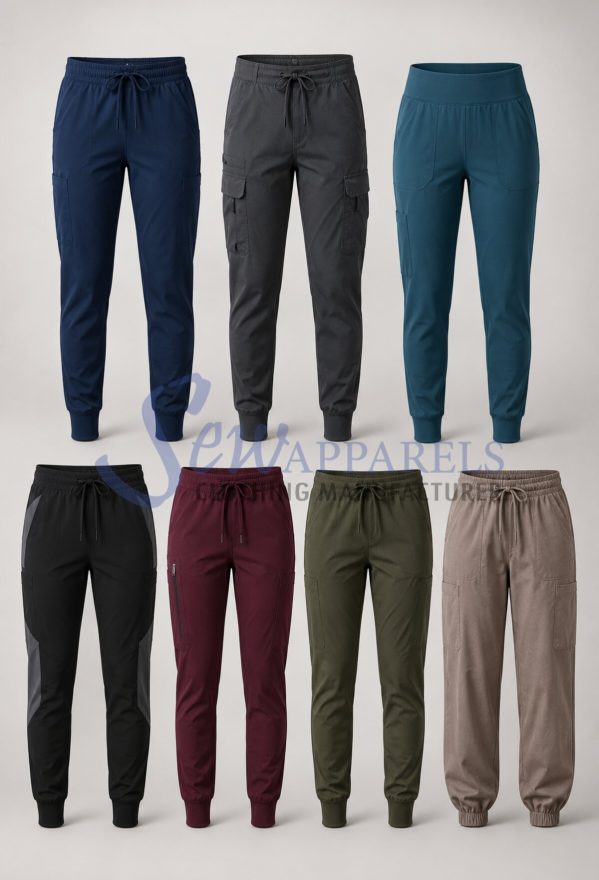
1. Identify the fabric and crotch seam under review
Begin jogger scrub pants crotch seam slippage testing with a defined sample. Record the fabric supplier reference, batch, fiber description, construction, finish and intended production specification. Confirm whether the material is woven or knitted, rather than inferring its structure from stretch alone. A stretch-woven fabric and an elastic knitted fabric need an appropriately selected assessment route.
The scrub jogger crotch seam construction record should identify the seam location, stitch and seam type, thread specification, seam allowance and relevant machine settings. Record reinforcement and intersecting seams where present. Mark the exact area of concern on a drawing or photograph. The curved crotch assembly should not be treated as identical to a straight laboratory specimen without explaining how the evidence relates to it.
Ask whether the sample represents proposed bulk construction or an early prototype. A developer might use available thread, a substitute fabric or temporary seam settings to review shape. Such a sample can generate useful observations, but its result cannot silently approve different production inputs. Keep any departures from the final specification visible in the sample identification record.
For a scrub jogger fabric weave slippage risk review, discuss the actual construction with the material supplier and laboratory. Do not assign a failure expectation solely from a blend name, fabric weight or visual looseness. Establish which direction and seam arrangement need assessment. The objective is a documented evaluation of identified material, not an unsupported ranking of every fabric in a broad category.
2. Separate yarn displacement, thread breakage and fabric rupture
The second check in jogger scrub pants crotch seam slippage testing is failure classification. With yarn displacement, the fabric yarn system moves relative to the seam and creates an opening while some stitches may remain intact. With thread breakage, one or more sewing threads fail. Fabric rupture involves broken or torn fabric material. More than one mechanism can occur in the same specimen.
Describe scrub jogger crotch seam opening as an observation first. Record when it became visible, its location and whether it remained after unloading. Ask the laboratory to identify the observed mechanism using the selected method and supporting examination. A photograph of an opening alone is insufficient to determine its cause or to justify changing only the sewing thread.
A scrub trouser yarn displacement review should examine yarn movement alongside stitch condition. Keep specimen identity visible in photographs, with a suitable scale and consistent views before and after the assessment. Retain the tested material when practical. Avoid pulling the sample apart further before documenting the condition, because additional handling can obscure what happened during testing.
For a scrub jogger stitch breakage comparison, record the thread, stitch formation and settings used for each specimen. A stronger thread is not automatically a complete solution: the next failure could involve a different part of the assembly. Treat proposed changes as development hypotheses requiring evidence. Do not convert a single observation into a claim that every garment will withstand a particular movement.
3. Agree the laboratory method and specimen direction
Jogger scrub pants crotch seam slippage testing needs a laboratory request that names the question being evaluated. Ask the laboratory to select a suitable current method, explain its material scope and identify the result it reports. Resistance to yarn slippage and force to seam rupture are different measurements. Their values should not be compared as if they were the same property.
The official ISO 13936-1 reference for yarn slippage at sewn seams in woven fabric identifies a fixed seam-opening method. Confirm its suitability and current edition with the laboratory for the material under review. A woven-fabric slippage method should not be casually applied to a knitted construction or described as a universal test for every scrub trouser.
Document jogger scrub seam specimen direction clearly. State which fabric direction is being evaluated, how the seam lies in relation to it and how specimens represent the intended assembly. Ask the laboratory to explain any limits created by the garment’s curved geometry. In particular, ISO 13935-1 describes a straight-seam strip assessment; a result under that method should not be presented as direct testing of the complete curved crotch.
A scrub jogger laboratory seam request should identify the desired comparison, material variants, construction variants and relevant care states. Obtain agreement on specimen preparation, quantity, conditioning, reporting and acceptance criteria before testing. Do not copy an arbitrary pass threshold from another product. The buyer and technical parties need criteria appropriate to the identified end use and method.
4. Control specimen construction for jogger scrub pants crotch seam slippage testing
For jogger scrub pants crotch seam slippage testing, a controlled comparison is more useful than changing several variables without a record. Identify a baseline construction and a proposed change. Keep the other recorded inputs consistent where feasible. If material availability requires additional changes, list them explicitly so that the review does not attribute the result to only one altered feature.
A jogger scrub seam allowance test sample should state the actual allowance and finishing arrangement. Do not rely on a verbal instruction such as “use the usual seam.” Similarly, document stitch density and thread specifications rather than assuming that samples made on different dates share the same settings. Ask the production team to confirm that an approved trial can be reproduced.
Record scrub jogger seam test conditioning and any other preparation required by the selected method. Identify the sample source and treatment history before dispatch. A newly sewn specimen, a previously fitted garment and a washed return are not automatically comparable. Use the laboratory’s documented preparation requirements, with deviations clearly recorded in the report.
The CottonWorks quality testing overview explains the relevance of textile construction, sampling and conditioning to consistent evaluation. That general background supports a structured request; it does not establish a scrub-jogger passing value. Ask for results tied to your specimen identities and agreed conditions rather than accepting an unspecified statement that the seam was tested.
Keep laboratory evidence separate from fitting observations. A fitting review can record movement, local strain and seam appearance during an agreed activity, but it does not replace a defined laboratory method. Use both records to ask better development questions. Avoid collecting identifiable wearer information when an anonymised fit reference and garment observations are sufficient.
5. Compare initial and relevant post-care evidence
The fifth check in jogger scrub pants crotch seam slippage testing is the condition represented by each result. Where the intended care route warrants comparison, agree initial and relevant post-care states before testing. Record the care procedure, drying approach, treatment count and specimen identification. Do not choose a convenient washing route and imply that it represents every healthcare laundry process.
A scrub jogger post care seam assessment should examine the selected seam property after the specified treatment. Washing and drying procedures prepare a defined care state; they do not themselves measure yarn slippage. If domestic procedures are used, explain that scope. Any intended institutional process needs its own technically appropriate review rather than an unsupported equivalence claim.
Scrub jogger seam report comparability depends on common methods and clearly identified conditions. Check edition, specimen direction, preparation, construction and reported units. If two reports use different approaches, ask the laboratory what comparison is technically justified. A numerical difference alone is not enough to announce an improvement, particularly when the specimen construction also changed.
For scrub jogger seam strength evidence, retain the reported failure mode as well as the numerical result. A specimen can change from thread failure to fabric damage after a construction adjustment. That observation matters to the release decision even if one measured value increases. Ask whether further work is needed to resolve the original problem and any newly observed mechanism.
6. Jogger scrub pants crotch seam slippage testing worksheet
Use the following original failure-classification matrix in your development record. Enter actual observations and laboratory-confirmed findings; the entries below define information fields, not results for Sew Apparels or a prediction of garment performance.
| Observation category | Specimen and method | Actual finding | Corrective action | Verification reference |
|---|---|---|---|---|
| Yarn displacement: record visible movement near the stitch line, fabric direction, stitch condition and the laboratory’s interpretation. Review the identified fabric-and-seam combination. | ||||
| Thread breakage: record failed stitch locations, thread identity and construction settings. Define the proposed sewing change and repeat evaluation scope. | ||||
| Fabric rupture: record where fabric damage occurred and whether other mechanisms were present. Review the material and assembly with the technical parties. | ||||
| Mixed or unresolved failure: retain photographs and specimens, list uncertainties and obtain further examination before assigning a final cause. |
A jogger scrub seam failure photographs record should connect each image to a specimen, method, condition and report reference. Add the proposed corrective action, responsible reviewer and verification evidence. Keep the original observation when a later interpretation changes. This preserves the reason for the decision and prevents an incomplete early description from becoming a permanent product claim.
For jogger scrub pants yarn slippage review, record the laboratory’s selected assessment and result separately from the buyer’s commercial approval. The scrub jogger seam release worksheet should state what has been accepted, what remains unresolved and which specification version may proceed. A supplier’s willingness to make a sample does not constitute evidence that a performance requirement has been met.
Jogger scrub pants crotch seam slippage testing: development request
Conclude jogger scrub pants crotch seam slippage testing by sending a defined brief: fabric identity, seam drawing, sample condition, observed opening and the comparison you need. Include the specification version and ask for technical feasibility, laboratory scope and itemized development terms. No standard fee, lead time, minimum order or test result is assumed in this guide.
Use the custom jogger scrub pants manufacturing page for the product discussion and the jogger scrub pants buying guides for related planning questions. Keep private label jogger scrub pants production decisions connected to verified sample evidence and an approved construction record. A clear failure description gives the sourcing team a better basis for a targeted change and a documented release decision.