
Kids cap decorative trim retention review is a controlled way for a buyer to decide whether an appliqué, pompom, badge, patch, bow, or other ornamental piece can remain on a children’s cap throughout intended wear, care, and foreseeable handling. A trim may look secure on a showroom sample yet loosen after repeated pulling, laundering, abrasion, or a material substitution. The review therefore has to connect the age range, component construction, attachment method, risk assessment, laboratory plan, and production bill of materials. It should never rely on appearance or a single informal pull.
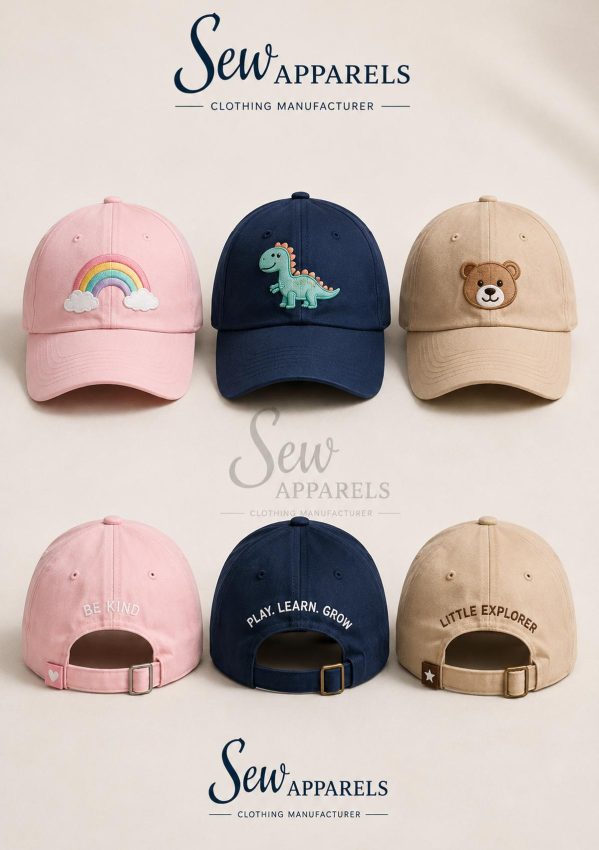
For brands sourcing custom kids cap manufacturing, the practical goal is a documented approval trail. The buyer and factory should identify every decorative component, confirm which requirements apply in each sales market, define relevant test conditions with a competent laboratory, and close every failure before bulk cutting. The following six-step method turns the review into a repeatable product-development decision.
Kids Cap Decorative Trim Retention Review: 6 Critical Checks
1. Inventory Every Decorative Piece by Age Range
Begin with a kids cap decorative trim decorative piece inventory. Give each item a component code and record its material, dimensions, weight, colour, surface finish, supplier, location, and attachment method. Include visible trims and less obvious pieces such as the centre of an embroidered badge, a pompom core, a layered appliqué edge, a decorative eyelet, a detachable tab, or a novelty fastener. Photographs should show both the face and reverse side before the trim is attached.
In a kids cap decorative trim retention review, the inventory must name the intended user group and labelled size range. Age affects how a wearer may mouth, pull, twist, or repeatedly flex a piece. A kids cap decorative trim age related trim assessment should also consider whether a childlike motif, small sizing, marketing presentation, or play value makes the item a children’s product in a target market. Do not treat a broad “kids” description as enough evidence; state the actual design age and keep that decision with the technical file.
For a kids hat pompom security assessment, record whether the pompom is sewn through a reinforced base, tied around a structural point, bonded, or attached by a removable device. For an appliqué, map the stitch path, stitch density, edge finishing, backing, and any adhesive layer. This level of detail prevents the approved sample and bulk production from quietly becoming different products.
2. Separate Component Rules from Practical Detachment Risk
A kids cap decorative trim retention review should define scope before testing. A sound children cap detachable decoration risk review distinguishes legal scope from good product-safety engineering. In the United States, the CPSC explains that children’s clothing and clothing accessories are exempt from the small-parts regulation, as listed in the regulation’s exclusions. The practical attachment review should still assess whether a decorative component could loosen or create a hazard. Buyers should read the official CPSC small-parts guidance and obtain market-specific advice where needed. The exemption is not a statement that loose decorative pieces are harmless, and it does not remove other applicable children’s-product obligations.
Document the kids cap decorative trim clothing small parts exemption scope rather than copying a toy test requirement onto every cap. The technical team should list the target countries, product classification, intended age, mandatory rules, retailer protocols, and voluntary risk controls separately. A kids cap decorative trim component rules applicability table makes the reasoning auditable and stops one market’s rule from being presented as universal.
The EU’s official safety requirements for certain children’s products describe the need to address detachable parts, choking, and snagging where appropriate. The European Commission decision on children’s-product safety requirements sets requirements for developing European standards, including products worn by children; it is not itself a cap test certificate. Confirm the product’s current legal framework separately. The buyer should avoid claims such as “certified safe” unless the evidence and certification scope genuinely support them.
3. Review Attachment Through Foreseeable Handling
During kids cap decorative trim retention review, create a kids cap decorative trim foreseeable handling checklist that reflects how the cap may be used, stored, washed, dropped, grabbed, or handled by a child or caregiver. Review pull, twist, snag, flex, abrasion, impact, and care-cycle exposure as relevant to the trim. The purpose is not to invent arbitrary forces. It is to identify credible routes by which the attachment, trim body, surrounding fabric, or reinforcement could fail.
A kids cap appliqué attachment review should examine the entire attachment system. Check whether stitches fully capture the border, whether corners lift, whether backing edges become sharp, whether adhesive softens with heat or moisture, and whether the cap fabric tears before the trim releases. For a pompom, look for fibre shedding, cord slippage, knot movement, core fracture, and fabric distortion. Record the condition before exposure and after every agreed stage.
The kids cap decorative trim pompom retention review and the kids cap decorative trim applique attachment inspection should use approved production-equivalent materials. A hand-reinforced development sample can hide a weak bulk method. Include samples from more than one operator or machine setup when workmanship variation is material. This creates evidence for process control rather than a one-off demonstration.
4. Agree Relevant Testing with a Competent Laboratory
For each kids cap decorative trim retention review, prepare a concise kids cap decorative trim retention test lab brief. It should identify the finished cap, component list, intended age, markets, attachment drawings, care instructions, known hazards, applicable requirements, retailer specifications, and the decisions the results must support. Ask the laboratory to confirm the method, conditioning, apparatus, sample count, acceptance criteria, and reporting format before samples are shipped.
Youth cap decorative trim testing may require different evaluations for different constructions. A sewn patch may need seam and material review; a pompom may need pull and twist assessment; a metal badge may need attachment, sharp-edge, coating, and accessible-material considerations. The competent laboratory should determine the suitable test programme from the product facts and market requirements. The factory should not promise a universal pass based on a test name taken from another product category.
Keep laboratory reports linked to the exact sample code and bill of materials. Photographs should identify the test location and failure mode. If the lab recommends additional assessment, record why it was accepted or rejected. This evidence protects private label kids cap production from rushed approvals and gives the brand a clear basis for future reorder comparisons.
5. Record Failure Mode and Redesign Decisions
The kids cap decorative trim retention review must capture failures consistently. Use a kids cap decorative trim detachment failure record whenever a component loosens, breaks, sheds, exposes a sharp area, damages the base fabric, or no longer meets the agreed appearance standard. Record the sample, test or handling stage, force or cycle where available, photographs, detached-piece dimensions, root-cause hypothesis, containment action, and responsible owner. “Failed” alone is not enough for corrective work.
Separate attachment failure from component failure. More stitches will not fix a brittle ornament, and a stronger ornament will not fix an unstable seam allowance. The corrective plan might change stitch pattern, thread, backing, reinforcement, component geometry, material, placement, or the decorative concept itself. Each revision should receive a new component or sample code so results cannot be mixed.
A kids cap decorative trim redesign approval should compare the original and revised construction side by side. Recheck the relevant hazards and confirm that the change has not created another problem, such as a hard internal ridge, reduced comfort, fabric tearing, colour migration, or a new snag point. Approve the revised evidence before authorising bulk use.
6. Approve Trim Changes Through a Controlled Bill of Materials
Close the kids cap decorative trim retention review with a controlled specification and bill of materials. The approved entry should include supplier, component code, material, dimensions, tolerances, colour reference, attachment drawing, stitch details, reinforcement, placement measurement, care compatibility, test report, and approved sample reference. A kids cap decorative trim attachment substitution must be blocked unless the buyer’s change process is followed.
Even a visually identical replacement can differ in coating, core construction, tensile behaviour, adhesive chemistry, or attachment interface. Require the factory to notify the brand before changing the trim supplier, thread, backing, glue, stitch type, or cap fabric. Risk-assess the proposed change, repeat relevant testing, update the bill of materials, and issue written approval. This control is especially important when repeat orders move between production lines.
Use the Kids Cap Buying Guides to coordinate trim placement, proportions and related component decisions. Carry the approved construction into the technical package for the custom kids cap manufacturer programme, with sample identity, material references and attachment details recorded together.
Coordinate trim position with kids caps youth cap proportioning; a changed crown size can move an ornament or alter its attachment interface.
Kids’ Cap Trim Retention Review Worksheet
Use one worksheet per trim construction. Record the style and sample code; intended age range; target markets; decorative-piece inventory; component photographs; attachment drawing; base fabric and reinforcement; applicable-rule assessment; foreseeable handling conditions; laboratory method and acceptance criteria; pre- and post-test observations; failure mode; corrective action; retest result; approved bill-of-materials revision; buyer approval; and production release date. Attach reports and photographs instead of relying on notes in email threads.
The worksheet should include a simple gate: approve, revise and retest, or remove the trim. No bulk release should occur while a detachment investigation is open. Production quality control can then verify component identity, placement, stitch path, reinforcement, and workmanship against the approved sample at incoming, inline, and final inspection stages.
Low MOQ Kids Cap Development
A low MOQ kids cap manufacturer discussion should start with the intended age range, trim concept, material route and quantity breakdown. Request a kids cap quotation with age range, trim specification, quantities and destination. Confirm the applicable minimums, sampling costs and attachment feasibility with Sew Apparels for the proposed construction. A smaller order still needs production-equivalent samples, an agreed review scope and traceable components. Simplifying the first range may reduce unresolved design combinations, but it must not remove evidence needed to approve the finished cap.
Development Support for Startup Brands
Startup brands can begin with one clearly defined cap, a manageable trim inventory and named decision owners. Bring artwork, target users, sales markets and material references to the development discussion. Agree which sampling and review activities are included, who commissions laboratory work and how revisions are approved. Keep the accepted sample and bill of materials together so the first order and later reorders follow the same documented construction.
Practical Buyer Decision
Kids cap decorative trim retention review works best as a product-development control, not a last-minute compliance checkbox. Inventory every component, define the real age and markets, separate regulatory scope from practical risk, simulate relevant handling, commission appropriate laboratory work, investigate failures, and lock the approved result into the bill of materials. That sequence produces evidence a buyer can explain and a factory can reproduce.
A reliable sourcing partner should be able to show where each trim comes from, how it is attached, which evidence supports the decision, and how substitutions are prevented. When those records agree with the production sample, the decorative concept can move forward with clearer safety reasoning, more consistent bulk quality, and fewer surprises after shipment.
Reopen the kids cap decorative trim retention review whenever the trim supplier, attachment material or production method changes.